Crossing the Bar by Alfred Lord Tennyson, Summary, Paraphrasing, Figure of Speech. Understand Tennyson’s “Crossing the Bar” with a clear summary, meaning of the bar and Pilot, poetic devices, paraphrase and solved comprehension questions.
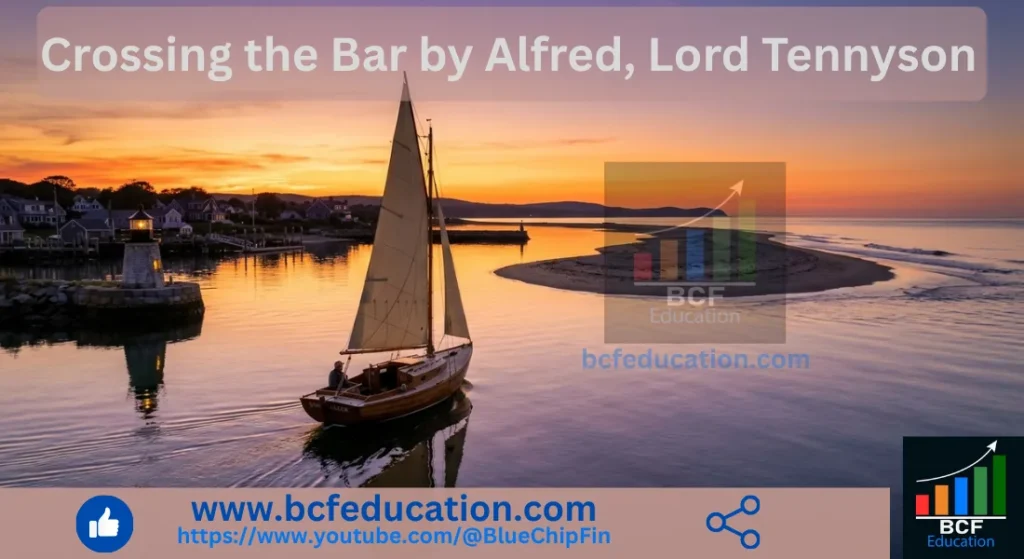
“Crossing the Bar” by Alfred, Lord Tennyson uses the image of a ship leaving harbor to express a calm, faithful acceptance of death and hope of meeting God. This poem is in the syllabus of SSC I FBISE. For more resources of English FBISE SSC I, please visit SSCI. For the resources of FBISE English SSC II, please visit SSCII.
Table of Contents
About the poet
Alfred, Lord Tennyson (1809–1892) was Poet Laureate for over forty years and one of the most celebrated poets of the Victorian age. He wrote “Crossing the Bar” in 1889, near the end of his life, and it is often read as his farewell to the world.
Crossing the Bar by Alfred Lord Tennyson, Summary, Paraphrasing, Figure of Speech
1. Poem Crossing the Bar by Alfred Lord Tennyson
Sunset and evening star,
And one clear call for me!
And may there be no moaning of the bar,
When I put out to sea,
But such a tide as moving seems asleep,
Too full for sound and foam,
When that which drew from out the boundless deep
Turns again home.
Twilight and evening bell,
And after that the dark!
And may there be no sadness of farewell,
When I embark;
For tho’ from out our bourne of Time and Place
The flood may bear me far,
I hope to see my Pilot face to face
When I have crost the bar.
2. Difficult Words and Meanings
| No. | Word | Meaning |
| 1 | Bar | A sandbank at a harbor’s mouth; here it means the boundary between life and death |
| 2 | Moaning | A low sad sound |
| 3 | Put out to sea | Set sail; leave the shore |
| 4 | Tide | The rise and fall of the sea |
| 5 | Foam | Froth on the waves |
| 6 | Boundless deep | The endless ocean; here it means God or eternity |
| 7 | Twilight | The soft light after sunset |
| 8 | Embark | To begin a journey on a ship |
| 9 | Bourne | A boundary or limit; a realm |
| 10 | Flood | The rushing tide or current |
| 11 | Pilot | A person who steers a ship; here it means God |
| 12 | Crost | Crossed (old spelling) |
3. Poem Crossing the Bar Line-by-Line Paraphrasing
| Original Line | Simple English |
| Sunset and evening star, | The sun is setting and the evening star has appeared. |
| And one clear call for me! | There is one clear call, meant for me (the call of death). |
| And may there be no moaning of the bar, | I hope the sandbank does not make any sad crying sound |
| When I put out to sea, | when I set out on my sea voyage (death). |
| But such a tide as moving seems asleep, | Let the tide be so calm that it looks as if it is sleeping, |
| Too full for sound and foam, | so full and deep that it makes no noise or froth. |
| When that which drew from out the boundless deep | It should be like that when the soul that came from God (the endless deep) |
| Turns again home. | returns to its true home. |
| Twilight and evening bell, | Dusk comes and the evening bell rings, |
| And after that the dark! | and after that comes darkness. |
| And may there be no sadness of farewell, | I hope there is no sad goodbye |
| When I embark; | when I begin my journey. |
| For tho’ from out our bourne of Time and Place | Although this journey may take me away from our world of time and space, |
| The flood may bear me far, | and the current of death may carry me far away, |
| I hope to see my Pilot face to face | I hope to meet my God (my guide) face to face |
| When I have crost the bar. | after I have crossed the bar, that is, after death. |
4. Poem Crossing the Bar Stanza-wise Paraphrasing
| Stanza | Paraphrase |
| Stanza 1 | The sun is setting and the evening star rises. The poet feels a clear call for him, meaning that his death is near. He hopes that there will be no sad crying of the waves at the harbor bar when he sets out to sea. |
| Stanza 2 | He wants the tide to be so calm and full that it seems asleep, with no noise or foam. His soul, which came from God, is now returning home peacefully. |
| Stanza 3 | It is twilight, the evening bell rings and darkness will follow. He asks that there should be no sorrowful goodbyes when he begins his last journey. |
| Stanza 4 | Though death may carry him far away from this world, he hopes to meet God, his Pilot, face to face after he has crossed the bar. |
5. Poem Crossing the Bar Summary
“Crossing the Bar” was written by Tennyson when he was an old man. It uses the picture of a ship leaving the harbor to describe death. The sandbar at the harbor mouth stands for the border between life and death.
The poet hopes that his death will be calm and peaceful, without crying or sad farewells. He believes the soul returns to its real home, which is God. He hopes to meet God, whom he calls his Pilot, after he crosses the bar.
The poem shows faith, courage and peace in facing death.
6. Poem Crossing the Bar Poetic Devices / Figures of Speech
| Device | Example | Explanation |
| Extended metaphor | Death as a sea voyage | The whole poem compares death to a ship setting out to sea. The bar is the boundary between life and death, and the Pilot is God. |
| Symbolism | sunset, evening star, twilight, dark | These stand for old age and the approach of death. |
| Personification | moaning of the bar; a tide… seems asleep | The sandbar moans and the tide sleeps like living things. |
| Imagery | sunset, evening bell, tide, foam | Pictures and sounds create a calm evening mood. |
| Alliteration | sound and foam; face to face; sadness of farewell | Repeated sounds create a gentle musical effect. |
| Capitalization / Allusion | Pilot | Refers to God as a guide through death. |
| Inversion | when I have crost the bar | Poetic word order and old spelling, suitable for the solemn tone. |
| Rhyme scheme | abab cdcd efef ghgh | Each stanza has alternating rhymes. |
7. Poem Crossing the Bar Comprehension Questions and Answers
Q1. What does “the bar” stand for in the poem?
Ans: The bar is a sandbank at the mouth of a harbor. In the poem it stands for the boundary between life and death.
Q2. What do “sunset” and “evening star” symbolize?
Ans: They symbolize the end of life, or old age. Just as the day ends at sunset, the poet’s life is coming to its end.
Q3. Who is the “Pilot” in the poem?
Ans: The Pilot is God, who guides the poet’s soul safely through death, just as a pilot guides a ship.
Q4. What does the poet wish for when he “puts out to sea”?
Ans: He wishes for a calm, peaceful death with no moaning of the bar and no sad farewells.
Q5. What is the central idea of the poem?
Ans: The central idea is the calm and faithful acceptance of death. The poet is not afraid, because he believes that death is a return home and a meeting with God.
Q6. What is the rhyme scheme and tone of the poem?
Ans: The rhyme scheme is abab cdcd efef ghgh. The tone is peaceful, calm, solemn and hopeful.