
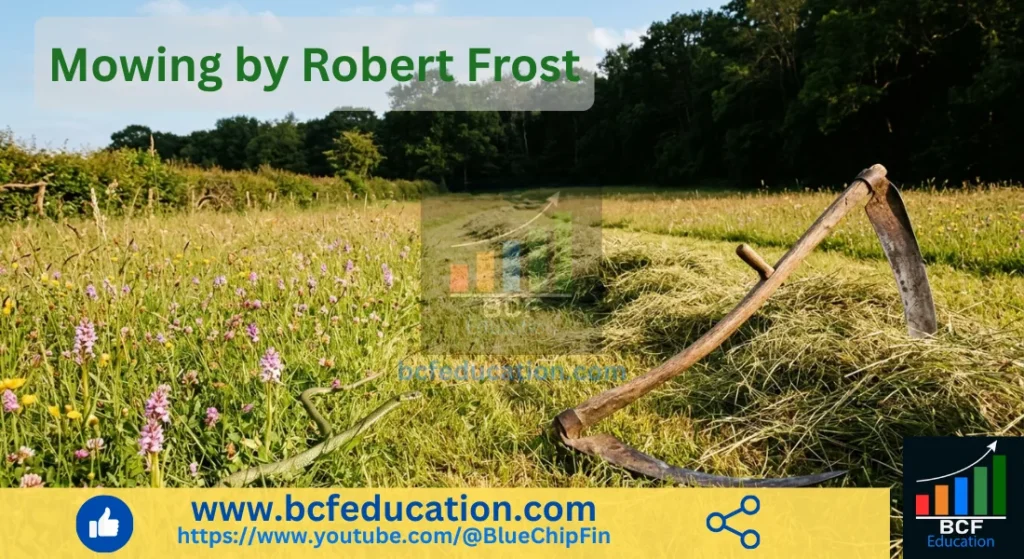
Mowing by Robert Frost: Summary, Meaning, Paraphrase & Q&A. Read Robert Frost’s “Mowing” with an easy summary, word meanings, paraphrase, poetic devices and solved questions. Simple notes for students and poetry lovers. This guide covers the poem’s structure, irony, key themes, and central message in detail. This poem is in the syllabus of HSSC II FBISE. For more resources of English FBISE SSC I, please visit SSCI. For the resources of FBISE English SSC II, please visit SSCII.
“Mowing” by Robert Frost is a 14-line poem about a man cutting grass with a scythe, and it teaches that honest hard work and plain truth are sweeter than any dream.
Table of Contents
About the poet
Robert Frost (1874–1963) was an American poet known for simple language, rural New England scenes and deep ideas about life and work. He won the Pulitzer Prize for Poetry four times. His famous poems include “The Road Not Taken” and “Stopping by Woods on a Snowy Evening.” “Mowing” appeared in his first collection, A Boy’s Will (1913).
Mowing By Robert Frost
1. The Poem
There was never a sound beside the wood but one,
And that was my long scythe whispering to the ground.
What was it whispered? I knew not well myself;
Perhaps it was something about the heat of the sun,
Something, perhaps, about the lack of sound—
And that was why it whispered and did not speak.
It was no dream of the gift of idle hours,
Or easy gold at the hand of fay or elf:
Anything more than the truth would have seemed too weak
To the earnest love that laid the swale in rows,
Not without feeble-pointed spikes of flowers
(Pale orchises), and scared a bright green snake.
The fact is the sweetest dream that labor knows.
My long scythe whispered and left the hay to make.
2. Mowing By Robert Frost Difficult Words and Meanings
| No. | Word | Meaning |
| 1 | Scythe | A tool with a long curved blade and a long handle, used to cut grass or crops |
| 2 | Swale | A low, damp stretch of meadow land |
| 3 | Fay | A fairy |
| 4 | Elf | A small magical creature of folk tales |
| 5 | Idle hours | Free time spent doing nothing in particular |
| 6 | Earnest | Sincere and serious |
| 7 | Feeble | Weak and delicate |
| 8 | Orchises | Wild orchid flowers (plural of orchis) |
| 9 | Labor | Hard physical work |
| 10 | Hay | Grass that is cut and dried to feed animals |
3. Mowing By Robert Frost Line-by-Line Paraphrasing
| Original Line | Simple English |
| There was never a sound beside the wood but one, | Near the woods there was only one single sound. |
| And that was my long scythe whispering to the ground. | That sound was my long scythe, making a soft whispering noise as it cut the grass. |
| What was it whispered? I knew not well myself; | What was it saying? I did not clearly know it myself. |
| Perhaps it was something about the heat of the sun, | Maybe it was talking about the heat of the sun. |
| Something, perhaps, about the lack of sound— | Or maybe it was talking about how silent everything was. |
| And that was why it whispered and did not speak. | That is why it only whispered softly and did not speak out loud. |
| It was no dream of the gift of idle hours, | It was not a daydream about enjoying free and lazy time. |
| Or easy gold at the hand of fay or elf: | Nor was it a dream of getting easy treasure from fairies or elves. |
| Anything more than the truth would have seemed too weak | Anything other than plain truth would have felt unreal and not strong enough |
| To the earnest love that laid the swale in rows, | for my sincere love of work, which cut the meadow grass and laid it in rows. |
| Not without feeble-pointed spikes of flowers | In doing so, the scythe also cut down thin, weak flower spikes |
| (Pale orchises), and scared a bright green snake. | (pale orchid flowers) and frightened a bright green snake. |
| The fact is the sweetest dream that labor knows. | Real, honest fact is the sweetest dream that hard work can have. |
| My long scythe whispered and left the hay to make. | My scythe went on whispering and left the cut grass to dry into hay. |
4. Mowing By Robert Frost Stanza-wise Paraphrasing
| Stanza | Paraphrase |
| The whole poem (Lines 1–14) | The poet is working alone in a quiet field. The only sound is the soft whisper of his scythe as it cuts the grass. He does not know exactly what the scythe is saying; it may be speaking of the sun’s heat or of the silence around. He then explains that the scythe’s message is not about dreams of easy time or magical treasure. Only the plain truth could satisfy a person who loves honest work. While cutting, he lays the grass in rows, cuts some pale orchid flowers and frightens a green snake. He concludes that real facts and honest labor are sweeter than any dream, and the scythe whispers on while the hay dries. |
5. Mowing By Robert Frost Summary
In “Mowing”, Robert Frost describes a man cutting grass with a scythe in a silent field. The only sound is the whisper of the scythe, and the poet wonders what it is trying to say. He guesses it may be talking about the heat or the silence, but he cannot be sure.
He then makes clear that the whisper is not about fairy gold or lazy dreams. Honest work needs honest truth, not fantasy. As he mows, he cuts delicate orchids and startles a snake, which are small real details of life in the field.
The poem ends with the idea that “fact”, meaning real, true experience, is the sweetest dream a worker can have. The poem teaches us to respect hard work and to value reality over imagination.
6. Mowing By Robert Frost Poetic Devices / Figures of Speech
| Device | Example | Explanation |
| Personification | my long scythe whispering to the ground | The scythe is given the human ability to whisper. |
| Imagery | a bright green snake; pale orchises; scythe whispering | Visual and sound images make the scene vivid. |
| Metaphor | The fact is the sweetest dream that labor knows | Truth/fact is compared to a dream; real work is more satisfying than fantasy. |
| Symbolism | scythe, whisper, hay | The scythe stands for honest labor; its whisper stands for the quiet message of work. |
| Repetition | Something, perhaps… Something…; whispered | Repetition shows the poet’s uncertainty and the soft, continuous sound. |
| Alliteration / Sibilance | sound… scythe… something… sun… sweetest | The repeated ‘s’ sound imitates the swishing of the scythe. |
| Allusion | gift of idle hours, easy gold at the hand of fay or elf | Refers to fairy tales about easy riches, which the poet rejects. |
| Enjambment | Anything more than the truth would have seemed too weak / To the earnest love… | Sentences run across lines, matching the smooth movement of mowing. |
| Rhyme scheme | abcabdecdfegfg | An irregular sonnet pattern in 14 lines. |
7. Mowing By Robert Frost Comprehension Questions and Answers
Q1. Who is whispering to the ground?
Ans: The poet’s long scythe is whispering to the ground as it cuts the grass.
Q2. What was whispered according to the poet?
Ans: The poet does not know exactly. He guesses that the scythe might be whispering about the heat of the sun or about the silence of the place. It whispers rather than speaks because everything around is so quiet.
Q3. Enlist poetic devices used in the poem.
Ans: Personification, imagery, metaphor, symbolism, repetition, alliteration (sibilance), allusion and enjambment. (See the table in Section 6.)
Q4. According to the poet, what is “the sweetest dream that labor knows”?
Ans: According to the poet, the sweetest dream that labor knows is the plain truth or fact: the real, honest result of hard work. It is more satisfying than any fantasy of easy leisure or magical gold.
Q5. What is the central idea of the poem?
Ans: The central idea is the dignity and joy of honest, hard work. Real work and real truth are more rewarding than daydreams. The reward of labor is in the work itself.
Q6. What is the form and tone of the poem?
Ans: Form: a single stanza of 14 lines, like an irregular sonnet, in free-flowing iambic lines with the rhyme scheme abcabdecdfegfg. Tone: calm, thoughtful, sincere and quietly appreciative of simple work.
Q7. What small details from nature does the poet mention while mowing?
Ans: He mentions pale orchid flowers that were cut down and a bright green snake that was frightened by the scythe.

