Daffodils by William Wordsworth: Summary, Analysis, Paraphrasing, & Figure of Speech. Explore Wordsworth’s “Daffodils” (I Wandered Lonely as a Cloud) with a summary, difficult words, stanza-wise paraphrase, figures of speech and exam questions.
“Daffodils” by William Wordsworth describes a field of golden daffodils dancing by a lake, and shows how memories of nature can bring lasting joy in times of solitude. This poem is in the syllabus of SSC I FBISE. For more resources of English FBISE SSC I, please visit SSCI. For the resources of FBISE English SSC II, please visit SSCII.
Table of Contents
Daffodils by William Wordsworth
About the poet
William Wordsworth (1770–1850) was an English Romantic poet who believed nature and simple feelings were the best subjects for poetry. He co-wrote Lyrical Ballads (1798) with Samuel Taylor Coleridge and became Poet Laureate in 1843. He lived in the Lake District, which inspired many of his poems.
1. The Poem Daffodils (I Wandered Lonely as a Cloud)
I wandered lonely as a cloud
That floats on high o’er vales and hills,
When all at once I saw a crowd,
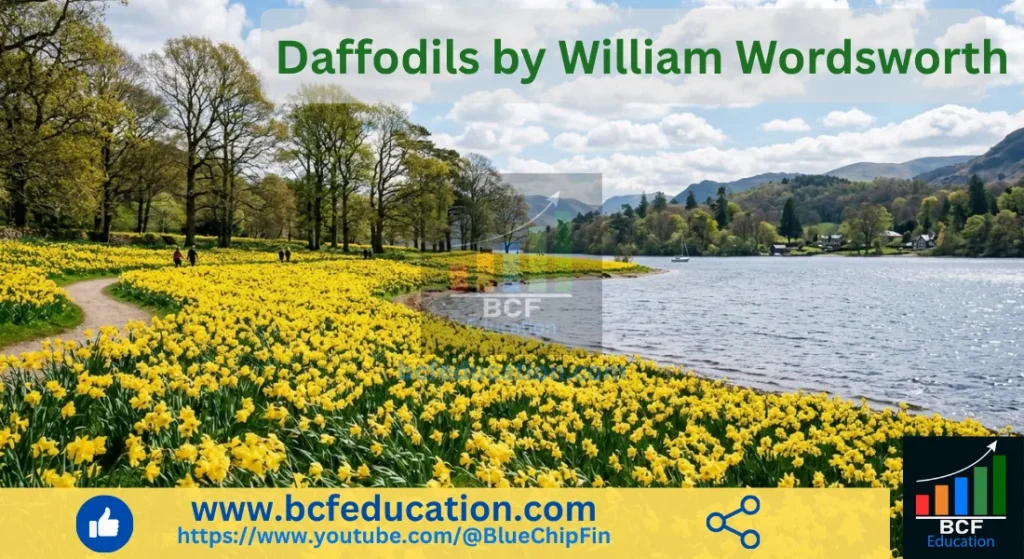
A host, of golden daffodils;
Beside the lake, beneath the trees,
Fluttering and dancing in the breeze.
Continuous as the stars that shine
And twinkle on the milky way,
They stretched in never-ending line
Along the margin of a bay:
Ten thousand saw I at a glance,
Tossing their heads in sprightly dance.
The waves beside them danced; but they
Out-did the sparkling waves in glee:
A poet could not but be gay,
In such a jocund company:
I gazed—and gazed—but little thought
What wealth the show to me had brought:
For oft, when on my couch I lie
In vacant or in pensive mood,
They flash upon that inward eye
Which is the bliss of solitude;
And then my heart with pleasure fills,
And dances with the daffodils.
2. Daffodils (I Wandered Lonely as a Cloud) Words and Meanings
| No. | Word | Meaning |
| 1 | Vales | Valleys |
| 2 | O’er | Over |
| 3 | Host | A large crowd or group |
| 4 | Margin | Edge or border |
| 5 | Sprightly | Lively and full of energy |
| 6 | Glee | Great joy |
| 7 | Gay | Cheerful and happy |
| 8 | Jocund | Cheerful and merry |
| 9 | Oft | Often |
| 10 | Couch | A sofa or bed to rest on |
| 11 | Vacant | Empty; free of thoughts |
| 12 | Pensive | Deep in thought, a little sad |
| 13 | Inward eye | The mind’s eye; imagination and memory |
| 14 | Bliss | Perfect happiness |
| 15 | Solitude | The state of being alone |
3. Daffodils (I Wandered Lonely as a Cloud) Line-by-Line Paraphrasing
| Original Line | Simple English |
| I wandered lonely as a cloud | I was walking alone, like a cloud drifting by itself, |
| That floats on high o’er vales and hills, | which floats high above the valleys and hills. |
| When all at once I saw a crowd, | Suddenly I saw a large group of something. |
| A host, of golden daffodils; | It was a great number of golden-yellow daffodil flowers. |
| Beside the lake, beneath the trees, | They were growing next to the lake and under the trees, |
| Fluttering and dancing in the breeze. | moving and dancing in the light wind. |
| Continuous as the stars that shine | They were as endless as the stars that shine |
| And twinkle on the milky way, | and sparkle in the Milky Way. |
| They stretched in never-ending line | They spread out in a line that seemed to have no end |
| Along the margin of a bay: | along the edge of the bay. |
| Ten thousand saw I at a glance, | I saw ten thousand flowers in a single look, |
| Tossing their heads in sprightly dance. | all shaking their heads in a lively dance. |
| The waves beside them danced; but they | The waves next to them were dancing too, but the daffodils |
| Out-did the sparkling waves in glee: | were even happier than the shining waves. |
| A poet could not but be gay, | A poet could not help feeling happy |
| In such a jocund company: | in the company of such cheerful flowers. |
| I gazed—and gazed—but little thought | I kept looking and looking, but did not think much |
| What wealth the show to me had brought: | about the great treasure that this sight would give me. |
| For oft, when on my couch I lie | Often, when I lie on my sofa or bed |
| In vacant or in pensive mood, | feeling empty or thoughtful, |
| They flash upon that inward eye | the daffodils appear suddenly in my mind’s eye, |
| Which is the bliss of solitude; | which is the great joy of being alone. |
| And then my heart with pleasure fills, | Then my heart becomes full of happiness |
| And dances with the daffodils. | and dances together with the daffodils. |

4. Daffodils (I Wandered Lonely as a Cloud) Stanza-wise Paraphrasing
| Stanza | Paraphrase |
| Stanza 1 | The poet was walking alone like a cloud floating over hills and valleys. Suddenly he saw a huge crowd of golden daffodils beside a lake, under the trees, dancing in the breeze. |
| Stanza 2 | The daffodils were endless like the stars in the Milky Way. They stretched in a long line along the edge of the bay. The poet saw thousands of them at one glance, all nodding their heads in a lively dance. |
| Stanza 3 | The waves also danced, but the flowers looked happier than the waves. The poet felt joyful in such cheerful company. He kept staring at them, not realizing yet how valuable that memory would become. |
| Stanza 4 | Later, when he lies on his couch feeling empty or thoughtful, the memory of the daffodils flashes in his mind. This gives him the joy of solitude, and his heart fills with happiness and dances with the flowers. |
5. Daffodils (I Wandered Lonely as a Cloud) Summary
In “Daffodils”, Wordsworth tells how he was walking alone, feeling like a lonely cloud, when he suddenly saw thousands of golden daffodils beside a lake. They were dancing in the wind, even more joyfully than the waves of the lake.
At that time, he enjoyed the sight but did not realize how precious it was. Afterwards, whenever he is alone, bored or thoughtful, the memory returns to his mind and fills him with happiness.
The poem shows that nature gives us joy, and that its beautiful memories can comfort us for the rest of our lives.
6. Daffodils (I Wandered Lonely as a Cloud) Poetic Devices / Figures of Speech
| Device | Example | Explanation |
| Simile | I wandered lonely as a cloud | The poet compares himself to a lonely cloud using ‘as’. |
| Simile | Continuous as the stars that shine | The endless daffodils are compared to stars. |
| Personification | dancing; tossing their heads; the waves danced | Flowers and waves are given human actions of dancing. |
| Metaphor | inward eye | Imagination and memory are compared to an eye that sees inside the mind. |
| Hyperbole | Ten thousand saw I at a glance; never-ending line | Exaggeration shows the great number of flowers. |
| Alliteration | golden… daffodils; beside… beneath; Fluttering… flowers | Repeated consonant sounds add music. |
| Repetition | I gazed—and gazed | Shows long, lingering admiration. |
| Imagery | golden daffodils, sparkling waves, twinkling stars | Strong visual pictures of nature. |
| Rhyme scheme | ababcc | Each six-line stanza follows this pattern. |
| Inversion | Ten thousand saw I at a glance | Word order is reversed for rhythm and rhyme. |
7. Daffodils (I Wandered Lonely as a Cloud) Comprehension Questions and Answers
Q1. How does the poet describe himself in the first line?
Ans: He says he wandered lonely as a cloud, meaning he was walking alone and aimlessly, like a cloud floating in the sky.
Q2. What did the poet see beside the lake?
Ans: He saw a huge crowd of golden daffodils growing beside the lake and under the trees, dancing in the breeze.
Q3. How does the poet show that there were countless daffodils?
Ans: He compares them to the stars of the Milky Way, says they stretched in a never-ending line along the bay and says he saw ten thousand at a glance.
Q4. Why were the daffodils happier than the waves?
Ans: The poet imagines that the daffodils danced with greater joy than the sparkling waves of the lake. This is personification, and it shows how lively the flowers were.
Q5. What is meant by “inward eye”?
Ans: It means the poet’s imagination or memory. With it he can see the daffodils again in his mind even when he is not there.
Q6. What is “the wealth” the poet gained from the daffodils?
Ans: The wealth is not money. It is the lasting happiness and peace that the memory of the beautiful scene gives him whenever he is alone.
Q7. What is the central idea of the poem?
Ans: The central idea is that nature is a source of joy, and that memories of nature’s beauty can bring happiness and comfort for a lifetime.
Q8. What is the tone of the poem?
Ans: The tone is joyful, cheerful, admiring and peaceful, with a thoughtful and grateful mood at the end.
Q9. What is the rhyming scheme of the poem?
Ans: ababcc in each stanza