The Eagle by Alfred Lord Tennyson, Summary, Paraphrasing, Poetic Devices. Study Tennyson’s “The Eagle” with a simple summary, word meanings, line-by-line paraphrase, symbolism, figures of speech and answers to common questions.
“The Eagle” by Alfred, Lord Tennyson is a six-line poem that portrays an eagle as a proud, solitary king of the heights who suddenly dives like a thunderbolt. This poem is in the syllabus of SSC I FBISE. For more resources of English FBISE SSC I, please visit SSCI. For the resources of FBISE English SSC II, please visit SSCII.
Table of Contents
The Eagle by Alfred Lord Tennyson
About the poet
Alfred, Lord Tennyson (1809–1892) was a leading Victorian poet and served as Poet Laureate of the United Kingdom from 1850 until his death. He is known for musical language and works such as “In Memoriam A.H.H.,” “Ulysses” and “The Charge of the Light Brigade.”
1. Poem The Eagle by Alfred Lord Tennyson
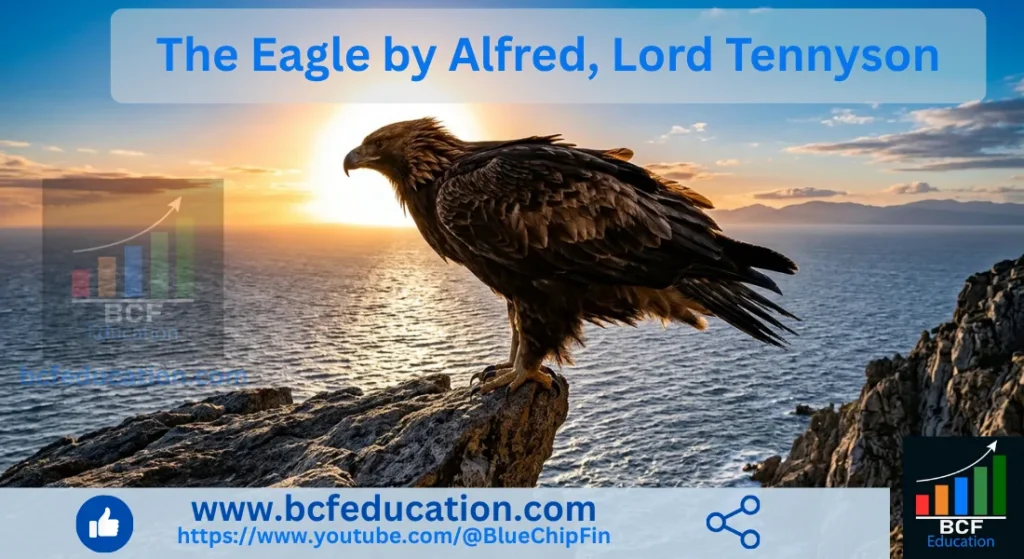
He clasps the crag with crooked hands;
Close to the sun in lonely lands,
Ring’d with the azure world, he stands.
The wrinkled sea beneath him crawls;
He watches from his mountain walls,
And like a thunderbolt he falls.
2. Difficult Words and Meanings
| No. | Word | Meaning |
| 1 | Clasps | Holds tightly |
| 2 | Crag | A steep, rough rock or cliff |
| 3 | Crooked | Bent or curved |
| 4 | Lonely lands | Remote, empty places |
| 5 | Ring’d | Surrounded, circled |
| 6 | Azure | Bright blue like the sky |
| 7 | Wrinkled | Full of small ripples or folds |
| 8 | Thunderbolt | A flash of lightning with a thunder crash; something sudden and powerful |
3. The Eagle Line-by-Line Paraphrasing in Simple English
| Original Line | Simple English |
| He clasps the crag with crooked hands; | The eagle grips the rough cliff tightly with his bent claws. |
| Close to the sun in lonely lands, | He is high up near the sun, in a faraway, lonely place. |
| Ring’d with the azure world, he stands. | Surrounded by the blue sky and world, he stands there. |
| The wrinkled sea beneath him crawls; | Far below him, the rippling sea moves slowly. |
| He watches from his mountain walls, | He keeps watch from the steep walls of the mountain. |
| And like a thunderbolt he falls. | Then he suddenly dives down, as fast and strong as lightning. |
4. The Eagle Stanza-wise Paraphrasing
| Stanza | Paraphrase |
| Stanza 1 | The eagle holds on to a high rocky cliff with his curved claws. He is near the sun, in a lonely place, surrounded by the blue sky. He stands proud and still. |
| Stanza 2 | Far below, the sea looks wrinkled and seems to move slowly. The eagle keeps watching from his mountain-top home. Suddenly he dives down at great speed, like a thunderbolt. |
5. The Eagle Summary
“The Eagle” is a short poem of six lines that describes a powerful eagle sitting on a high cliff near the sun. He is alone, surrounded by the blue sky, and the sea looks small and slow far below him.
He watches calmly for his prey, and then suddenly dives down like a thunderbolt. The poem shows the strength, pride, loneliness and speed of the eagle, and presents him as the king of the heights.
6. The Eagle Poetic Devices / Figures of Speech
| Device | Example | Explanation |
| Personification | He clasps the crag with crooked hands | The eagle’s claws are called ‘hands’, giving him human qualities. |
| Simile | like a thunderbolt he falls | The eagle’s dive is compared to lightning to show speed and power. |
| Metaphor | mountain walls; the wrinkled sea | The cliff is compared to walls, and the sea’s waves to wrinkles. |
| Alliteration | crag… crooked… clasps; wrinkled… watches… walls | Repeated sounds make the language strong and musical. |
| Imagery | azure world, wrinkled sea, thunderbolt | Vivid pictures of height, colour and motion. |
| Symbolism | eagle, sun, thunderbolt | The eagle symbolizes power, freedom and majesty. |
| Rhyme scheme | aaa bbb | Each stanza is a triplet with a single rhyme. |
| Contrast | close to the sun vs. sea beneath him | Shows the eagle’s great height above the world. |
7. The Eagle Comprehension Questions and Answers
Q1. What images or emotions come to mind when you read the words “crag”, “sun”, “sea” and “thunderbolt”?
Ans: “Crag” suggests a rough, high cliff and a feeling of danger and strength. “Sun” suggests brightness, height and power. “Sea” suggests a vast, far-off world below. “Thunderbolt” suggests sudden, fast and violent force. Together they create feelings of awe, admiration and a little fear.
Q2. How do you interpret the relationship between the subject and the elements of nature in this poem?
Ans: The eagle is part of nature and also its master. The cliff is his throne, the sun is his neighbor, and the sea is far beneath him. Nature serves as a grand stage that shows the eagle’s power and dignity.
Q3. What emotions did you experience while reading this poem?
Ans: I felt awe and wonder at the eagle’s majesty, excitement at the sudden dive, and admiration for his strength and independence.
Q4. If you are given the chance of revising the poem’s current title, what would you choose it to be?
Ans: I would choose “The Lord of the Heights” (other good options: “King of the Crags” or “Master of the Sky”), because it highlights the eagle’s royal and powerful nature.
Q5. Can you identify any symbolic or metaphorical elements in the poem?
Ans: Yes. The eagle symbolizes power, pride and freedom. The sun suggests glory, and the sea suggests the lower world. “Crooked hands” and “mountain walls” are metaphors, and “thunderbolt” compares the eagle’s dive to lightning.
Q6. Who or what is the main subject of the poem?
Ans: The main subject is an eagle. The poet does not name the bird directly in the poem and calls him “he”, but the title makes the subject clear.
Q7. What is the significance of the subject’s physical attributes, such as “crooked hands” and being “close to the sun”?
Ans: “Crooked hands” means strong curved talons that grip the rock firmly, and also makes the eagle seem human and noble. Being “close to the sun” shows his great height, his closeness to the heavens, and his royal, powerful position above all other creatures.
Q8. How does the poem explore the theme of solitude or loneliness?
Ans: The eagle stands alone on a high cliff in “lonely lands”. However, this solitude is not sad. It is a proud, majestic aloneness that shows his independence and superiority.
Q9. What is the overall tone of the poem, and how does it change throughout the stanzas?
Ans: The tone is majestic, admiring and awed. In the first stanza the mood is calm, still and watchful. In the second stanza it moves from calm watching to sudden, dramatic action in the last line.
Q10. Which figure of speech is used in “He clasps the crag with crooked hands” and comment on its effect?
Ans: It is personification (and a metaphor), because the eagle’s claws are called hands. It makes the eagle seem human-like and strong, and creates a vivid picture of a firm grip on the rock. Alliteration of ‘c’ also adds force.
Q11. How does the final line, “like a thunderbolt he falls,” relate to the preceding lines and the poem’s central theme?
Ans: The earlier lines show the eagle calmly standing and watching from a great height, which builds suspense. The last line, a simile, releases that tension with a sudden, powerful dive. It completes the central theme of the eagle’s power, speed and majesty.