Travel by Robert Louis Stevenson, Summary, Paraphrasing, Poetic Devices, Explore “Travel” by Robert Louis Stevenson with a summary, difficult words, paraphrase, poetic devices, rhyme scheme and solved questions for students.
“Travel” by Robert Louis Stevenson is a poem in which a young boy imagines visiting faraway lands, and it celebrates curiosity, adventure and the power of imagination. This poem is in the syllabus of SSC I FBISE. For more resources of English FBISE SSC I, please visit SSCI. For the resources of FBISE English SSC II, please visit SSCII.
Table of Contents
Travel by Robert Louis Stevenson, Summary, Paraphrasing, Poetic Devices
About the poet
Robert Louis Stevenson (1850–1894) was a Scottish novelist, poet and travel writer. He wrote Treasure Island, Kidnapped and Strange Case of Dr Jekyll and Mr Hyde. His poetry collection A Child’s Garden of Verses (1885) includes “Travel.” He spent his last years in Samoa.
1. Poem Travel by Robert Louis Stevenson
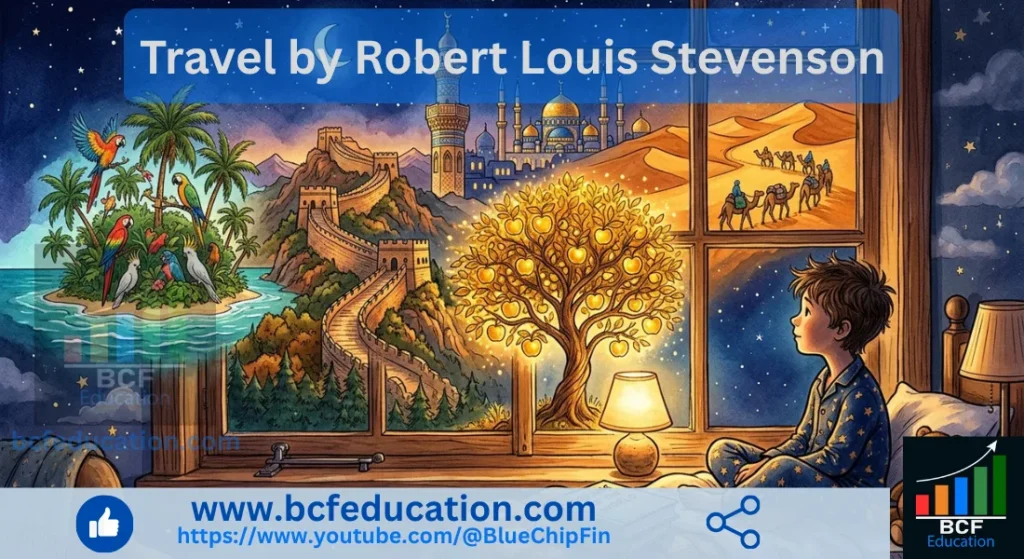
I should like to rise and go
Where the golden apples grow;—
Where below another sky
Parrot islands anchored lie,
And, watched by cockatoos and goats,
Lonely Crusoes building boats;—
Where in sunshine reaching out
Eastern cities, miles about,
Are with mosque and minaret
Among sandy gardens set,
And the rich goods from near and far
Hang for sale in the bazaar;—
Where the Great Wall round China goes,
And on one side the desert blows,
And with the voice and bell and drum,
Cities on the other hum;—
Where are forests hot as fire,
Wide as England, tall as a spire,
Full of apes and cocoa-nuts
And the negro hunters’ huts;—
Where the knotty crocodile
Lies and blinks in the Nile,
And the red flamingo flies
Hunting fish before his eyes;—
Where in jungles near and far,
Man-devouring tigers are,
Lying close and giving ear
Lest the hunt be drawing near,
Or a comer-by be seen
Swinging in the palanquin;—
Where among the desert sands
Some deserted city stands,
All its children, sweep and prince,
Grown to manhood ages since,
Not a foot in street or house,
Not a stir of child or mouse,
And when kindly falls the night,
In all the town no spark of light.
There I’ll come when I’m a man
With a camel caravan;
Light a fire in the gloom
Of some dusty dining-room;
See the pictures on the walls,
Heroes fights and festivals;
And in a corner find the toys
Of the old Egyptian boys.
Note: The poem is given exactly as written in 1885. Stanza 3 contains a dated nineteenth-century term for African people; in the paraphrase it is rendered as “African hunters”. The poem is long, so Section 3 is arranged in rhyming pairs of lines.
2. Poem Travel Difficult Words and Meanings
| No. | Word | Meaning |
| 1 | Golden apples | Magical fruit from Greek myth; here a symbol of a wonderful far-off land |
| 2 | Parrot islands | Tropical islands full of parrots |
| 3 | Cockatoo | A large white parrot-like bird with a crest |
| 4 | Crusoe | Robinson Crusoe, the sailor shipwrecked on a lonely island in a famous novel |
| 5 | Mosque | A Muslim place of worship |
| 6 | Minaret | A tall slim tower of a mosque |
| 7 | Bazaar | A market, especially in Eastern countries |
| 8 | Knotty | Rough and bumpy |
| 9 | Flamingo | A tall pink water bird with long legs |
| 10 | Man-devouring | Man-eating |
| 11 | Lest | In case; for fear that |
| 12 | Palanquin | A covered seat carried on poles by men, used in Asia |
| 13 | Sweep | A person who cleans chimneys; a poor person |
| 14 | Ages since | Many ages ago |
| 15 | Caravan | A group of travelers with camels crossing a desert |
| 16 | Gloom | Darkness |
3. Poem Travel Line-by-Line Paraphrasing
| Original Line | Simple English |
| I should like to rise and go / Where the golden apples grow;— | I would love to get up and go to the land where golden apples grow. |
| Where below another sky / Parrot islands anchored lie, | There, under a different sky, islands full of parrots rest in the sea like anchored ships. |
| And, watched by cockatoos and goats, / Lonely Crusoes building boats;— | Cockatoos and goats look on while lonely castaways, like Robinson Crusoe, build boats. |
| Where in sunshine reaching out / Eastern cities, miles about, | Where eastern cities stretch out for miles under the bright sun, |
| Are with mosque and minaret / Among sandy gardens set, | with mosques and tall towers standing among gardens on sandy ground, |
| And the rich goods from near and far / Hang for sale in the bazaar;— | and valuable goods from near and far are hung up for sale in the market. |
| Where the Great Wall round China goes, / And on one side the desert blows, | Where the Great Wall runs around China, with desert winds blowing on one side, |
| And with the voice and bell and drum, / Cities on the other hum;— | while on the other side, cities are busy and noisy with voices, bells and drums. |
| Where are forests hot as fire, / Wide as England, tall as a spire, | Where there are forests as hot as fire, as wide as England and as tall as a church tower, |
| Full of apes and cocoa-nuts / And the negro hunters’ huts;— | full of apes and coconuts and the huts of African hunters. |
| Where the knotty crocodile / Lies and blinks in the Nile, | Where the rough-skinned crocodile lies blinking in the River Nile, |
| And the red flamingo flies / Hunting fish before his eyes;— | and the red flamingo flies, looking for fish in front of him. |
| Where in jungles near and far, / Man-devouring tigers are, | Where in jungles, near and far, man-eating tigers live, |
| Lying close and giving ear / Lest the hunt be drawing near, | lying low and listening carefully in case hunters are coming close, |
| Or a comer-by be seen / Swinging in the palanquin;— | or in case a traveler is seen being carried along in a palanquin. |
| Where among the desert sands / Some deserted city stands, | Where in the desert sands an abandoned city stands, |
| All its children, sweep and prince, / Grown to manhood ages since, | whose children, both poor and royal, grew up and passed away ages ago. |
| Not a foot in street or house, / Not a stir of child or mouse, | No footstep is heard in any street or house, and no child or even mouse moves. |
| And when kindly falls the night, / In all the town no spark of light. | When night falls gently, there is not a single light in the whole town. |
| There I’ll come when I’m a man / With a camel caravan; | I will come there when I grow up, with a caravan of camels. |
| Light a fire in the gloom / Of some dusty dining-room; | I will light a fire in the darkness of some dusty dining room. |
| See the pictures on the walls, / Heroes fights and festivals; | I will see the pictures on the walls showing heroes’ battles and celebrations. |
| And in a corner find the toys / Of the old Egyptian boys. | And in a corner I will find the toys of Egyptian boys from long ago. |
4. Poem Travel Stanza-wise Paraphrasing
| Stanza | Paraphrase |
| Stanza 1 (Lines 1–6) | The poet wishes to leave and go to a magical land where golden apples grow, where islands full of parrots lie under a different sky, and where lonely castaways like Crusoe build boats while cockatoos and goats watch them. |
| Stanza 2 (Lines 7–12) | He imagines sunny eastern cities that stretch for miles, with mosques, minarets and sandy gardens, and busy markets where goods from many places are sold. |
| Stanza 3 (Lines 13–20) | He thinks of the Great Wall of China with the desert on one side and noisy cities on the other, and of burning-hot forests as big as England full of apes, coconuts and African hunters’ huts. |
| Stanza 4 (Lines 21–30) | He imagines crocodiles in the Nile, red flamingos hunting fish, and tigers hiding in the jungle, listening for hunters or travelers carried in palanquins. |
| Stanza 5 (Lines 31–42) | He pictures an old city in the desert, empty for ages, with no people and no lights at night. He decides that when he is grown, he will come there with a camel caravan and light a fire in a dusty dining room. |
| Stanza 6 (Lines 43–46) | There he will look at wall paintings of heroes and festivals, and find the toys of long-ago Egyptian boys in a corner. |
5. Poem Travel Summary in Simple English
In “Travel”, Robert Louis Stevenson writes as a child full of curiosity who dreams of visiting faraway lands. He imagines magical islands, eastern cities and bazaars, the Great Wall of China, hot forests, the Nile and its crocodiles, flamingos, and tigers in the jungle.
He also dreams of an abandoned desert city that has been empty for ages. When he grows up, he promises to go there with a camel caravan, light a fire, look at the old pictures and find the toys of ancient Egyptian children.
The poem shows a child’s love of adventure, imagination and wonder about the wide world.
6. Poem Travel Poetic Devices / Figures of Speech
| Device | Example | Explanation |
| Imagery | parrot islands, red flamingo, knotty crocodile, desert sands | Rich pictures of foreign places appeal to the senses. |
| Simile | forests hot as fire; wide as England, tall as a spire | Compares the forest to fire, England and a spire to show its heat and enormous size. |
| Hyperbole | Wide as England, tall as a spire | Exaggeration shows the wonder of a child’s imagination. |
| Allusion | Lonely Crusoes; golden apples | Refers to Robinson Crusoe and to the golden apples of Greek myth. |
| Metaphor | Lonely Crusoes building boats | Lonely castaways are called ‘Crusoes’ to show their loneliness and resourcefulness. |
| Alliteration | golden apples grow; man-devouring | Repeated sounds give the poem a musical flow. |
| Onomatopoeia / Personification | Cities… hum | Cities are made to ‘hum’ like busy living things; the word imitates the sound of crowds. |
| Anaphora | Where… Where… Where… | Repeating ‘Where’ builds excitement and links the places. |
| Contrast | busy bustling cities vs. silent deserted city | Highlights the variety of the world. |
| Rhyme scheme | aabbccdd… (rhyming couplets) | Every pair of lines rhymes, giving a quick, lively rhythm like a journey. |
7. Poem Travel Comprehension Questions and Answers
Q1. How does the poet describe the allure of travel in the first stanza?
Ans: In the first stanza, the poet makes travel sound magical and exciting. He speaks of golden apples, parrot islands under a different sky, cockatoos and goats, and lonely Crusoes building boats. These unusual pictures make faraway lands seem full of wonder and adventure.
Q2. What is the rhyme scheme of the poem?
Ans: The poem is written in rhyming couplets, so its scheme is aabbccdd and so on. Every two lines rhyme with each other.
Q3. What are your thoughts about the imagination of an innocent young boy who wants to explore the world? Write a few lines about it.
Ans: A young boy’s imagination is pure, bright and fearless. He sees the world as a giant adventure full of wonders, not dangers. Such dreams make him curious, brave and eager to learn. They help him grow into an open-minded person who respects other places and cultures.
Q4. What is the central theme of Robert Louis Stevenson’s poem “Travel”, and how does the poet convey this theme through the use of poetic devices?
Ans: The central theme is the child’s wish for adventure and discovery of the wide world. The poet conveys it through vivid imagery of foreign lands, similes and hyperbole to show their vastness, allusions to Crusoe and golden apples, repeated ‘Where’ to show endless curiosity, and quick rhyming couplets that sound like a journey.
Q5. Which figurative device is used by the poet in the line “wide as England, tall as a spire”? Explain briefly.
Ans: It is a simile, with hyperbole. The forest is compared to England in width and to a church spire in height, using ‘as… as’. The exaggeration shows how huge and wonderful the forest is in the child’s imagination.
Q6. When does the speaker plan to make his journey, and how?
Ans: He plans to travel when he is a man (an adult), with a camel caravan.
Q7. What does he hope to find in the deserted city?
Ans: He hopes to light a fire in a dusty dining room, see the wall pictures of heroes and festivals, and find the toys of old Egyptian boys in a corner.