Sympathy by Allama Iqbal: Full Explanation, Line-by-Line Paraphrase, Literary Devices & MCQs
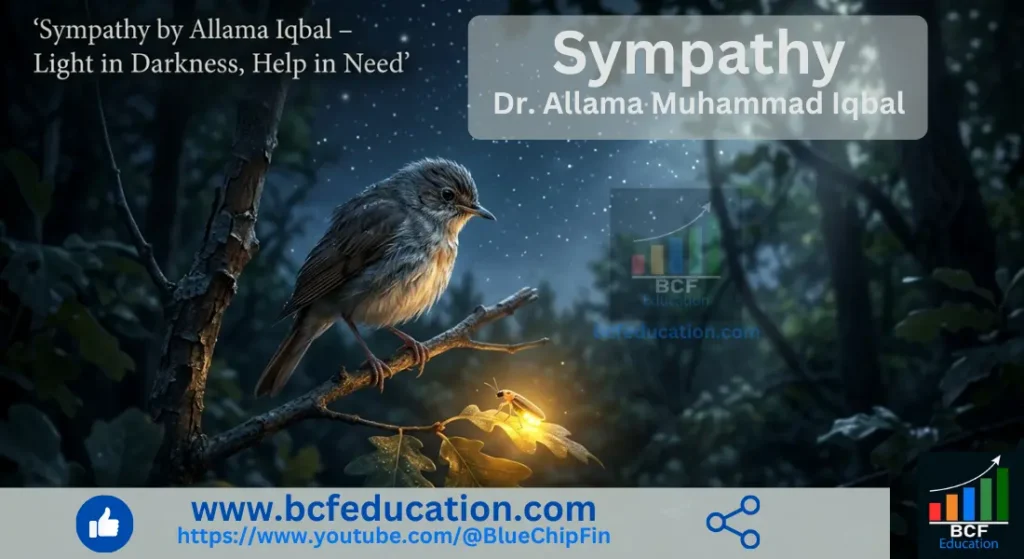
What does it mean to truly help someone? In his beautiful poem “Sympathy,” Dr. Allama Muhammad Iqbal tells the touching story of a sad, lonely nightingale trapped in darkness and a tiny glow-worm that offers its light. This blog post provides a complete, easy-to-understand explanation perfect for students and teachers. You’ll find: poet introduction, poem type, summary, stanza-wise and line-by-line paraphrasing in simple English, difficult word meanings, important short and long questions with answers, central idea and themes, literary devices (figures of speech), rhyme scheme, and a table of MCQs with four options. Written in a human-friendly, non-plagiarized style for exams, assignments, or blog content. Discover Iqbal’s powerful message that true goodness means being ready to help others, no matter how small you are.
Table of Contents
Sympathy by Allama Iqbal: Full Explanation, Line-by-Line Paraphrase, Literary Devices & MCQs
“Sympathy” by Dr. Allama Muhammad Iqbal (Original Text)
Perched on the branch of a tree
Was a nightingale sad and lonely
“The night has drawn near”, He was thinking
“I passed the day in flying around and feeding
How can I reach up to the nest
Darkness has enveloped everything”?
Hearing the nightingale wailing thus
A glow-worm lurking nearby spoke thus
“With my heart and soul ready to help I am
Though only an insignificant insect I am
Never mind if the night is dark
I shall shed light if the way is dark
God has bestowed a torch on me
He has given a shining lamp to me
The good in the world only those are
Ready to be useful to others who are
1. Introduction of the Poet
Dr. Allama Muhammad Iqbal (1877–1938) was a great philosopher, poet, thinker, and politician from South Asia. He is known as the “Poet of the East” (Shair-e-Mashriq) and is considered the spiritual father of Pakistan. Iqbal wrote poetry in Persian and Urdu, but his work has been translated into many languages, including English. His famous works include Bang-e-Dara, Bal-e-Jibril, Zarb-e-Kalim, and Payam-e-Mashriq. Iqbal’s poetry often focuses on self-discovery (Khudi), spiritual awakening, action, and helping humanity. “Sympathy” is a short, simple, but deeply meaningful poem that teaches the value of helping others selflessly.
2. Type of Poem
“Sympathy” is a narrative poem (it tells a short story) with a didactic (teaching) purpose. It has elements of a fable because it uses animals and insects (a nightingale and a glow-worm) to teach a moral lesson. The poem is also a lyric poem because it expresses emotions like sadness, loneliness, and kindness. It is written in simple, rhyming couplets, making it easy to read and remember.
3. Summary of the Poem
A sad and lonely nightingale is sitting on a tree branch. The night has come, and the bird is worried. He thinks about how he spent the whole day flying around and searching for food. Now it is dark, and he cannot see how to reach his nest. Darkness has covered everything.
Hearing the nightingale’s sad cries, a small glow-worm (firefly) hiding nearby speaks to him. The glow-worm says that he is ready to help with all his heart and soul, even though he is just a tiny insect. He tells the nightingale not to worry about the darkness. He will provide light if the path is dark.
The glow-worm explains that God has given him a torch – a shining lamp. Then the poem ends with a powerful message: the truly good people in this world are those who are always ready to be useful to others.
4. Paraphrasing Stanza Wise
| Stanza | Paraphrase |
| Stanza 1 | A nightingale was sitting on a tree branch. It was sad and felt completely alone. |
| Stanza 2 | The nightingale was thinking, “Night has come close. I spent my whole day flying around and finding food.” |
| Stanza 3 | “How can I reach my nest now? Darkness has covered everything around me.” |
| Stanza 4 | Hearing the nightingale crying like this, a glow-worm that was hiding nearby spoke to him. |
| Stanza 5 | The glow-worm said, “I am ready to help you with all my heart and soul. I know I am just a tiny, unimportant insect, but still I want to help.” |
| Stanza 6 | “Never mind if the night is dark. If the path is dark, I will create light.” |
| Stanza 7 | “God has given me a torch. He has blessed me with a shining lamp.” |
| Stanza 8 | The truly good people in this world are only those who are always ready to be useful and helpful to others. |
5. Paraphrasing Line by Line
| Line(s) | Original Text | Paraphrase |
| 1 | Perched on the branch of a tree | Sitting on the branch of a tree |
| 2 | Was a nightingale sad and lonely | There was a nightingale that was sad and felt completely alone |
| 3 | “The night has drawn near”, He was thinking | “The night has come closer,” the bird was thinking to himself |
| 4 | “I passed the day in flying around and feeding” | “I spent the whole day flying from place to place and searching for food” |
| 5 | “How can I reach up to the nest” | “How will I be able to find my way back to my nest?” |
| 6 | “Darkness has enveloped everything” | “Darkness has covered and surrounded everything” |
| 7 | Hearing the nightingale wailing thus | When the glow-worm heard the nightingale crying sadly like this |
| 8 | A glow-worm lurking nearby spoke thus | A glow-worm (firefly) that was hiding close by spoke these words |
| 9 | “With my heart and soul ready to help I am” | “I am completely ready to help you with all my feelings and inner strength” |
| 10 | “Though only an insignificant insect I am” | “Even though I am just a very small and unimportant insect” |
| 11 | “Never mind if the night is dark” | “Don’t worry at all if the night is dark” |
| 12 | “I shall shed light if the way is dark” | “If the path is dark, I will produce light to show you the way” |
| 13 | “God has bestowed a torch on me” | “God has given me a torch (a source of light)” |
| 14 | “He has given a shining lamp to me” | “He has blessed me with a bright, shining lamp” |
| 15 | “The good in the world only those are” | “The truly good people in this world are only those” |
| 16 | “Ready to be useful to others who are” | “Who are always prepared to be helpful and useful to other people” |
6. Difficult Words and Their Meanings
| Word/Phrase | Meaning in Easy English |
| Perched | Sat or rested on (like a bird sitting on a branch) |
| Nightingale | A small bird famous for its beautiful, sad-sounding song |
| Drawn near | Come closer, approached |
| Feeding | Eating, searching for and eating food |
| Enveloped | Completely covered, wrapped around |
| Wailing | Crying loudly in a sad way |
| Lurking | Hiding nearby, staying in a hidden place |
| Thus | Like this, in this way |
| Insignificant | Very small, unimportant, not valuable |
| Shed light | Produce light, shine, illuminate |
| Bestowed | Given as a gift (usually by God or someone higher) |
| Torch | A portable light source (here, the glow-worm’s natural light) |
| Shining lamp | A bright light (another word for the glow-worm’s glow) |
| Useful | Helpful, able to serve a purpose |
7. Important Short Questions and Their Answers
Q1: Where was the nightingale sitting?
A: The nightingale was sitting (perched) on the branch of a tree.
Q2: How did the nightingale feel?
A: The nightingale felt sad and completely lonely.
Q3: What did the nightingale do during the day?
A: The nightingale spent the whole day flying around and searching for food.
Q4: Why couldn’t the nightingale reach its nest?
A: Because darkness had covered everything, and it could not see the way to its nest.
Q5: Who heard the nightingale’s crying?
A: A glow-worm (firefly) that was hiding nearby heard the nightingale’s sad cries.
Q6: How did the glow-worm describe itself?
A: The glow-worm called itself an “insignificant insect” – very small and unimportant.
Q7: What did the glow-worm promise to do?
A: The glow-worm promised to shed light if the path was dark, so the nightingale could see.
Q8: Who gave the torch to the glow-worm?
A: God bestowed (gave) the torch and shining lamp to the glow-worm.
Q9: According to the poem, who are truly good people?
A: Truly good people are those who are always ready to be useful and helpful to others.
Q10: What is the main message of the poem?
A: The main message is that even small, seemingly unimportant creatures can help others. True goodness means being ready to serve others selflessly.
8. Important Long Questions and Their Answers
Q1: Explain the role of the glow-worm in the poem “Sympathy.” What does it represent?
Answer:
The glow-worm is the hero of the poem. Despite being a tiny, “insignificant insect,” it plays a huge role by offering help to the sad and lonely nightingale. The glow-worm represents several important ideas:
Selfless service – The glow-worm does not ask for anything in return. It simply says, “With my heart and soul ready to help I am.”
Humility – The glow-worm knows it is small and unimportant, but it does not let that stop it from helping. It says, “Though only an insignificant insect I am” – this shows humility, not weakness.
Using God-given gifts for others – The glow-worm recognizes that its light is a gift from God (“God has bestowed a torch on me”). It uses that gift not for itself, but to guide the nightingale.
Courage – The glow-worm is brave. It does not fear the darkness. Instead, it says, “Never mind if the night is dark. I shall shed light if the way is dark.”
The glow-worm teaches us that you don’t need to be big, rich, or powerful to help someone. Even a small act of kindness can make a huge difference in someone’s life.
Q2: What is the central message of the poem “Sympathy”? How does Iqbal convey it?
Answer:
The central message of “Sympathy” is: True goodness lies in being ready to help others selflessly, no matter how small or insignificant you think you are.
Iqbal conveys this message in several ways:
| Technique | How Iqbal uses it |
| Story format (narrative) | He tells a simple story of a nightingale in trouble and a glow-worm that helps. Stories are easy to remember and understand. |
| Animal characters | Using a bird and an insect makes the lesson universal and non-threatening. If a tiny glow-worm can help, so can we. |
| Contrast | The nightingale is sad, helpless, and in darkness. The glow-worm is confident, helpful, and carries light. This contrast highlights the power of kindness. |
| Direct moral statement | The last two lines state the lesson clearly: “The good in the world only those are / Ready to be useful to others who are.” |
| Simple language | Iqbal uses short, easy words so the message reaches everyone, including young students. |
The poem teaches that sympathy (feeling for others) is not enough. You must turn that feeling into action. The glow-worm doesn’t just feel sad for the nightingale – it actively offers its light.
9. Central Idea & Theme of the Poem
Central Idea:
True goodness and nobility come from being selflessly helpful to others. No matter how small or unimportant you may feel, you have something to offer. Use your God-given abilities to serve humanity.
Main Themes:
| Theme | Explanation |
| Selfless service | Help others without expecting anything in return. |
| Humility | Even small creatures can do great things. Don’t underestimate yourself. |
| Sympathy vs. action | True sympathy means doing something to help, not just feeling sad. |
| Light in darkness | Kindness is like light that guides lost, helpless people. |
| God-given gifts | Everyone has a unique gift (like the glow-worm’s light). Use it to help others. |
| Overcoming helplessness | One small act of help can change someone’s situation completely. |
| Value of every creature | No one is truly “insignificant.” Everyone has a purpose. |
10. Literary Devices / Figures of Speech / Poetic Devices
| Device | Example from Poem | Explanation |
| Personification | The nightingale is “sad and lonely” and “thinking” | A bird is given human emotions and thoughts. |
| Personification | The glow-worm “spoke thus” | An insect is given the ability to speak. |
| Metaphor | “God has bestowed a torch on me” | The glow-worm’s natural light is compared to a torch. |
| Metaphor | “He has given a shining lamp to me” | Another metaphor – light = lamp. |
| Symbolism | Nightingale | Represents helpless, sad people in need. |
| Symbolism | Glow-worm | Represents small, humble helpers. |
| Symbolism | Darkness | Represents problems, confusion, hopelessness. |
| Symbolism | Light | Represents help, guidance, kindness. |
| Contrast | Sad nightingale vs. helpful glow-worm | Contrast between helplessness and helpfulness. |
| Contrast | Darkness vs. light | Opposite ideas placed together for effect. |
| Anaphora | “I shall shed light if the way is dark” | Repetition of structure (not exact word repetition here). |
| Alliteration | “sad and lonely” | Repetition of the ‘s’ and ‘l’ sounds. |
| Alliteration | “flying around and feeding” | Repetition of the ‘f’ sound. |
| Rhyming couplets | Every two lines rhyme | AABB rhyme scheme throughout. |
| Simple diction | Short, everyday words | Makes the poem accessible to all readers. |
| Direct moral lesson | Last two lines | The poet directly states the message. |
11. Rhyme Scheme for Each Stanza
This poem uses rhyming couplets – each pair of lines rhymes (AA BB CC DD…). Since the poem has 16 lines (8 couplets), here is the rhyme scheme:
| Couplet | Lines | Rhyme Scheme | Rhyming Words |
| 1 | 1-2 | AA | tree / lonely |
| 2 | 3-4 | BB | thinking / feeding |
| 3 | 5-6 | CC | nest / everything |
| 4 | 7-8 | DD | thus / thus (same word rhyme) |
| 5 | 9-10 | EE | am / am (same word rhyme) |
| 6 | 11-12 | FF | dark / dark (same word rhyme) |
| 7 | 13-14 | GG | me / me (same word rhyme) |
| 8 | 15-16 | HH | are / are (same word rhyme) |
Note: Some rhymes use the exact same word repeated (like “am/am”, “dark/dark”, “me/me”, “are/are”). This is called an identical rhyme or repetition rhyme. It is simple but effective for emphasis.
12. Important MCQs of the Poem (Including Figures of Speech)
| Question | A | B | C | D | Correct Answer |
| Who wrote the poem “Sympathy”? | William Wordsworth | Dr. Allama Muhammad Iqbal | William Shakespeare | Robert Frost | B |
| What is the nightingale doing at the beginning of the poem? | Singing happily | Building a nest | Sitting sadly on a branch | Flying high | C |
| How does the nightingale feel? | Angry and jealous | Sad and lonely | Excited and joyful | Tired but happy | B |
| What did the nightingale do during the day? | Slept all day | Flew around and fed | Sang for everyone | Hid from predators | B |
| Why can’t the nightingale reach its nest? | The nest fell down | A predator is nearby | Darkness has covered everything | The branch broke | C |
| Who hears the nightingale’s cries? | An owl | A firefly (glow-worm) | Another nightingale | The moon | B |
| How does the glow-worm describe itself? | Strong and powerful | Wise and old | Insignificant insect | Beautiful and bright | C |
| “With my heart and soul ready to help I am” shows what quality? | Arrogance | Selfishness | Selfless readiness | Fear | C |
| What does the glow-worm promise to do? | Build a nest | Find food | Shed light if the way is dark | Call for help | C |
| Who gave the torch to the glow-worm? | Nature | The nightingale | God | The moon | C |
| “God has bestowed a torch on me” – “bestowed” means? | Took away | Borrowed | Given as a gift | Hid | C |
| The line “Never mind if the night is dark” shows what attitude? | Worry | Confidence and reassurance | Fear | Anger | B |
| According to the poem, who are truly good people? | Those who are rich | Those who are powerful | Those ready to be useful to others | Those who pray all day | C |
| “Perched on the branch of a tree” – “perched” means? | Flew away | Sat or rested | Fell down | Sang loudly | B |
| “Darkness has enveloped everything” – “enveloped” means? | Covered completely | Pushed away | Created | Destroyed | A |
| The poem “Sympathy” is written in which style? | Blank verse | Free verse | Rhyming couplets | Sonnet form | C |
| What does the glow-worm’s light symbolize? | Wealth | Pride | Help and kindness | Anger | C |
| What does the darkness in the poem symbolize? | Happiness | Problems and hopelessness | Sleep | Night only (literal) | B |
| What literary device is used in “sad and lonely”? | Onomatopoeia | Simile | Alliteration | Hyperbole | C |
| The final message of the poem is about? | The beauty of night | The importance of being useful to others | How to catch a glow-worm | Why nightingales sing | B |