Sonnet 116: Let me not to the marriage of true minds” by William Shakespeare Central Idea, Themes, Figures of Speech + MCQs
What is true love according to Shakespeare? In Sonnet 116, also known as “Let me not to the marriage of true minds,” the Bard gives his famous definition of ideal, unchanging love. This blog post offers a complete, easy-to-understand explanation perfect for students and teachers. You’ll find: poet introduction, poem type, summary, stanza-wise and line-by-line paraphrasing in simple English, difficult word meanings, important short and long questions with answers, central idea and themes, literary devices (figures of speech), rhyme scheme, and a table of MCQs with four options. Written in a human-friendly, non-plagiarized style for exams, assignments, or blog content. Discover why this sonnet is one of Shakespeare’s most beloved poems about love that “alters not with his brief hours and weeks.”
Table of Contents
Let me not to the marriage of true minds by William Shakespeare (Original Text)
Let me not to the marriage of true minds
Admit impediments. Love is not love
Which alters when it alteration finds,
Or bends with the remover to remove:
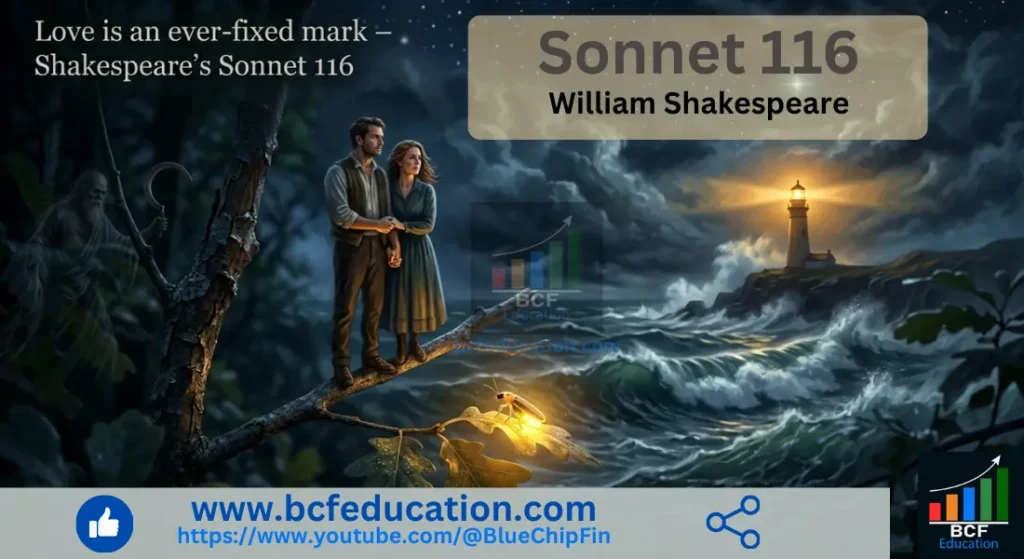
O, no! it is an ever-fixed mark,
That looks on tempests and is never shaken;
It is the star to every wandering bark,
Whose worth’s unknown, although his height be taken.
Love’s not Time’s fool, though rosy lips and cheeks
Within his bending sickle’s compass come;
Love alters not with his brief hours and weeks,
But bears it out even to the edge of doom.
If this be error, and upon me prov’d,
I never writ, nor no man ever lov’d.
1. Introduction of the Poet
William Shakespeare (1564–1616) is widely regarded as the greatest writer in the English language. He was born in Stratford-upon-Avon, England. Shakespeare wrote 39 plays, 154 sonnets, and several narrative poems. His works include famous tragedies like Hamlet, Macbeth, and Romeo and Juliet, as well as comedies and historical plays. Shakespeare’s sonnets, published in 1609, explore themes like love, beauty, time, and death. Sonnet 116 is one of his most famous poems, defining what true, unchanging love really means. People often call him “The Bard of Avon.”
2. Type of Poem
Sonnet 116 is an English (or Shakespearean) sonnet. A sonnet is a 14-line poem written in iambic pentameter (each line has 10 syllables in a “da-DUM” rhythm). The Shakespearean sonnet has:
Three quatrains (4-line stanzas)
One couplet (2-line closing)
Rhyme scheme: ABAB CDCD EFEF GG
This poem is also a lyric poem (expresses personal feelings) and a philosophical poem (discusses the nature of true love).
3. Summary of the Poem
Shakespeare says he will not admit any obstacles to the union of two true lovers. Love is not real if it changes when the beloved changes, or if it bends away when someone tries to remove it. No – true love is a fixed mark (like a lighthouse) that stands firm even during storms. It is like the North Star that guides every lost ship, whose value cannot be measured even if we can calculate its height. Love is not a fool controlled by Time. Even though physical beauty (rosy lips and cheeks) will be cut down by Time’s sickle, love does not change with hours and weeks. It lasts until the end of the world. If what he has said is wrong, then he never wrote anything, and no man has ever truly loved.
4. Paraphrasing Stanza Wise
| Stanza | Paraphrase |
| Quatrain 1 (Lines 1-4) | I will not admit any obstacles to the marriage of two true minds. That is not real love which changes when it finds changes in the beloved, or which bends away when someone tries to remove it. |
| Quatrain 2 (Lines 5-8) | Oh no! Love is a permanently fixed landmark (like a lighthouse) that looks at storms and never shakes. It is the North Star that guides every lost ship. Its true worth is unknown, even though we can measure its position in the sky. |
| Quatrain 3 (Lines 9-12) | Love is not a fool controlled by Time. Even though rosy lips and cheeks come within the range of Time’s curved sickle (meaning physical beauty fades), love does not change with Time’s brief hours and weeks. Instead, it lasts all the way until the day of judgment (the end of the world). |
| Couplet (Lines 13-14) | If what I have said is wrong, and someone proves it against me, then I never wrote anything, and no man has ever truly loved. |
5. Paraphrasing Line by Line
| Line(s) | Original Text | Paraphrase |
| 1 | Let me not to the marriage of true minds | I will never admit or accept |
| 2 | Admit impediments. Love is not love | Any obstacles to the union of two faithful lovers. That is not real love |
| 3 | Which alters when it alteration finds | Which changes when it sees changes in the beloved |
| 4 | Or bends with the remover to remove | Or bends away when someone tries to remove it |
| 5 | O, no! it is an ever-fixed mark | Oh no! True love is a permanently fixed landmark |
| 6 | That looks on tempests and is never shaken | That faces storms and never gets shaken |
| 7 | It is the star to every wandering bark | It is the North Star that guides every lost ship |
| 8 | Whose worth’s unknown, although his height be taken | Its real value is unknown, even though we can measure its position |
| 9 | Love’s not Time’s fool, though rosy lips and cheeks | Love is not a fool controlled by Time, even though beautiful young faces |
| 10 | Within his bending sickle’s compass come | Come within the range of Time’s curved blade (get old and die) |
| 11 | Love alters not with his brief hours and weeks | Love does not change with Time’s short hours and weeks |
| 12 | But bears it out even to the edge of doom | Instead, it lasts all the way until the end of the world |
| 13 | If this be error, and upon me prov’d | If what I have said is wrong, and someone proves it against me |
| 14 | I never writ, nor no man ever lov’d | Then I never wrote anything, and no man has ever truly loved |
6. Difficult Words and Their Meanings
| Word/Phrase | Meaning in Easy English |
| Marriage of true minds | Union of two faithful, sincere lovers |
| Admit impediments | Accept obstacles or problems (from wedding vows: “If any of you know just cause or impediment…”) |
| Alters | Changes |
| Alteration | Change (in the beloved’s behavior, looks, or feelings) |
| Bends with the remover to remove | Yields when someone tries to destroy it |
| Ever-fixed mark | A permanent landmark (like a lighthouse or a sea mark for navigation) |
| Tempests | Violent storms |
| Star | The North Star (Pole Star), used for navigation |
| Wandering bark | Lost ship (bark = small ship) |
| Height be taken | Its position in the sky can be measured (but not its true worth) |
| Time’s fool | A puppet or plaything controlled by Time |
| Bending sickle | Time’s curved blade (like the Grim Reaper’s scythe) |
| Compass | Range, scope, or reach |
| Bears it out | Lasts, endures, survives |
| Edge of doom | Judgment Day, the end of the world |
| Error | Mistake, falsehood |
| Upon me prov’d | Proven against me, shown to be wrong |
| I never writ | I never wrote (anything) |
7. Important Short Questions and Their Answers
Q1: What does the poet refuse to admit?
A: He refuses to admit any obstacles or impediments to the marriage of two true minds (true lovers).
Q2: According to Shakespeare, what is NOT love?
A: Love is not real if it changes when the beloved changes, or if it bends away when someone tries to remove it.
Q3: What is “an ever-fixed mark”?
A: It is a permanent landmark (like a lighthouse) that remains steady even during storms – a metaphor for true love.
Q4: What does “the star to every wandering bark” mean?
A: It means true love is like the North Star that guides every lost ship. It provides direction and stability.
Q5: What does Shakespeare say about Time and love?
A: Love is not Time’s fool. Even though Time destroys physical beauty with its sickle, love does not change with hours and weeks. It lasts until the end of the world.
Q6: What does “rosy lips and cheeks” represent?
A: They represent physical beauty and youth, which fade with time.
Q7: What does the poet say in the final couplet?
A: If what he has said is wrong and someone proves it, then he never wrote anything, and no man has ever truly loved.
Q8: What is the tone of the poem?
A: The tone is confident, defiant, passionate, and absolutely certain.
8. Important Long Questions and Their Answers
Q1: Explain Shakespeare’s definition of true love as presented in Sonnet 116.
Answer:
In Sonnet 116, Shakespeare defines true love as unchanging, permanent, and invincible. He uses three powerful metaphors:
The “ever-fixed mark” – Like a lighthouse or sea mark, true love stands firm against all storms. It does not shake or move, no matter what difficulties come.
The “star” (North Star) – True love is like the Pole Star that guides lost ships. Its position can be measured (we know it exists), but its true worth is beyond calculation. It provides direction in the chaos of life.
Love not being “Time’s fool” – Physical beauty (rosy lips and cheeks) fades under Time’s sickle, but true love does not change. It is not controlled by Time. Instead, it endures until “the edge of doom” (Judgment Day).
Shakespeare also says what love is NOT: it does not alter when it finds alteration, nor does it bend away when someone tries to remove it. The final couplet is a bold wager: if this definition is wrong, then he has never written anything, and no one has ever truly loved. This shows his absolute confidence in his definition.
Q2: Analyze the use of imagery and metaphors in Sonnet 116.
Answer:
Shakespeare uses two extended metaphors to describe true love:
| Metaphor | Meaning | Effect |
| Ever-fixed mark | A lighthouse or navigational landmark | Love is steady, reliable, and unmovable |
| Star (North Star) | The Pole Star that guides ships | Love provides direction; its value is beyond measurement |
Other imagery:
Tempests – Storms represent life’s difficulties and challenges.
Wandering bark – A lost ship represents a confused or struggling person.
Time’s bending sickle – Time is personified as the Grim Reaper, cutting down beauty and youth.
Rosy lips and cheeks – Represents physical beauty that fades.
Personification: Time is given human qualities – it has a “bending sickle,” “brief hours and weeks,” and can make a fool of love (but fails).
These images make abstract ideas (love, time, permanence) feel concrete and visual. The poem argues that true love is not emotional or physical attraction alone – it is a spiritual, permanent force that defeats time.
9. Central Idea & Theme of the Poem
Central Idea:
True love is unchanging, permanent, and invincible. It does not fade when beauty fades, nor does it bend when tested. It stands firm through all storms and lasts until the end of time.
Main Themes:
| Theme | Explanation |
| Constancy of true love | Real love never changes, no matter what happens. |
| Love vs. Time | Time destroys physical beauty but cannot destroy true love. |
| Love as a guiding force | Love provides direction like the North Star. |
| Immutability (Unchangeableness) | True love is fixed, permanent, and eternal. |
| Rejection of conditional love | Love that changes when circumstances change is not real love. |
| Certainty and confidence | The poet is absolutely sure of his definition of love. |
10. Literary Devices / Figures of Speech / Poetic Devices
| Device | Example from Poem | Explanation |
| Metaphor (extended) | “Ever-fixed mark” and “star” | Love is compared to a lighthouse and the North Star throughout the poem. |
| Personification | “Love’s not Time’s fool” | Time is given human qualities (having a fool, using a sickle). |
| Personification | “his bending sickle” | Time is imagined as the Grim Reaper. |
| Alliteration | “marriage of true minds” | Repetition of ‘m’ sound. |
| Alliteration | “bends with the remover to remove” | Repetition of ‘r’ and ‘b’ sounds. |
| Alliteration | “brief hours and weeks” | Repetition of ‘b’ and ‘w’ sounds. |
| Anaphora | “Love is not love / Which alters… Or bends…” | Repetition of structure at the beginning of clauses. |
| Parallelism | “alters when it alteration finds” | Similar grammatical structure. |
| Hyperbole | “bears it out even to the edge of doom” | Exaggeration – love lasts until Judgment Day. |
| Hyperbole | “I never writ, nor no man ever lov’d” | Extreme exaggeration to show certainty. |
| Antithesis | Love vs. Time, constancy vs. change | Opposite ideas placed together. |
| Inversion | “Let me not… admit” instead of “Do not let me admit” | Poetic word order for rhythm. |
| Double negative | “nor no man” | Emphatic negative for strong effect. |
11. Rhyme Scheme for Each Stanza
This is a Shakespearean sonnet – rhyme scheme: ABAB CDCD EFEF GG
| Stanza | Lines | Rhyme Scheme | Rhyming Words |
| Quatrain 1 | 1-4 | ABAB | minds/impediments – love/remove |
| Quatrain 2 | 5-8 | CDCD | mark/shaken – bark/taken |
| Quatrain 3 | 9-12 | EFEF | cheeks/weeks – come/doom |
| Couplet | 13-14 | GG | prov’d/lov’d |
Note: In line 2, “love” rhymes with “remove” (sight rhyme/eye rhyme). “Impediments” (line 2) rhymes with “minds” (line 1) – this is a slant rhyme (not perfect).
12. Important MCQs of the Poem (Including Figures of Speech)
| Question | A | B | C | D | Correct Answer |
| Who wrote Sonnet 116? | John Milton | William Wordsworth | William Shakespeare | John Keats | C |
| What is the rhyme scheme of Sonnet 116? | ABAB BCBC CDCD EE | ABBA ABBA CDE CDE | ABAB CDCD EFEF GG | AABB CCDD EEFF GG | C |
| “Love is not love which alters when it alteration finds” is an example of? | Simile | Personification | Polyptoton (using alter/alteration) | Hyperbole | C |
| What does the “ever-fixed mark” represent? | A grave | True love | Time | Death | B |
| “It is the star to every wandering bark” – here “bark” means? | Tree bark | Dog’s bark | Ship | A loud sound | C |
| Love is NOT Time’s what? | Enemy | Master | Fool | Friend | C |
| What does Time carry in this poem? | A clock | A bending sickle | A sword | A book | B |
| “Rosy lips and cheeks” represent? | Health | Physical beauty that fades | Youthful energy | All of the above | D |
| Love lasts until the “edge of doom” – doom means? | Death | Judgment Day | Sadness | The grave | B |
| “Let me not to the marriage of true minds / Admit impediments” – these words echo which ceremony? | Baptism | Wedding | Graduation | Funeral | B |
| Which literary device is used in “bears it out even to the edge of doom”? | Understatement | Hyperbole | Irony | Sarcasm | B |
| “Love’s not Time’s fool” is an example of? | Simile | Personification | Metaphor | Onomatopoeia | B (and also metaphor) |
| In the final couplet, Shakespeare says if he is wrong, then? | Love is real | No man ever loved | Time wins | Beauty is eternal | B |
| The poem is written in which meter? | Trochaic pentameter | Iambic pentameter | Anapestic tetrameter | Dactylic hexameter | B |
| How many lines does a Shakespearean sonnet have? | 12 | 14 | 16 | 10 | B |
| “Alters when it alteration finds” is an example of? | Alliteration | Polyptoton | Assonance | Oxymoron | B |
| What guides the “wandering bark”? | The moon | The star (North Star) | The wind | The tide | B |
| “Whose worth’s unknown, although his height be taken” refers to? | A mountain | The star | A person | Love itself | B |
| The tone of Sonnet 116 is? | Doubtful | Confident and defiant | Sad and gloomy | Humorous | B |
| “I never writ, nor no man ever lov’d” contains? | Double negative | Simile | Oxymoron | Litotes | A |