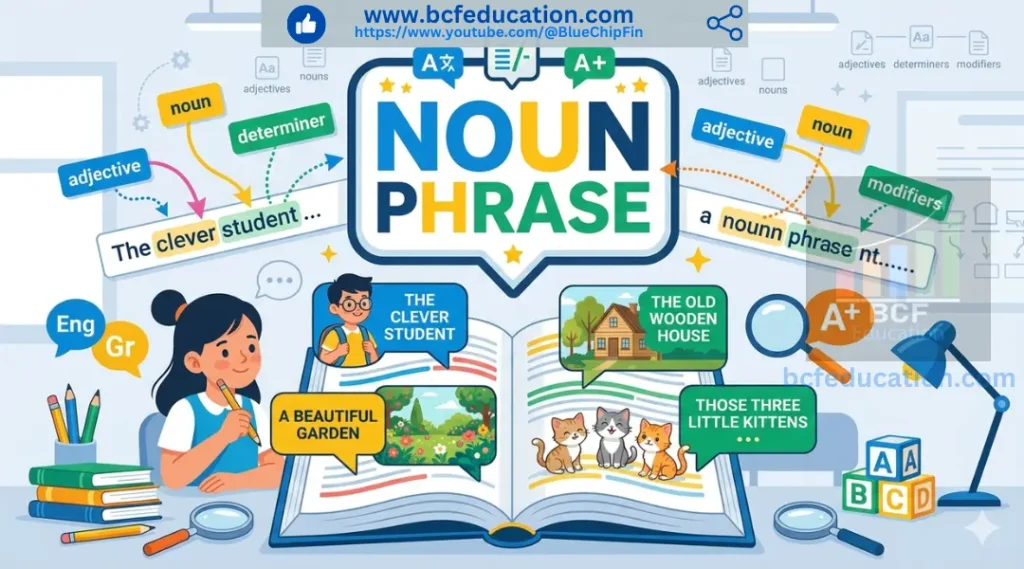
Mastering the Noun Phrase A Complete Guide with Clear Examples
Introduction
Imagine trying to build a house with only bricks and no cement. You would have the raw materials, but nothing would stick together. In English grammar, single nouns are like those bricks. They are essential, but they often lack the strength to paint a full picture.
Enter the Noun Phrase (NP) — the cement that turns a simple “dog” into “the fluffy, brown dog that barked all night.”
Whether you are a student learning English, a writer polishing a novel, or a professional crafting an email, understanding noun phrases will transform your communication. In this blog, we will break down what a noun phrase is, its internal structure, and how to use it effectively.
Table of Contents
What is a Noun Phrase?
A noun phrase is a group of two or more words that functions exactly like a noun. The key rule is: the entire phrase must act as a single unit—either as the subject, object, or complement of a sentence.
The most important word in a noun phrase is the head noun. All other words in the phrase exist to modify or describe this head noun.
Minimal vs. Expanded Phrases
- Minimal noun phrase: Birds fly. (Just one noun)
- Expanded noun phrase: The flock of migratory birds fly south.
The Anatomy of a Noun Phrase
A standard noun phrase follows a specific order. Think of it as a formula:
(Determiner) + (Pre-modifiers) + Head Noun + (Post-modifiers)
Let’s look at each component with original examples.
1. The Head Noun (The Boss)
This is the non-negotiable core of the phrase.
- Courage is rare.
- Table broke.
2. Determiners (The Gatekeepers)
These come first. They tell you which one or how many.
- Articles: a, an, the
- Demonstratives: this, that, these, those
- Possessives: my, your, his, Sarah’s
- Quantifiers: some, many, few, every, five
Example: Those five apples look fresh. (Determiners: Those, five)
3. Pre-Modifiers (Adjectives & Nouns before the Head)
These add description before the main noun.
- A beautiful sunset.
- A leather jacket. (Noun acting as an adjective)
- The very tall, mysterious stranger.
4. Post-Modifiers (The Clauses & Phrases after the Head)
These add information after the main noun. They are often prepositional phrases or clauses.
- Prepositional phrase: The house on the hill.
- Infinitive phrase: A desire to learn.
- Relative clause: The student who won the prize.
Detailed Examples in Context
Let us look at how noun phrases work inside full sentences.
Example 1: As the Subject (Doing the action)
The old wooden chest at the foot of the bed contained secret letters.
- Head Noun: chest
- Determiner: The
- Pre-modifiers: old, wooden
- Post-modifier: at the foot of the bed
- Function: This entire phrase is the subject (the thing doing the containing).
Example 2: As the Object (Receiving the action)
The archaeologist discovered a rare, golden coin from the Roman era.
- Head Noun: coin
- Determiner: a
- Pre-modifiers: rare, golden
- Post-modifier: from the Roman era
- Function: This phrase is the object (the thing being discovered).
Example 3: As the Object of a Preposition
She whispered the secret to her most trusted best friend.
- Head Noun: friend
- Determiner: her
- Pre-modifiers: most trusted, best
- Post-modifier: (None in this case)
Common Mistakes to Avoid (And How to Fix Them)
Even advanced writers sometimes misuse noun phrases. Here are two frequent errors.
Mistake 1: The Stacked Noun Phrase (Too many nouns in a row)
Incorrect: The company research product development team meeting schedule changed.
(Too many head nouns stacked together)
Correct: The schedule for the meeting of the product development team in research changed.
Mistake 2: The Dangling Modifier
Incorrect: Walking home from school, the rain started.
(It sounds like the rain was walking.)
Correct: Walking home from school, the young boy felt the rain start.
(Now “the young boy” is the noun phrase attached to “walking.”)
Why Do Noun Phrases Matter?
- Precision: “The document” is vague. “The signed legal document on my desk” is specific.
- Flow: Noun phrases prevent choppy writing. Instead of “The car was red. The car was fast. The car crashed,” write “The fast red car crashed.”
- Complexity: Mature writing uses varied noun phrases to pack information efficiently.
Practice Exercise (Test Yourself)
Identify the entire noun phrase in the following sentence:
“That tiny, buzzing mosquito in my bedroom is driving me crazy.”
Answer: That tiny, buzzing mosquito in my bedroom
- Head Noun: mosquito
- Determiner: That
- Pre-modifiers: tiny, buzzing
- Post-modifier: in my bedroom
Final Thoughts
A noun phrase is not just a grammar rule; it is a tool for clarity. Start by looking at your last email or story. Where did you write “The man”? Could it be “The tall man with the blue hat”? Where did you write “An idea”? Could it be “A revolutionary idea that changed history”?
The next time you read a novel or a news article, highlight the noun phrases. You will quickly realize that great writing is simply a series of well-built noun phrases chained together.