FBISE ICOM 1 Business Mathematics Paper 2017 Solved – Complete Step-by-Step Guide

FBISE ICOM 1 Business Mathematics Paper 2017 Solved – Complete Step-by-Step Guide

FBISE ICOM 1 Business Mathematics Paper 2017 Solved – Complete Step-by-Step Guide. Get complete and easy-to-understand solutions of the FBISE ICOM Part 1 Business Mathematics Paper 2017. This detailed guide provides step-by-step answers, helping students prepare effectively for exams and improve their problem-solving skills in business mathematics.

Table of Contents

FBISE ICOM 1 Business Mathematics Paper 2017 Solved – Complete Step-by-Step Guide

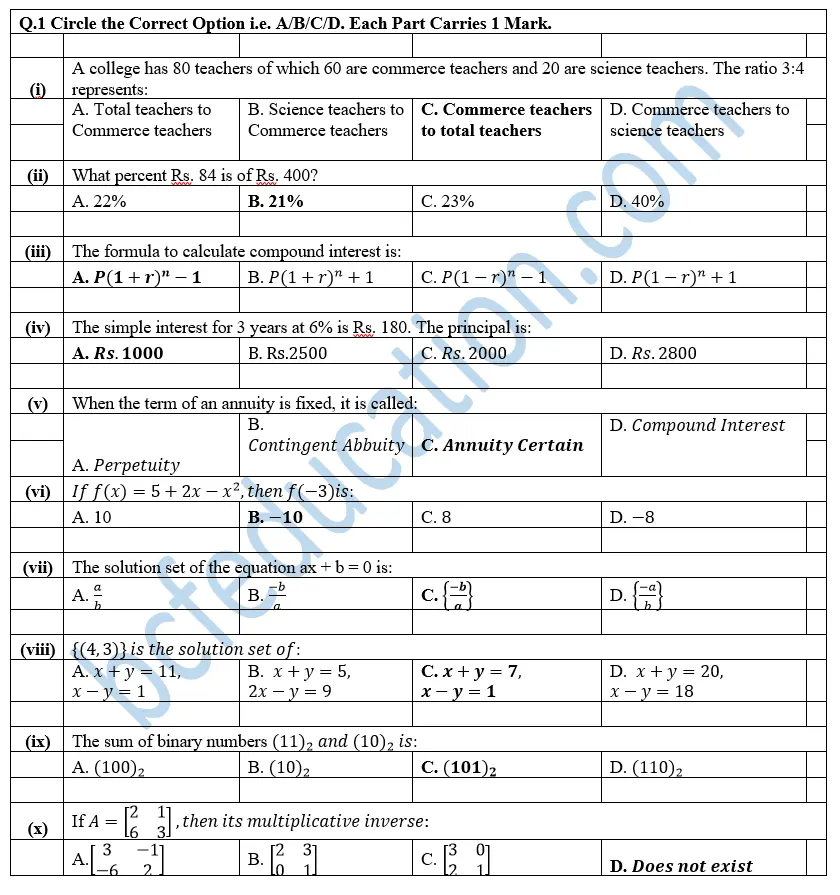
Q.1 MCQS

FBISE ICOM 1 Business Mathematics Paper 2017 Solved – Complete Step-by-Step Guide

SECTION-B (Marks 24)

Q.2 Attempt any eight parts. The answer to each part should not exceed 3 to 4 lines. (8 x 3 = 24)

i. A milk man mixes milk with water in the ratio of 7:2. He has 81 liters of mixed milk. What is the quantity of pure milk?

Solution

Total amount of milk = 81 Liters

Ratio of Mil with Water = 7:2

Sum of ratios = 7+2=9

Amount of Milk=819×7=63 Liters\text{Amount of Milk} = \frac{81}{9} \times 7 = 63 \text{ Liters} \\

Amount of Water=819×2=18 Liters\text{Amount of Water} = \frac{81}{9} \times 2 = 18 \text{ Liters}

ii.Assad’s monthly salary is Rs. 5800 per month and his boss promises him at 12% raise at the first of next year. What will be his monthly salary after the raise?

Solution

Monthly Salary = 5800 Per Month

Percentage Raise in the Salary= 12%

Amount of Raise = 5800 x 0.12 = 696

Total Salary after raise = 5800 + 696 = 6496    

iii. A house was sold for Rs. 220000 by agent, who received a commission of  How much commission did he receive?

Solution

Sale Price = 220,000

Commission Percentage=112% or 1.5%\text{Commission Percentage} = 1\frac{1}{2}\% \text{ or } 1.5\%

Fraction of percentage=1.5100=0.015\text{Fraction of percentage} = \frac{1.5}{100} = 0.015

Amount of Commission = 220,000 x 0.015 = 3300

iv. At what annual rate of interest would Rs. 780 amount to Rs. 1320 in 2 years and 3 months?

Solution

It is not mentioned here either it is a case of simple or compound interest so we will see both conditions below:

F.V = 1320, P = 780, n=2 years 3 month or 9 quarters, i=?

In Case of Simple Interest

FV=P(1+IN)1320=780(1+I(9))1320780=1+9I1.6923=1+9I1.69231=9II=0.69239=0.0769 or 8% approx\begin{aligned} FV &= P(1 + IN) \\ 1320 &= 780 \bigl(1 + I(9)\bigr) \\ \frac{1320}{780} &= 1 + 9I \\ 1.6923 &= 1 + 9I \\ 1.6923 – 1 &= 9I \\ I &= \frac{0.6923}{9} = 0.0769 \text{ or } 8\% \text{ approx} \end{aligned}

In Case of Compound Interest

FV=P(1+i)n1320=780(1+i)91320780=(1+i)91.6923=(1+i)91.6923(1/9)=1+i1.060=1+ii=1.0601=0.06 or 6%\begin{aligned} FV &= P(1+i)^n \\ 1320 &= 780(1+i)^9 \\ \frac{1320}{780} &= (1+i)^9 \\ 1.6923 &= (1+i)^9 \\ 1.6923^{(1/9)} &= 1+i \\ 1.060 &= 1+i \\ i &= 1.060 – 1 = 0.06 \text{ or } 6\% \end{aligned}

v. Mr. Munir has invested Rs. 25000 at 6% compounded annually. What amount would he receive after 4 years?

Solution

P=25000,i=6% or 0.06,n=4FV=P(1+i)nFV=25000(1+0.06)4FV=25000(1.26247696)FV=31562\begin{aligned} P &= 25000, \quad i = 6\% \text{ or } 0.06, \quad n = 4 \\ FV &= P(1+i)^n \\ FV &= 25000(1+0.06)^4 \\ FV &= 25000(1.26247696) \\ FV &= 31562 \end{aligned}

vi. A company is expected to pay Rs. 4 every year on a share of its stock. What is the present value of its stock if money is worth 5% compounded semi-annually?

Solution

C.I=P(1+i)nPC.I=P{(1+i)n1}4=P{(1+0.025)21}4=P(1.0506251)4=P(0.050625)P=40.050625=79\begin{aligned} C.I &= P(1+i)^n – P \\ C.I &= P\left\{(1+i)^n – 1\right\} \\ 4 &= P\left\{(1+0.025)^2 – 1\right\} \\ 4 &= P(1.050625 – 1) \\ 4 &= P(0.050625) \\ P &= \frac{4}{0.050625} = 79 \end{aligned}

vii. Find the slope and y-intercept of the straight line

Solution

Equation of slope intercept form is:

y= mx + b

Where m is slope and b is the y intercept

4x – 3y – 7 = 0

– 3y  =-4x+7 Or  3y  =4x-7

y=4x73y = \frac{4x – 7}{3}
y=1.33x2.33is the y-intercept formy = 1.33x – 2.33 \quad \text{is the } y\text{-intercept form}

Slope (m)is 1.33

viii. Find the market equilibrium point for the following demand and supply functions:

 Demand: P=-3q+26

Supply: P=4q-9

Solution

Demand = Supply

3q+26=4q93q4q=9267q=357q=35q=357=5\begin{aligned} -3q + 26 &= 4q – 9 \\ -3q – 4q &= -9 – 26 \\ -7q &= -35 \\ 7q &= 35 \\ q &= \frac{35}{7} = 5 \end{aligned}

At 5 units of output there is equilibrium in the market

ix. Solve 4x²-6x-5=0 by using quadratic formula.

Solution

a=4,b=6,c=5x=b±b24ac2ax=(6)±(6)24(4)(5)2(4)x=6±36+808x=6±1168x=6±10.7708x1=6+10.7708=16.7708=2.09625x2=610.7708=4.778=0.59625\begin{aligned} a &= 4, \quad b = -6, \quad c = -5 \\ x &= \frac{-b \pm \sqrt{b^2 – 4ac}}{2a} \\ x &= \frac{-(-6) \pm \sqrt{(-6)^2 – 4(4)(-5)}}{2(4)} \\ x &= \frac{6 \pm \sqrt{36 + 80}}{8} \\ x &= \frac{6 \pm \sqrt{116}}{8} \\ x &= \frac{6 \pm 10.770}{8} \\ x_1 &= \frac{6 + 10.770}{8} = \frac{16.770}{8} = 2.09625 \\ x_2 &= \frac{6 – 10.770}{8} = \frac{-4.77}{8} = -0.59625 \end{aligned}

x. Convert (101101.01)2 in to a decimal number.

Solution

1(2)2+0(2)1+1(2)0+0(2)1+1(2)2+1(2)3+0(2)4+1(2)5=0.25+0+1+0+4+8+0+32=45.25(101101.01)2=(45.25)10\begin{aligned} & 1(2)^{-2} + 0(2)^{-1} + 1(2)^0 + 0(2)^1 + 1(2)^2 + 1(2)^3 + 0(2)^4 + 1(2)^5 \\ &= 0.25 + 0 + 1 + 0 + 4 + 8 + 0 + 32 \\ &= 45.25 \\ (101101.01)_2 &= (45.25)_{10} \end{aligned}

xi. Check the singularity of a matrix:

A=[3355]A = \begin{bmatrix} 3 & -3 \\ -5 & -5 \end{bmatrix}

Solution:

|A|=3(5)(3)(5)|A|=1515=300\begin{aligned} |A| &= 3(-5) – (-3)(-5) \\ |A| &= -15 – 15 = -30 \neq 0 \end{aligned}
Therefore, A is a non-singular matrix.\text{Therefore, } A \text{ is a non-singular matrix.}

Section C (Marks 16)

Note: Attempt any two questions. All questions carry equal marks. (2×8=16)

Q.3 (a). A man needs to borrow Rs. 30,000 for two years. Show by calculation which one of the following loans is more advantageous to him?

(i) 4.1% simple interest

(ii) 4% per annum compounded semi-annually

Solution:

P=30,000,n=2,I=4.1% or 0.041(i) S.I=P×I×nS.I=30,000×2×0.041S.I=2460\begin{aligned} P &= 30,000, \quad n = 2, \quad I = 4.1\% \text{ or } 0.041 \\ \text{(i) } S.I &= P \times I \times n \\ S.I &= 30,000 \times 2 \times 0.041 \\ S.I &= 2460 \end{aligned}

(ii) C.I=P(1+i)nPC.I=30,000(1+0.041)230,000C.I=30,000(1.041)230,000C.I=30,000(1.083681)30,000C.I=32,510.4330,000C.I=2510.43\begin{aligned} \text{(ii) } C.I &= P(1+i)^n – P \\ C.I &= 30,000(1 + 0.041)^2 – 30,000 \\ C.I &= 30,000(1.041)^2 – 30,000 \\ C.I &= 30,000(1.083681) – 30,000 \\ C.I &= 32,510.43 – 30,000 \\ C.I &= 2510.43 \end{aligned}

Option (ii) with compound interest is more advantageous

b. Find the value of………………..by changing into binary number system.

[(101010011)2+(1011111)2](199)10\left[ (101010011)_2 + (1011111)_2 \right] – (199)_{10}

Solution:

Conversion of (199)10 to binary:199÷2=99 remainder 199÷2=49 remainder 149÷2=24 remainder 124÷2=12 remainder 012÷2=6 remainder 06÷2=3 remainder 03÷2=1 remainder 11÷2=0 remainder 1Reading remainders from bottom to top:(199)10=(11000111)2\begin{aligned} & \text{Conversion of } (199)_{10} \text{ to binary:} \\ & 199 \div 2 = 99 \text{ remainder } 1 \\ & 99 \div 2 = 49 \text{ remainder } 1 \\ & 49 \div 2 = 24 \text{ remainder } 1 \\ & 24 \div 2 = 12 \text{ remainder } 0 \\ & 12 \div 2 = 6 \text{ remainder } 0 \\ & 6 \div 2 = 3 \text{ remainder } 0 \\ & 3 \div 2 = 1 \text{ remainder } 1 \\ & 1 \div 2 = 0 \text{ remainder } 1 \\ & \text{Reading remainders from bottom to top:} \\ & (199)_{10} = (11000111)_2 \end{aligned}

Or

 199 
2991
2491
2241
2120
260
230
211
(199)10=(11000111)2(199)_{10} = (11000111)_2

Now

[(101010011)2+(1011111)2](11000111)2\left[ (101010011)_2 + (1011111)_2 \right] – (11000111)_2

[(101010011)2+(1011111)2](11000111)2Step 1: Add the binary numbers101010011+001011111(align by 9 bits)=1101100102Step 2: Subtract (11000111)2110110010011000111(align by 9 bits)=0111010112Result: (11101011)2\begin{aligned} & \left[ (101010011)_2 + (1011111)_2 \right] – (11000111)_2 \\ \\ & \text{Step 1: Add the binary numbers} \\ & \quad 101010011 \\ & \quad +\; 001011111 \quad \text{(align by 9 bits)} \\ & \quad = 110110010_2 \\ \\ & \text{Step 2: Subtract } (11000111)_2 \\ & \quad 110110010 \\ & \quad -\; 011000111 \quad \text{(align by 9 bits)} \\ & \quad = 011101011_2 \\ \\ & \text{Result: } (11101011)_2 \end{aligned}

Alternative with Clarity

101010011
+1011111
110110010
110110010
 –11000111
 011101011
Answer=(11101011)2\text{Answer} = (11101011)_2

Q.4(a). Solve the system of linear equations by Crammer’s Rule: x+3y=7,  2x-5y=12

Solution:

[1325][xy]=[712]x=|Ax||A|,y=|Ay||A||A|=|1325|=1(5)3(2)=56=11|Ax|=|73125|=7(5)3(12)=3536=71|Ay|=|17212|=1(12)7(2)=1214=2x=|Ax||A|=7111=6.4545y=|Ay||A|=211=0.1818\begin{aligned} \begin{bmatrix} 1 & 3 \\ 2 & -5 \end{bmatrix} \begin{bmatrix} x \\ y \end{bmatrix} &= \begin{bmatrix} 7 \\ 12 \end{bmatrix} \\ x &= \frac{|A_x|}{|A|}, \quad y = \frac{|A_y|}{|A|} \\ |A| &= \begin{vmatrix} 1 & 3 \\ 2 & -5 \end{vmatrix} = 1(-5) – 3(2) = -5 – 6 = -11 \\ |A_x| &= \begin{vmatrix} 7 & 3 \\ 12 & -5 \end{vmatrix} = 7(-5) – 3(12) = -35 – 36 = -71 \\ |A_y| &= \begin{vmatrix} 1 & 7 \\ 2 & 12 \end{vmatrix} = 1(12) – 7(2) = 12 – 14 = -2 \\ x &= \frac{|A_x|}{|A|} = \frac{-71}{-11} = 6.4545 \\ y &= \frac{|A_y|}{|A|} = \frac{-2}{-11} = 0.1818 \end{aligned}

(b). If Rs. 300 is deposited in the beginning of each quarter in an account which earns interest at the rate of 8% compounded quarterly. What will be the amount after the end of 3 ½ years?

Solution

Deposits are made at the beginning of the period so it is the case of annuity due.

R=300,i=8% Annualiquarterly=8%4=2% or 0.02,n=312 years=14 quartersFV=?FV or S=R[(1+i)n1i](1+i)FV or S=300[(1+0.02)1410.02](1+0.02)FV or S=300[15.9739](1.02)FV or S=300×15.9739×1.02FV or S=4888\begin{aligned} R &= 300, \quad i = 8\% \text{ Annual} \\ i_{\text{quarterly}} &= \frac{8\%}{4} = 2\% \text{ or } 0.02, \\ n &= 3\frac{1}{2} \text{ years} = 14 \text{ quarters} \\ FV &= \, ? \\ \\ FV \text{ or } S &= R \left[ \frac{(1+i)^n – 1}{i} \right] (1 + i) \\ FV \text{ or } S &= 300 \left[ \frac{(1+0.02)^{14} – 1}{0.02} \right] (1 + 0.02) \\ FV \text{ or } S &= 300 \left[ 15.9739 \right] (1.02) \\ FV \text{ or } S &= 300 \times 15.9739 \times 1.02 \\ FV \text{ or } S &= 4888 \end{aligned}

Q.5 (a) Verify the Matrix given below:

A=[112210],A = \begin{bmatrix} 1 & -1 & 2 \\ 2 & 1 & 0 \end{bmatrix}, \quad
B=[122011],B = \begin{bmatrix} 1 & 2 \\ 2 & 0 \\ -1 & 1 \end{bmatrix}, \quad
then verify that (AB)t=BtAt\text{then verify that } (AB)^t = B^t A^t

Solution:

AB=[1(1)+(1)2+2(1)1(2)+(1)0+2(1)2(1)+(1)2+0(1)2(2)+(1)0+0(1)]AB = \begin{bmatrix} 1(1) + (-1)2 + 2(-1) & 1(2) + (-1)0 + 2(1) \\ 2(1) + (1)2 + 0(-1) & 2(2) + (1)0 + 0(1) \end{bmatrix}
AB=[12220+22+204+0+0]=[3444]AB = \begin{bmatrix} 1 – 2 – 2 & 2 – 0 + 2 \\ 2 + 2 – 0 & 4 + 0 + 0 \end{bmatrix} = \begin{bmatrix} -3 & 4 \\ 4 & 4 \end{bmatrix}
(AB)t=[3444](AB)^t = \begin{bmatrix} -3 & 4 \\ 4 & 4 \end{bmatrix}
B=[122011],Bt=[121201]B = \begin{bmatrix} 1 & 2 \\ 2 & 0 \\ -1 & 1 \end{bmatrix}, \quad B^t = \begin{bmatrix} 1 & 2 & -1 \\ 2 & 0 & 1 \end{bmatrix}
A=[112210],At=[121120]A = \begin{bmatrix} 1 & -1 & 2 \\ 2 & 1 & 0 \end{bmatrix}, \quad A^t = \begin{bmatrix} 1 & 2 \\ -1 & 1 \\ 2 & 0 \end{bmatrix}
Bt=[121201],At=[121120]B^t = \begin{bmatrix} 1 & 2 & -1 \\ 2 & 0 & 1 \end{bmatrix}, \quad A^t = \begin{bmatrix} 1 & 2 \\ -1 & 1 \\ 2 & 0 \end{bmatrix}
BtAt=[1(1)+2(1)+(1)21(2)+2(1)+(1)02(1)+0(1)+1(2)2(2)+0(1)+1(0)]B^t A^t = \begin{bmatrix} 1(1) + 2(-1) + (-1)2 & 1(2) + 2(1) + (-1)0 \\ 2(1) + 0(-1) + 1(2) & 2(2) + 0(1) + 1(0) \end{bmatrix}
AB=[1222+2020+24+0+0]=[3444]AB = \begin{bmatrix} 1 – 2 – 2 & 2 + 2 – 0 \\ 2 – 0 + 2 & 4 + 0 + 0 \end{bmatrix} = \begin{bmatrix} -3 & 4 \\ 4 & 4 \end{bmatrix}
(AB)t=BtAt(AB)^t = B^t A^t

(b) A manufacturer offered 33 1/3 % commission to an agent to sale his old stock. The agent received Rs. 15000 as commission. Find the amount received by the manufacturer.


Solution

Commission Percentage=3313% or 33.33%\text{Commission Percentage} = 33\frac{1}{3}\% \text{ or } 33.33\%

Amount of commission=15000\text{Amount of commission} = 15000

Manufacturer Received=1500033.33×100=45004.50\text{Manufacturer Received} = \frac{15000}{33.33} \times 100 = 45004.50

Leave a Comment

Your email address will not be published. Required fields are marked *