Are you a Class 11 student of the Federal Board of Intermediate and Secondary Education (FBISE), Islamabad, studying the poem Break, Break, Break by Lord Alfred Tennyson for your English I syllabus? This blog post is your ultimate, student-friendly study guide.
Inside, you will find everything you need to ace your exam: a simple summary, stanza-wise and line-by-line paraphrasing, difficult word meanings with explanations, important short and long questions with answers, central idea and themes, a complete list of literary devices (figures of speech), rhyme scheme, and a table of multiple-choice questions (MCQs) including figure of speech-related ones.
Lesson 12: Break Break Break Poem by Lord Alfred Tennyson Summary Paraphrasing Theme MCQS
1: Summary of the Poem
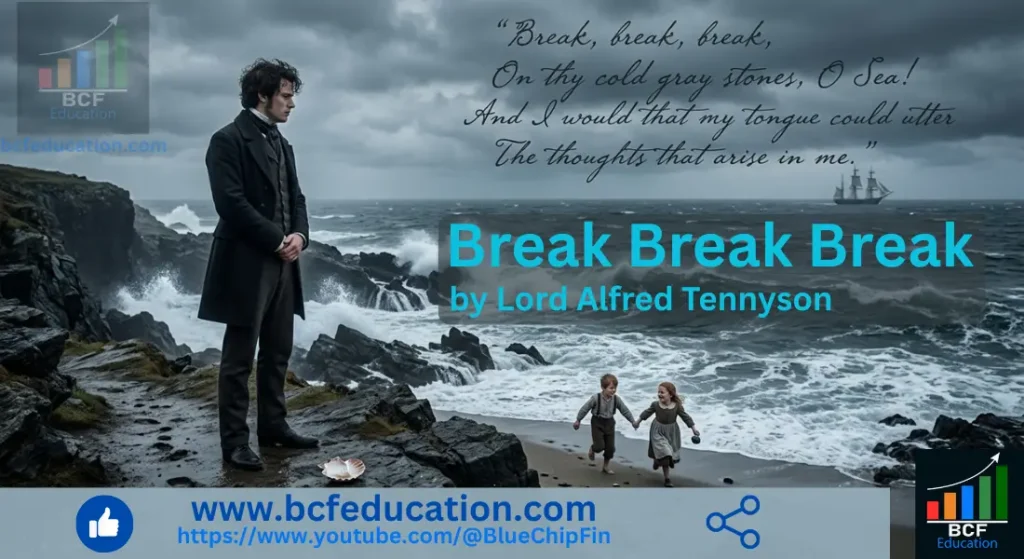
The speaker stands by the ocean and watches the waves crash endlessly on the cold stones. He wishes he could express the heavy thoughts inside him. Around him, he sees others enjoying life—a fisherman’s boy shouting with his sister, a sailor singing in his boat, and large ships sailing calmly to the harbor. But the speaker cannot feel their joy. He longs to touch the hand of a person who is gone and hear a voice that has fallen silent. In the end, he accepts that the happy moments of the past will never return.
2: Paraphrasing Stanza wise
| Stanza | Paraphrase |
| Stanza 1 | The waves keep crashing on the cold, gray stones of the shore. I wish I could speak out loud all the sad thoughts that are rising inside my heart. |
| Stanza 2 | How lucky is the fisherman’s son, shouting happily while playing with his sister! How lucky is the young sailor, singing cheerfully in his boat on the bay! |
| Stanza 3 | The large, beautiful ships keep moving toward their safe harbor under the hill. But I only want to touch the hand of someone who has died, and hear a voice that is now silent forever. |
| Stanza 4 | The waves keep breaking again and again at the bottom of the rocky cliffs. But the soft, beautiful memory of a day that is gone will never come back to me. |
3: Paraphrasing Line by Line
| Line | Paraphrase |
| Break, break, break, | The waves keep crashing repeatedly. |
| On thy cold gray stones, O Sea! | They hit your cold, gray rocks, O Ocean. |
| And would that my tongue could utter | I truly wish my mouth could speak |
| The thoughts that arise in me. | All the painful feelings growing inside me. |
| O, well for the fisherman’s boy, | How happy and lucky is the fisherman’s son, |
| That he shouts with his sister at play! | Because he can shout while playing with his sister! |
| O, well for the sailor lad, | How happy and lucky is the young sailor, |
| That he sings in his boat on the bay! | Because he can sing in his boat on the sea! |
| And the stately ships go on | The grand, majestic ships keep moving forward |
| To their haven under the hill; | Toward their safe harbor at the bottom of the hill. |
| But O for the touch of a vanished hand, | But how I long to touch the hand of a person who has disappeared (died), |
| And the sound of a voice that is still! | And to hear the voice that is now silent forever. |
| Break, break, break, | The waves keep crashing again and again, |
| At the foot of thy crags, O Sea! | At the base of your rocky cliffs, O Ocean. |
| But the tender grace of a day that is dead | But the gentle beauty of a past day that is gone forever |
| Will never come back to me. | Will never return to me. |
4: Difficult Words/Phrases and Their Meanings
| Word/Phrase | Meaning |
| Break | The sound and action of waves crashing |
| Thy | Old English word for “your” |
| Would that | I wish (expresses a strong desire) |
| Utter | Speak aloud |
| O, well for | How lucky/happy for (someone) |
| Stately ships | Large, impressive, majestic ships |
| Haven | A safe harbor or port |
| Vanished hand | The hand of a dead person (who has disappeared from life) |
| Still (voice) | Silent, no longer speaking (because of death) |
| Crags | Steep, rough rocks on a cliff |
| Tender grace | Soft, gentle beauty or charm |
| A day that is dead | A past happy time that will never return |
5: Important Short Questions and their Answers
Q1: Who is the poet of “Break, Break, Break”?
A: Lord Alfred Tennyson.
Q2: What is the central feeling in the poem?
A: Deep grief and sadness over the loss of a loved one.
Q3: Why does the speaker envy the fisherman’s boy and the sailor lad?
A: Because they are happy and carefree, while the speaker is trapped in sorrow.
Q4: What does the speaker long for in stanza 3?
A: He longs to touch the hand and hear the voice of a dead friend.
Q5: What does the sea symbolize in the poem?
A: The cold, uncaring, and endless nature of time and grief.
Q6: Why can’t the speaker “utter” his thoughts?
A: Because his pain is too deep to express in words.
Q7: What does “a day that is dead” mean?
A: A happy time from the past that will never return.
Q8: What is the rhyme scheme of the poem?
A: ABAB in each stanza.
Q9: Who was the “vanished hand” for Tennyson?
A: His close friend Arthur Hallam, who died suddenly.
Q10: Does the poem end with hope or sadness?
A: Sadness – the speaker accepts that happiness will never come back.
6: Important Long Questions and their Answers
Q1: How does Tennyson contrast joy and grief in the poem?
A: Tennyson shows a sharp contrast between the joy of others and the speaker’s grief. The fisherman’s boy shouts playfully, the sailor sings happily, and the ships move calmly. Everyone and everything seems normal and cheerful. But the speaker cannot join them. He only feels the absence of his dead friend. This contrast makes his loneliness even deeper. The world keeps living, but he feels dead inside.
Q2: Explain the significance of the sea in the poem.
A: The sea represents the cold, unstoppable force of time and nature. It keeps “breaking” whether the speaker is happy or sad. The sea does not care about human pain. It is repetitive, powerful, and indifferent. The “cold gray stones” and “crags” add to the harsh, unforgiving mood. By the end, the speaker realizes that just as the waves cannot stop, his happy past cannot return. The sea becomes a symbol of permanent loss.
Q3: Discuss the theme of loss and memory in “Break, Break, Break.”
A: The poem’s main theme is the pain of losing someone you love. The speaker cannot forget his dead friend. He remembers the “touch of a vanished hand” and the “sound of a voice that is still.” These memories haunt him. While others live in the present, the speaker is stuck in the past. The poem shows that grief does not follow a timeline. Even when life goes on around you, your heart remains frozen in the moment of loss.
Q4: What is the mood of the poem, and how does Tennyson create it?
A: The mood is melancholic, sorrowful, and lonely. Tennyson creates this through:
- Repetition of “Break, break, break” – like endless, painful waves.
- Imagery of cold stones, gray sea, and silent voice.
- Contrast between joyful children/sailor and the grieving speaker.
- Sound devices – harsh consonant sounds (break, cold, crags) vs. soft sounds (tender grace).
The mood never lifts; it only deepens into final acceptance of loss.
7: Central Idea & Theme of the Poem
Central Idea
The poem expresses the deep, personal grief of someone who has lost a loved one. While nature and other people continue their happy routines, the speaker remains trapped in sorrow, longing for what can never return.
Themes
| Theme | Explanation |
| Grief and Loss | The speaker cannot overcome the death of a friend. |
| Isolation | He feels alone even when surrounded by happy people. |
| Nature’s Indifference | The sea keeps breaking without caring about human pain. |
| Past vs. Present | Happy memories of the past make the present unbearable. |
| Inability to Express | Some sorrows are too deep for words. |
8: Literary Devices / Figures of Speech / Poetic Devices
| Device | Example from Poem | Explanation |
| Apostrophe | “O Sea!” | Speaker talks directly to the sea as if it can hear him. |
| Repetition | “Break, break, break” | Mimics the endless crashing of waves and the speaker’s persistent grief. |
| Imagery | “cold gray stones,” “stately ships,” “tender grace” | Creates vivid mental pictures of the sea, ships, and lost happiness. |
| Contrast | Happy boy/sailor vs. sad speaker | Highlights the speaker’s loneliness. |
| Personification | “a voice that is still” (voice treated as living) | Gives human qualities to a voice that is now silent. |
| Symbolism | Sea = time/grief; Ships = life moving on; Vanished hand = death | Objects represent deeper ideas. |
| Metaphor | “a day that is dead” | Compares a past time to a dead person. |
| Alliteration | “break, break, break”; “stately ships”; “tender grace” | Repetition of consonant sounds for rhythm. |
| Assonance | “O for the touch of a vanished hand” (repetition of short ‘o’ sound) | Creates a mournful, sighing effect. |
9: Rhyme Scheme for Each Stanza
| Stanza | Rhyme Scheme | Line Example |
| Stanza 1 | A B A B | break (A) – sea (B) – utter (A) – me (B) |
| Stanza 2 | A B A B | boy (A) – play (B) – lad (A) – bay (B) |
| Stanza 3 | A B A B | on (A) – hill (B) – hand (A) – still (B) |
| Stanza 4 | A B A B | break (A) – sea (B) – dead (A) – me (B) |
Note: The rhyme is not always perfect (e.g., “sea” and “me” are eye rhymes), but the pattern is consistent.
10: Important MCQS of the Poem (including Figure of Speech related)
| No. | Question | Option A | Option B | Option C | Option D | Correct |
| 1 | Who wrote “Break, Break, Break”? | Robert Browning | Lord Alfred Tennyson | William Wordsworth | John Keats | B |
| 2 | The poem is primarily about? | Love for nature | Joy of childhood | Grief over a lost friend | Adventure at sea | C |
| 3 | “Break, break, break” is an example of? | Simile | Metaphor | Repetition | Onomatopoeia | C |
| 4 | The speaker addresses the sea directly. This is called? | Personification | Apostrophe | Hyperbole | Alliteration | B |
| 5 | “Cold gray stones” creates which imagery? | Warm and soft | Bright and happy | Harsh and cold | Soft and gentle | C |
| 6 | “A voice that is still” means? | A quiet voice | A singing voice | A dead person’s voice | A loud voice | C |
| 7 | What does the “vanished hand” symbolize? | A lost glove | Death of a loved one | A sailor’s wave | A ship’s anchor | B |
| 8 | The rhyme scheme of each stanza is? | AABB | ABAB | ABBA | ABCB | B |
| 9 | The fisherman’s boy is described as? | Crying | Working | Shouting with sister | Sailing alone | C |
| 10 | The mood of the poem is? | Joyful | Angry | Melancholic | Exciting | C |
| 11 | “Stately ships go on to their haven” is an example of? | Metaphor | Personification | Apostrophe | Imagery | D |
| 12 | What will never come back according to the last line? | The sea waves | The ships | The tender grace of a past day | The fisherman’s boy | C |
| 13 | “O for the touch of a vanished hand” uses which device? | Simile | Hyperbole | Metaphor | Alliteration (v sound) | D |
| 14 | The word “haven” means? | Storm | Rock | Safe harbor | Ship | C |
| 15 | The poet uses contrast between? | Sea and sky | Ships and boats | Happy children and sad speaker | Day and night | C |
| 16 | “Break, break, break” imitates the sound of waves. This is? | Onomatopoeia | Simile | Metaphor | Personification | A |
| 17 | Who was the “vanished hand” for Tennyson? | His father | Arthur Hallam | His brother | A sailor | B |
| 18 | The sea is described as having “cold gray stones” to show? | Beauty | Warmth | Indifference and harshness | Friendliness | C |
| 19 | “A day that is dead” is an example of? | Simile | Metaphor | Apostrophe | Oxymoron | B |
| 20 | The speaker wishes his tongue could? | Sing like a bird | Utter his thoughts | Praise the sea | Curse the waves | B |