Harvest Hymn by John Betjeman: Summary, Analysis, Theme & Central Idea. We spray the fields and scatter the poison on the ground…” A biting satire on greed and industrial farming — full analysis of Betjeman’s Harvest Hymn.
An in-depth look at “Harvest Hymn” by John Betjeman — a sharp satire on modern farming, greed, and environmental destruction, disguised as a traditional hymn.
In “Harvest Hymn,” John Betjeman uses the ironic form of a traditional church hymn to expose the greed and environmental cost of modern industrial farming. Through the voice of self-satisfied farmers boasting about pesticides, factory sheds, and luxury cars, the poem critiques how profit has replaced respect for nature and rural heritage. This guide covers the poem’s structure, irony, key themes, and central message in detail. This poem is in the syllabus of HSSC II FBISE. You may also visit the English HSSC II Study Notes.
Table of Contents
Harvest Hymn by John Betjeman: Summary, Analysis, Theme & Central Idea
Full Poem
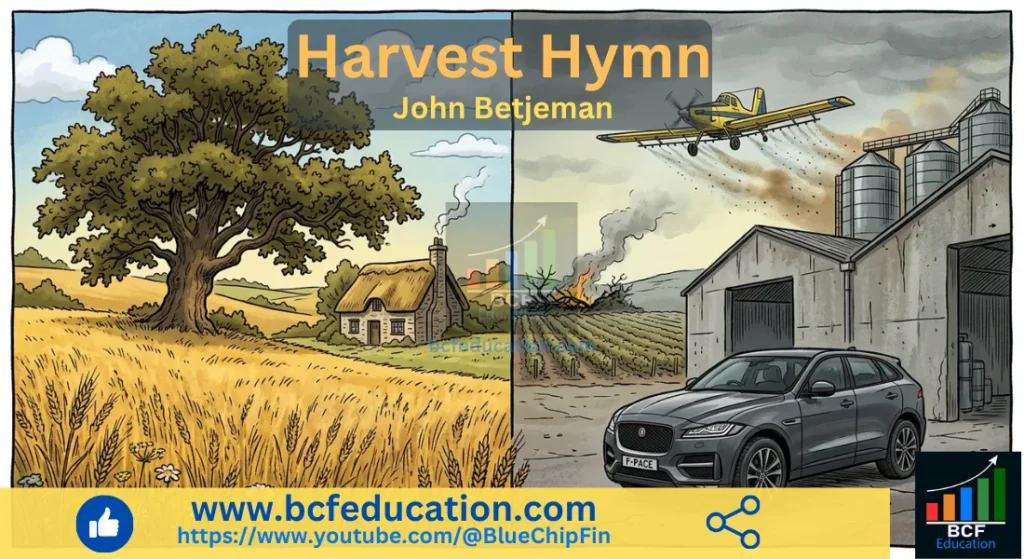
We spray the fields and scatter
The poison on the ground
So that no wicked wild flowers
Upon our farm be found.
We like whatever helps us
To line our purse with pence;
The twenty-four-hour broiler-house
And neat electric fence.
All concrete sheds around us
And Jaguars in the yard,
The telly lounge and deep-freeze
Are ours from working hard.
We fire the fields for harvest,
The hedges swell the flame,
The oak trees and the cottages
From which our fathers came.
We give no compensation,
The earth is ours today,
And if we lose on arable,
The bungalows will pay.
All concrete sheds around us
And Jaguars in the yard
The telly lounge and deep freeze
Are ours from working hard.
(i) Introduction of the Poet
Sir John Betjeman (1906–1984) was an English poet, writer, and broadcaster who served as Poet Laureate of Britain from 1972 until his death. Born in London to a middle-class family, he was educated at Marlborough College and Magdalen College, Oxford. Betjeman became widely loved for his accessible, witty, and often nostalgic verse, which used traditional rhyme and metre at a time when most poets favoured free verse.
His poetry frequently expressed affection for the England of the past — its old buildings, churches, and countryside — while gently (and sometimes sharply) satirising the ugliness of modern commercial “progress,” suburban sprawl, and materialism.
He was also a great authority on English architecture and played an important role in preserving historic buildings, including London’s St Pancras railway station. “Harvest Hymn” is typical of this satirical side of his work, mocking the greed and environmental destruction caused by modern industrial farming, in the ironic style of a traditional hymn.
(ii) Line-by-Line Paraphrasing
Stanza 1
- The farmers spray their fields with chemicals, scattering poison (pesticides/herbicides) over the land.
- They do this so that not a single “wicked” wildflower — that is, any weed or wild plant that is not commercially useful — is allowed to grow on their farm.
- (The word “wicked” is used ironically: harmless wildflowers are spoken of as if they were evil, mocking the farmers’ single-minded attitude toward nature.)
Stanza 2
- The farmers approve of and adopt anything that increases their profit — that helps them fill their pockets with money.
- Examples given are the “twenty-four-hour broiler-house” — a factory-style shed where chickens are reared non-stop under artificial conditions purely for quick profit — and a “neat electric fence” used to control livestock efficiently and cheaply.
Stanza 3 (Refrain)
- The farmers are surrounded by concrete sheds (modern factory-farm buildings) and expensive Jaguar cars parked in their yards.
- They also boast of a television lounge and a deep-freezer at home.
- They claim, self-righteously, that all these luxuries are theirs because they have “worked hard” for them — though the poem’s irony suggests this wealth actually comes at the cost of nature and tradition.
Stanza 4
- At harvest time, the farmers set fire to the stubble left in the fields (a real farming practice called “stubble burning”).
- The fire spreads and grows as it catches the hedges surrounding the fields.
- Even the old oak trees and the humble cottages — where earlier generations (their own fathers/ancestors) once lived — get consumed in the flames, symbolising the destruction of rural heritage and tradition for the sake of modern efficiency.
Stanza 5
- The farmers pay no compensation to anyone for the environmental damage or loss caused by their actions.
- They believe the land belongs entirely to them to do with as they please, “today” — with no thought for the future or for others.
- They add that even if they fail to make a profit from growing crops (arable farming), they can always sell the land for building bungalows (housing developments), which will bring them money instead — showing that profit matters more to them than the land itself.
Stanza 6 (Refrain Repeated)
- The poem ends by repeating the same boastful refrain about concrete sheds, Jaguars, the telly lounge, and the deep-freeze — reinforcing, through repetition, the farmers’ unchanged pride in their material gains.
(iii) Meaning of Difficult Words
| Word/Phrase | Meaning |
| Spray / scatter | To spread a substance (here, chemicals) widely over an area |
| Poison | Harmful chemical substance — here, pesticides/herbicides/weed-killers |
| Wicked | Evil, sinful (used ironically here for harmless wildflowers) |
| Line our purse with pence | To make money/profit; to fill one’s pocket with cash |
| Broiler-house | A shed where chickens are reared intensively for meat production |
| Electric fence | A fence carrying an electric current, used to control or contain animals |
| Concrete sheds | Modern, industrial farm buildings made of concrete |
| Jaguar | A brand of expensive, luxury British motor car |
| Telly lounge | A living room with a television set (British colloquial term) |
| Deep-freeze | A large freezer used to store food for long periods |
| Fire the fields | To deliberately burn crop stubble after harvest |
| Hedges swell the flame | The hedgerows catch fire and make the flames grow bigger |
| Compensation | Payment made to make up for loss or damage |
| Arable | Land used for growing crops |
| Bungalows | Small, single-storey houses (here, symbolising housing development on farmland) |
(iv) Figure of Speech
1. Irony / Satire — The poem is written throughout in an ironic, mocking tone. It is titled a “hymn” (a song of praise, traditionally to God for a good harvest) but is really a sharp satire on the greed, materialism, and environmental destruction of modern intensive farming. The farmers “praise” their own selfishness as if it were a virtue.
2. Allusion — The poem’s form and refrain deliberately echo the well-known traditional harvest hymn “We Plough the Fields and Scatter,” turning a song of gratitude to God into an ironic celebration of greed and profit.
3. Personification — “wicked wild flowers” gives human moral qualities (wickedness) to flowers, mocking the farmers’ extreme attitude toward nature.
4. Refrain — The third stanza (“All concrete sheds around us…”) is repeated word-for-word as the final stanza, imitating the chorus of a hymn while ironically celebrating materialism instead of faith.
5. Symbolism — “Jaguars,” “telly lounge,” and “deep-freeze” symbolise modern material wealth and consumerism; “oak trees and cottages” symbolise old rural heritage, tradition, and natural beauty that are being destroyed.
6. Contrast — The poem contrasts old rural values (the fathers’ cottages, oak trees, natural wildflowers) with modern greed (concrete, cars, chemicals, profit), highlighting what is being lost.
7. Metaphor — “line our purse with pence” is a metaphor for making money/profit.
8. Alliteration — e.g. “wicked wild,” “fields and,” “fire the fields” — repeated consonant sounds add rhythm and emphasis.
(v) Rhyming Scheme
Each stanza of “Harvest Hymn” is a quatrain (four lines) following an ABCB rhyme scheme — the second and fourth lines of each stanza rhyme, while the first and third lines generally do not.
| Stanza | Rhyme Pattern | Rhyming Words |
| 1 | ABCB | ground / found |
| 2 | ABCB | pence / fence |
| 3 (refrain) | ABCB | yard / hard |
| 4 | ABCB | flame / came |
| 5 | ABCB | today / pay |
| 6 (refrain repeated) | ABCB | yard / hard |
This simple, regular ABCB rhyme scheme, along with the short, sing-song lines, deliberately imitates the structure of a traditional church hymn — making the poem’s satire more biting, since a form usually used for devotion and gratitude is used here to mock greed and destruction.
(vi) Theme of the Poem
The central theme of “Harvest Hymn” is a satirical critique of modern industrial farming and the materialism and greed it promotes at the cost of nature, tradition, and rural heritage.
Betjeman exposes how the pursuit of profit — through chemical pesticides, factory farming, and land exploitation — destroys wildflowers, hedgerows, ancient oak trees, and the humble cottages of earlier generations. The poem also comments more broadly on post-war British society’s shift from respect for nature and tradition to a culture of consumerism, symbolised by luxury cars, televisions, and deep-freezers.
(vii) Central Idea of the Poem
Using the ironic form of a hymn (a song that traditionally gives thanks to God for the harvest), Betjeman lets modern farmers unknowingly reveal their own greed and lack of conscience.
Instead of thanking God, they “praise” their own success — spraying poison to kill wildflowers, keeping birds in cramped broiler-houses, burning fields (and along with them, old oak trees and cottages), and refusing to pay compensation for the damage they cause.
Their pride in concrete sheds, Jaguar cars, television lounges, and deep-freezers — repeated as a refrain — shows how material wealth has replaced older values of respect for the land and for the generations who came before. The poem’s central idea is thus a warning about how blind pursuit of profit is destroying both the natural environment and the rural heritage of England.
(viii) Comprehension Questions
1. Why do the farmers spray poison on their fields?
They spray poison (pesticides/weed-killer) on their fields so that no wildflowers — which they dismissively call “wicked” — are able to grow on their farmland, since these plants are not commercially useful to them.
2. What does the phrase “line our purse with pence” mean, and what does it tell us about the farmers’ priorities?
The phrase means “to make money/profit.” It shows that the farmers’ main priority is financial gain, and they are willing to adopt any method — however harmful to nature — that increases their income.
3. What is a “broiler-house,” and what does its mention suggest about modern farming methods?
A broiler-house is a shed where chickens are reared intensively, around the clock, purely for fast meat production. Its mention suggests that modern farming has become industrial and mechanical, treating animals as products rather than living creatures, all for greater profit.
4. List the material possessions the farmers are proud of. What do these possessions symbolize?
The farmers are proud of their concrete sheds, Jaguar cars, television lounge, and deep-freeze. These possessions symbolize modern material wealth, consumerism, and the farmers’ self-satisfied belief that such luxuries prove they have “worked hard” and succeeded.
5. What happens to the oak trees and cottages in the poem, and what do they represent?
The oak trees and cottages are burned along with the fields and hedges during the harvest-time field-firing. They represent the old rural heritage and tradition — including the farmers’ own ancestors (“our fathers”) — which is carelessly destroyed in the pursuit of modern efficiency and profit.
6. What do the farmers do if they “lose on arable,” and what does this reveal about their attitude to the land?
If they do not make enough profit from growing crops, the farmers plan to sell the land for building bungalows instead. This reveals that they see the land purely as a source of income, with no real attachment or respect for it as a natural or ancestral resource.
7. Why is the poem called a “hymn,” and why is this title ironic?
A hymn is traditionally a song of praise and gratitude, especially to God — and “harvest hymns” are usually sung in church to give thanks for a good harvest. The title is ironic because, instead of expressing gratitude to God or respect for nature, the poem “praises” greed, chemical farming, and material wealth — turning a form of worship into a satire on human selfishness.