The Sea by James Reeves, Study Notes, Summary, Central Idea, Theme, and Figure of Speech. “The sea is a hungry dog, giant and grey…” Explore James Reeves’ vivid poem comparing the restless sea to a dog — full analysis inside.
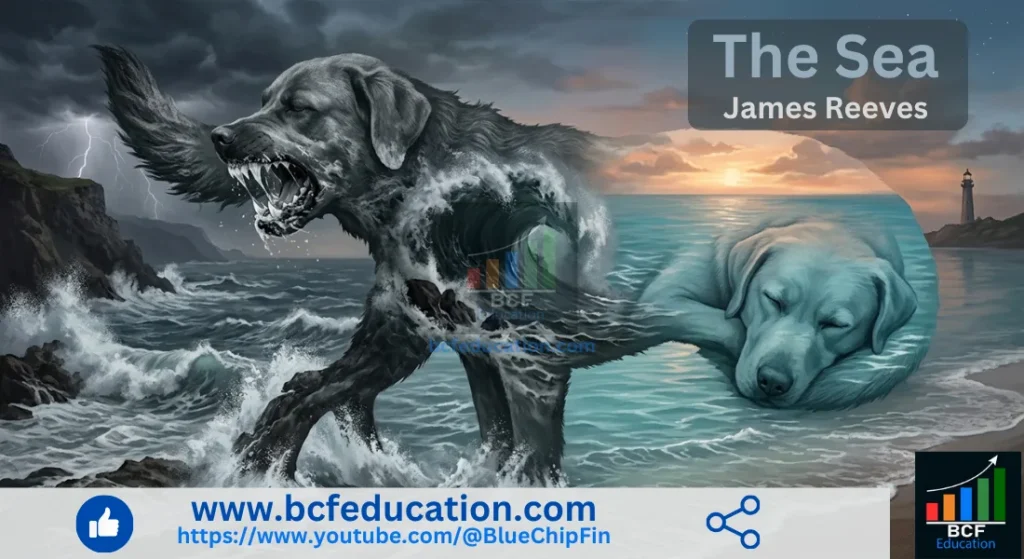
In “The Sea,” James Reeves brings the ocean to life through a striking extended metaphor, portraying it as a giant grey dog that hungrily gnaws at pebbles, howls during storms, and sleeps peacefully on calm days. Through simple, rhythmic language and vivid imagery, the poem captures nature’s unpredictable, ever-changing moods — making it a favorite for young readers and poetry students alike. This guide breaks down the poem’s meaning, structure, and literary devices in detail. This poem is in the syllabus of HSSC II FBISE. You may also visit the English HSSC II Study Notes.
Table of Contents
The Sea by James Reeves, Study Notes, Summary, Central Idea, Theme, and Figure of Speech
Full Poem
The sea is a hungry dog,
Giant and grey.
He rolls on the beach all day.
With his clashing teeth and shaggy jaws
Hour upon hour he gnaws
The rumbling, tumbling stones,
And ‘Bones, bones, bones, bones!’
The giant sea-dog moans,
Licking his greasy paws.
And when the night wind roars
And the moon rocks in the stormy cloud,
He bounds to his feet and snuffs and sniffs,
Shaking his wet sides over the cliffs,
And howls and hollos long and loud.
But on quiet days in May or June,
When even the grasses on the dune
Play no more their reedy tune,
With his head between his paws
He lies on the sandy shores,
So quiet, so quiet, he scarcely snores.
About the Poet
James Reeves (1909–1978), born John Morris Reeves near London, was a British poet, playwright, literary critic, and anthologist, widely celebrated for his contribution to children’s literature. He studied English at Jesus College, Cambridge, and began his career as a schoolteacher before turning to full-time writing and editing after failing eyesight forced his retirement.
Reeves wrote extensively for both adults and children, but he is best remembered for his children’s poetry, most notably collected in “The Wandering Moon and Other Poems” (1973) and “Complete Poems for Children” (1973). His verse for young readers is known for its simple, musical language, playful imagery, and imaginative use of personification and sound — qualities clearly visible in “The Sea,” where the ocean is brought to life as a great, moody dog. Besides his own poetry, Reeves was also a noted editor of anthologies and of the works of poets such as John Donne and Gerard Manley Hopkins.
(i) Line-by-Line Paraphrasing
Stanza 1
- The sea is compared to a hungry dog — enormous in size and grey in colour, like a big grey dog.
- All day long the sea rolls back and forth over the beach, just as a dog rolls about playfully.
- The crashing waves are like a dog’s snapping teeth and untidy, hairy jaws.
- For hour after hour, the sea keeps chewing at the pebbles on the shore, the way a dog gnaws a bone.
- The stones get tossed and tumbled about noisily by the waves.
- The sea seems to growl “Bones, bones, bones, bones!” — as if demanding more bones to chew, imitating the sound of the waves dragging stones.
- The huge sea-dog makes a low, moaning sound.
- It licks its foamy, wet (greasy-looking) paws — the froth and foam along the shoreline is compared to a dog licking its paws after eating.
Stanza 2
- At night, when the wind blows loudly and fiercely,
- and the moon appears to sway as it is seen through fast-moving stormy clouds,
- the sea suddenly springs up energetically (like a dog jumping to its feet), sniffing about.
- It shakes its wet, foamy sides against the cliffs, just as a wet dog shakes water off its body.
- It howls and barks loudly and continuously — describing the roar of the sea during a storm.
Stanza 3
- But on calm, peaceful days in the months of May or June,
- when even the reeds/grasses on the sand dunes are still and make no rustling sound,
- with its head resting between its paws (like a sleeping dog),
- the sea lies quietly along the sandy shore,
- and is so calm and still that it barely makes any sound at all (compared to a dog’s soft snoring).
(ii) Meaning of Difficult Words
| Word | Meaning |
| Hungry | Wanting food eagerly; here, wanting to devour/chew |
| Giant | Extremely large in size |
| Clashing | Striking noisily together |
| Shaggy | Rough, hairy, untidy-looking |
| Gnaws | Bites or chews persistently |
| Rumbling | Making a deep, continuous, heavy sound |
| Tumbling | Rolling over and over |
| Moans | Makes a low, sad or painful sound |
| Greasy | Oily or slippery (here, referring to wet, foamy paws) |
| Bounds | Jumps or leaps energetically |
| Snuffs | Sniffs loudly through the nose |
| Hollos | Shouts or calls out loudly (also spelled “hollers”) |
| Dune | A mound or ridge of sand formed by wind, usually near a shore |
| Reedy | Thin, high-pitched sound, like that made by reeds/grass in the wind |
| Scarcely | Hardly; barely |
(iii) Figures of Speech
1. Extended Metaphor / Personification — The entire poem compares the sea to a dog throughout (not just once), making it an extended metaphor. The sea is given human/animal qualities — rolling, gnawing, moaning, licking paws, bounding, snuffing, howling, sleeping — this is personification.
- “The sea is a hungry dog” — direct metaphor.
2. Onomatopoeia — Words that imitate natural sounds:
- “clashing”, “gnaws”, “rumbling, tumbling”, “moans”, “roars”, “snuffs and sniffs”, “howls and hollos”, “snores”
3. Alliteration — Repetition of the same consonant sound at the start of nearby words:
- “Giant and grey” (g sound)
- “rumbling, tumbling”
- “snuffs and sniffs”
- “So quiet, so quiet”
4. Repetition — Used for emphasis and rhythm:
- “Bones, bones, bones, bones!”
- “So quiet, so quiet”
5. Imagery — Vivid visual and auditory imagery is used throughout to help the reader “see” and “hear” the sea (e.g., waves as teeth, foam as licked paws, storm as a barking dog, calm sea as a sleeping dog).
6. Contrast — Between the wild, hungry sea of stanzas 1–2 and the calm, sleepy sea of stanza 3.
(iv) Rhyming Scheme
The poem does not follow one single strict rhyme scheme throughout — it changes slightly stanza to stanza, but each stanza has clear rhyming pairs/clusters.
Stanza 1 (9 lines)
- Line 1: dog
- Line 2: grey
- Line 3: day — rhymes with grey
- Line 4: jaws
- Line 5: gnaws — rhymes with jaws
- Line 6: stones
- Line 7: bones — rhymes with stones
- Line 8: moans — rhymes with stones/bones
- Line 9: paws — rhymes with jaws/gnaws
Stanza 2 (5 lines)
roars / cloud / sniffs / cliffs / loud — “roars” rhymes with “loud”; “sniffs” rhymes with “cliffs”; “cloud” stands a little apart (near rhyme with loud).
Stanza 3 (6 lines)
June / dune / tune rhyme together; paws / shores rhyme together; snores echoes the paws/shores group loosely.
Overall pattern: The poem uses irregular / loose rhyme with rhyming couplets and triplets clustered within each stanza rather than one fixed pattern (ABAB, etc.) across the whole poem. This loose, flowing rhyme mimics the unpredictable rolling and crashing of waves.
Theme of the Poem
The central theme of “The Sea” is the ever-changing, dual nature of the sea — its power to be both fierce and gentle. Through the extended comparison to a dog, James Reeves explores how a single force of nature can display completely opposite moods: wild, hungry, and destructive at one time, and calm, peaceful, and harmless at another. The poem celebrates the unpredictability and living energy of nature, encouraging readers to see the sea not as a lifeless body of water but as a dynamic, almost living being with its own moods and personality.
Central Idea
The poem personifies the sea as a huge, grey dog to bring out its changing moods. During the day and especially at night in stormy weather, the sea behaves like a hungry, restless dog — gnawing at the stones on the shore, growling, shaking itself against the cliffs, and howling loudly. However, on calm days in May or June, the same sea turns gentle and quiet, lying still on the shore like a tired dog sleeping peacefully with its head on its paws. Through this simple yet vivid comparison, the poet captures the two contrasting faces of the sea — its raging, powerful side and its calm, restful side — reminding readers of nature’s constantly shifting and unpredictable character.
(v) Answers to Comprehension Questions
1. “Giant and grey.” What two qualities of the sea is the poet emphasizing?
The poet is emphasizing the enormous size (“giant”) and the grey colour of the sea, just like a huge grey dog.
2. Write down some common qualities of the sea and a dog.
- Both are large and powerful.
- Both make a lot of noise (the sea roars/rumbles; a dog barks/growls).
- Both “gnaw” or wear away at things (the sea wears down stones; a dog gnaws bones).
- Both can be wild and energetic (during a storm) or calm and quiet (while resting/sleeping).
- Both shake themselves when wet.
- Both like to roll about playfully.
3. ‘Shaking his wet sides over the cliffs.’ What is the sea doing?
The poet describes the waves crashing against and spraying water up the cliffs, just like a wet dog shaking the water off its body/fur.
4. ‘And howls and hollos long and loud.’ What aspect of the sea is the poet emphasizing?
The poet is emphasizing the loud, wild, and fierce roaring sound of the sea during a storm at night, comparing it to a dog howling loudly.
5. Identify the time when the sea is calm and quiet.
The sea is calm and quiet on quiet days in May or June (spring/summer), as described in the third stanza.
6. State the feelings of the dog (sea) in the third verse.
In the third stanza, the sea-dog appears peaceful, relaxed, and sleepy — calm and gentle, resting quietly with its head between its paws, scarcely making a sound, in complete contrast to its wild, hungry, and noisy behaviour earlier in the poem.
7. Describe the picture of the sea as portrayed in the poem.
The poem paints the sea as a huge, grey dog with two very different moods. In the day, it hungrily gnaws at the stones on the beach, growling and moaning like a dog chewing bones. At night, especially during storms, it becomes fierce and wild — leaping up, shaking itself against the cliffs, and howling loudly under a stormy, moving moon. But on calm days in late spring/early summer, the same sea becomes gentle and silent, lying peacefully on the shore like a sleeping dog, barely making any sound. Overall, the sea is shown as a living, changeable creature with moods just like a dog.
8. Compare the changes in the state of the sea when it is wild and when it is quiet.
| Wild Sea (Stanzas 1–2) | Quiet Sea (Stanza 3) |
| Hungry, restless, active all day | Calm, resting, still |
| Loud — clashing, gnawing, moaning, howling | Almost silent — “scarcely snores” |
| Rough waves crashing on stones and cliffs | Gentle waves, no motion in the grass/dunes either |
| Compared to a dog chewing bones and barking/howling | Compared to a dog sleeping peacefully with head on paws |
| Happens especially at night/during storms | Happens on quiet days in May or June |
The poem thus shows the sea’s two contrasting moods — fierce and hungry versus peaceful and sleepy — through the single extended image of a dog.