
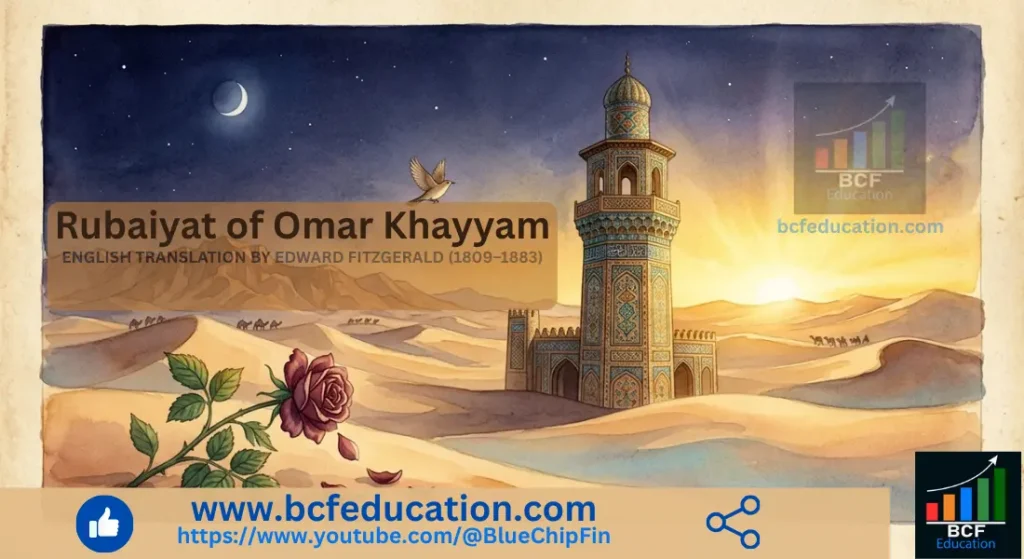
Rubaiyat of Omar Khayyam: Summary, Paraphrase & Analysis (Stanza-Wise). Explore the timeless wisdom of the Rubaiyat of Omar Khayyam in Edward FitzGerald’s classic translation. This stanza-wise guide breaks down difficult words, figures of speech, central ideas, and key themes — perfect for Federal Board students and poetry lovers seeking simple, clear explanations. Please be in touch with bcfeducation.com for other useful study resources.
Table of Contents
Rubaiyat of Omar Khayyam: Summary, Paraphrase & Analysis (Stanza-Wise)
Stanza 1
Awake for morning in the Bowl of Night
Has flung the Stone that puts the Stars to Flight:
And Lo! the Hunter of the East has caught;
The Sultan’s Turret in a Noose of Light.
Paraphrase (Meaning in Simple Words)
Wake up! Night has ended. The night sky (pictured here as a great bowl) has thrown a stone — the rising sun — which has driven all the stars away and made them disappear. Look! The sun, rising in the East like a skilful hunter, has already thrown its rope of light around the tall tower of the Sultan’s palace, catching it in a net of golden sunshine. In short: a new day has begun, and the poet is calling on us to wake up and notice it.
Meanings of Difficult Words
| Word / Phrase | Meaning |
| Bowl of Night | The night sky, imagined as an upside-down bowl covering the earth. |
| Stone that puts the Stars to Flight | The rising sun, whose light makes the stars vanish from view. |
| Lo! | An old word meaning ‘Look!’ or ‘Behold!’ — used to draw attention. |
| Hunter of the East | The rising sun, compared to a hunter who traps his prey. |
| Sultan’s Turret | The tower or minaret of a king’s (Sultan’s) palace. |
| Noose of Light | A rope-like beam of sunlight, as if the sun has lassoed the tower. |
Figures of Speech
- Metaphor — the sky is called a ‘Bowl of Night’, and the sun is called a ‘Stone’ and a ‘Hunter’.
- Personification — morning is shown as a living being that ‘flings’ a stone.
- Imagery — vivid visual imagery of sunrise, light, and the palace tower.
- Alliteration — repetition of similar sounds, e.g. ‘Stone’ and ‘Stars’.
Central Idea
The stanza describes the beauty and freshness of sunrise and is really an invitation to wake up and make the most of life, since a new day — like life itself — does not stay long.
Stanza 2
The Worldly Hope men set their Hearts upon
Turns Ashes – or it prospers; and anon,
Like snow upon the Desert’s dusty Face
Lighting a little Hour or two – is gone.
Paraphrase (Meaning in Simple Words)
People place all their hopes and ambitions on worldly things — wealth, fame, power. Sometimes these hopes come to nothing and turn to ashes; sometimes they succeed for a while. But either way, success does not last. It is like snow falling on the hot, dusty desert: it shines brightly and beautifully for just an hour or two, and then it melts away and disappears completely, as if it had never been there.
Meanings of Difficult Words
| Word / Phrase | Meaning |
| Worldly Hope | Ambitions and desires related to material things such as wealth, status, or success. |
| Turns Ashes | Comes to nothing; is destroyed or wasted. |
| Prospers | Succeeds or does well. |
| Anon | Soon afterwards. |
| Desert’s dusty Face | The surface of the desert. |
| Lighting a little Hour | Shining brightly for a short time. |
Figures of Speech
- Simile — worldly hope is compared to snow on a desert using ‘Like’.
- Personification — the desert is given a ‘Face’.
- Metaphor — hope turning to ‘Ashes’ represents failure and loss.
- Contrast — ‘Turns Ashes’ is contrasted with ‘it prospers’ to show two possible, but equally temporary, outcomes.
Central Idea
Worldly success and ambition, however great, are short-lived and temporary — just like snow that melts quickly in a desert. This stanza highlights the theme of the transience (impermanence) of worldly life.
Stanza 3
There was a Door to which! found no Key;
There was Veil past which I could not see:
Some little Talk awhile of Me and Thee
There seem’d—–and then no more of Thee and Me.
Paraphrase (Meaning in Simple Words)
There was a locked door (the mystery of life, death, and the universe) for which the poet could never find a key — meaning he could never solve or understand it. There was a curtain of mystery beyond which he was unable to see the truth. All that existed was a short conversation between ‘me and you’ — that is, the whole of human life and relationships — and then, suddenly, that too came to an end, and nothing was left of ‘you and me’.
Meanings of Difficult Words
| Word / Phrase | Meaning |
| Door | A symbol for the great mystery of existence, life, and death. |
| Key | A symbol for the answer or solution to that mystery. |
| Veil | A curtain or covering; here it symbolizes the unknown truth hidden from human eyes. |
| Some little Talk | A short conversation — symbolic of the brief span of human life. |
| Thee and Me | You and I — representing human beings and their relationships. |
Figures of Speech
- Symbolism — ‘Door’, ‘Key’, and ‘Veil’ all symbolize the unsolved mystery of existence.
- Metaphor — life is compared to a brief ‘talk’ that ends abruptly.
- Repetition — ‘Me and Thee’ / ‘Thee and Me’ is repeated to stress how quickly the relationship (life) ends.
- Melancholic tone — created through broken, hesitant phrasing (‘There seem’d—–‘).
Central Idea
Human beings can never fully understand the mystery of life, death, or the universe. Life itself is nothing more than a brief conversation that ends suddenly, leaving its biggest questions unanswered.
Stanza 4
The Moving finger writes; and having writ,
Move on: nor all thy Piety nor Wit
Shall lure it back to cancel half a Line,
Nor alt thy Tears wash out a Word of it.
Paraphrase (Meaning in Simple Words)
Fate is compared to a hand that writes down everything that happens in a person’s life. Once it has written something down, it moves forward and does not stop or turn back. No matter how religious (pious) or how clever (witty) a person is, they cannot call fate back to erase or change even half a line of what has already been written. Similarly, no amount of crying or regret can wash away or undo even a single word of one’s destiny.
Meanings of Difficult Words
| Word / Phrase | Meaning |
| Moving Finger | A symbol for Fate or Destiny, imagined as a hand writing the story of one’s life. |
| Having writ | Having written (old form of ‘written’). |
| Piety | Deep religious devotion or goodness. |
| Wit | Intelligence or cleverness. |
| Lure it back | Bring it back; persuade it to return. |
| Cancel | Erase or undo. |
Figures of Speech
- Personification — Fate is personified as a ‘Moving Finger’ that writes.
- Metaphor — human destiny is compared to writing that cannot be erased.
- Symbolism — the written ‘Line’ and ‘Word’ symbolize the events of a person’s fixed destiny.
- Allusion — the image recalls the biblical ‘handwriting on the wall’ from the Book of Daniel.
Central Idea
This is the most famous stanza of the poem, expressing the idea of Fatalism — that destiny is fixed and unchangeable. Neither religious devotion, nor intelligence, nor tears of regret can alter what fate has already decided.
Stanza 5
Yet Ah, that spring should vanish with the Rose!
That Youth’s sweet – scented manuscript should close
The Nightingale that in the branches sang,
Ah whence, and whither flown again, who knows!
Paraphrase (Meaning in Simple Words)
The poet sighs with sorrow that spring — the season of youth and freshness — must disappear along with the rose, the symbol of beauty. He grieves that the sweet, fragrant ‘book’ of youth must eventually close, just as every book comes to an end. The nightingale that once sang so beautifully among the branches has flown away — and no one truly knows where it came from or where it has gone. This is a symbol of the soul: no one knows where life comes from before birth, or where it goes after death.
Meanings of Difficult Words
| Word / Phrase | Meaning |
| Vanish | Disappear completely. |
| Youth’s sweet-scented manuscript | A poetic way of describing youth as a beautiful, fragrant book of life. |
| Nightingale | A songbird, here used as a symbol of youth, beauty, the soul, or the joyful song of life. |
| Whence | From where. |
| Whither | To where. |
Figures of Speech
- Metaphor — youth is compared to a ‘sweet-scented manuscript’ (a book) that closes.
- Symbolism — the Nightingale symbolizes youth, beauty, and the human soul.
- Exclamation — ‘Yet Ah!’ expresses deep sorrow and regret.
- Rhetorical Question — ‘who knows!’ emphasizes the mystery of life and death, since no answer is expected.
Central Idea
This stanza mourns the passing of youth and beauty, comparing it to a rose that fades and a bird that flies away forever. It reflects on the mystery of the soul — where it comes from and where it goes — a question that remains forever unanswered.
Overall Theme of the Poem
Taken together, these stanzas of the Rubaiyat build a single, connected message about human life. The poem opens with the fresh beauty of a new morning, then moves on to show that worldly hopes, youth, and beauty are all extremely short-lived. It reflects deeply on the fact that the biggest questions of existence — where we come from, why we are here, and where we go after death — remain forever unanswered.
Finally, it presents the idea that our destiny is fixed by Fate and cannot be changed by prayers, wisdom, or tears. Because life is this brief and its mysteries cannot be solved, the poem’s underlying advice to the reader is to value and enjoy the present moment fully — a philosophy often called ‘Carpe Diem’, meaning ‘seize the day’.
Rubaiyat of Omar Khayyam Summary
The Rubaiyat of Omar Khayyam, translated into English by Edward FitzGerald, is one of the most celebrated works of world poetry. Written in short, four-line stanzas (called rubai), it captures deep philosophical reflections on life, death, fate, and the passage of time — all wrapped in rich, vivid imagery.
The selected stanzas take readers on an emotional journey: it begins with the fresh beauty of dawn, symbolizing the start of a new day and, metaphorically, life itself. From there, the poem reflects on how worldly hopes and ambitions are as fleeting as snow melting in a desert. It then turns inward, questioning the unsolvable mysteries of existence — the “door” without a key, the “veil” that cannot be lifted.
One of the most famous stanzas, “The Moving Finger writes,” expresses the idea that fate is fixed and unchangeable, no matter how much we pray, think, or grieve. The poem closes with a moving lament over the fading of youth and beauty, comparing life to a rose that withers and a nightingale whose song eventually fades into silence.
At its heart, the Rubaiyat delivers a timeless message: life is short, its deepest questions may never be answered, and because of this, we should value and live fully in the present moment — a philosophy widely known as Carpe Diem (“seize the day”).
Poetry-Related Short Questions and Answers
Q1. Who wrote the Rubaiyat of Omar Khayyam, and who translated it into English?
The Rubaiyat was originally written in Persian by the poet and mathematician Omar Khayyam. It was translated into English by Edward FitzGerald (1809–1883).
Q2. What does the word ‘Rubaiyat’ mean?
‘Rubaiyat’ is the plural of ‘Rubai’, a Persian word meaning a four-lined verse or quatrain. So the Rubaiyat is simply a collection of four-line stanzas.
Q3. What does the “Bowl of Night” symbolize in the first stanza, and how does the morning affect it?
In the first stanza, the ‘Bowl of Night’ is a profound metaphor symbolizing the dark, dome-like, inverted structure of the night sky that covers the earth. When morning arrives, it is described as flinging a ‘stone’ of light. This symbolic stone represents the sudden, powerful emergence of dawn, which drives away the stars (putting them ‘to flight’) and replaces darkness with brilliant morning light.
Q4: Explain the metaphors of the “Hunter of the East” and the “Noose of Light”.
In Stanza 1, the poet employs brilliant imagery through two connected metaphors:
1. ‘Hunter of the East’ refers to the rising sun, which originates in the East. It is personified as an active hunter seeking its prey.
2. ‘Noose of Light’ represents the first golden rays of dawn. Just as a hunter casts a lasso (noose) to capture his target, the rising sun casts its bright, circular rays to envelop and capture the highest peaks of the world, specifically the Sultan’s palace towers (turret).
Q5: What is the significance of comparing worldly hope to “snow upon the Desert’s dusty Face” in Stanza 2?
This comparison uses a powerful simile to highlight the ultimate transience and impermanence of human ambitions. The ‘Desert’s dusty face’ represents the harsh, dry, and indifferent nature of the physical world. ‘Snow’ is cold, delicate, and completely incompatible with a hot desert. When snow falls on hot desert sand, it melts almost instantly. Similarly, the material desires and achievements that people dedicate their lives to (‘Worldly Hope’) may appear beautiful or successful for a brief moment (‘a little hour or two’), but they are destined to vanish rapidly without leaving a trace.
Q6: According to the poet, what are the two potential outcomes of “Worldly Hope”, and what is their common end?
According to Stanza 2, the worldly hopes and material ambitions that human beings set their hearts upon have two potential immediate outcomes: they may either fail and ‘turn ashes’ (symbolizing disappointment and ruin) or succeed and ‘prosper’. However, the poet stresses that their ultimate end is exactly the same—both outcomes are highly temporary and are bound to disappear (‘is gone’) shortly, like melting snow on desert sand. Therefore, success and failure are equally fleeting in the grand scheme of time.
Q7: What do the “Door” and the “Veil” represent in the third stanza, and what philosophical limitation do they highlight?
In Stanza 3, the ‘Door’ and the ‘Veil’ are metaphors representing the absolute limits of human understanding, philosophy, and intellect:
1. The ‘Door’ (to which the poet found no key) represents the mysterious gateway to ultimate knowledge, the purpose of existence, and the secrets of the afterlife.
2. The ‘Veil’ (past which the poet could not see) represents the barrier dividing human consciousness from spiritual or ultimate reality.
Together, they highlight the philosophical limitation that despite all intellectual efforts, humans cannot solve the ultimate mysteries of life, death, and what lies beyond.
Q8: Explain the meaning of the lines: “Some little Talk awhile of Me and Thee / There seem’d—and then no more of Thee and Me.”
These lines reflect on the temporary nature of individual human existence and identity. The phrase ‘Me and Thee’ represents our individual egos, personal relationships, and distinct earthly identities. The poet suggests that during our brief lifetime, there seems to be a lot of noise, discussion, and focus on our personal identities (‘some little talk awhile’). However, once death arrives, this illusion of individual existence is completely shattered, and we dissolve back into the universe, leaving ‘no more of Thee and Me’—representing complete non-existence and the erasure of individual identity.
Q9: What is the symbolic meaning of “The Moving Finger” in Stanza 4, and what is its primary characteristic?
In Stanza 4, ‘The Moving Finger’ is a powerful metaphor for Time, Fate, or Destiny (the Divine Will). It is personified as a silent scribe that is continuously writing the record of human history and individual lives. The primary and most striking characteristic of this force is its absolute irreversibility and ruthlessness. Once it writes an action or event, it moves forward immediately; it cannot be paused, reversed, or persuaded to change what has already occurred.
Q10: Can human tears or piety alter the course of destiny? Support your answer with reference to Stanza 4.
No, according to the poet, human actions and emotions are completely powerless against the decrees of destiny. Stanza 4 explicitly states that neither ‘Piety’ (religious devotion and prayers) nor ‘Wit’ (supreme human intelligence and cleverness) can tempt or persuade (‘lure’) fate to go back and erase even half a line of what is written. Furthermore, even ‘all thy Tears’—representing deepest grief, repentance, and sorrow—are completely unable to wash away or change a single word of the written past. The past is final and unchangeable.
Q11: What does the poet lament in the final stanza? What do “Spring” and the “Rose” symbolize?
In Stanza 5, the poet expresses deep sorrow and nostalgic grief (pathos) over the inevitable passing of youth and beauty. He laments that the beautiful season of ‘Spring’ must disappear and that ‘Youth’s sweet-scented manuscript’ (the precious book of young life) must eventually be closed forever. In this context, ‘Spring’ and ‘the Rose’ are universal symbols of youth, physical beauty, vigor, and the joyful prime of life, all of which are fleeting and destined to decay.
Q11: What is the significance of the “Nightingale” in the final stanza, and what mystery does its departure highlight?
The ‘Nightingale’ is a traditional literary symbol of joy, artistic beauty, music, and the vibrant spirit of youth. In Stanza 5, the nightingale’s song represents the happy, carefree moments of life. Its sudden departure from the branches highlights the profound mystery of life and death. The poet asks a rhetorical question—’Ah whence, and whither flown again, who knows!’—which emphasizes that no human being truly knows where the soul or the joyful moments of life come from (whence) and where they vanish to (whither) after they are gone. It underscores the ultimate mystery of mortal existence.
Rhyme Scheme: AABA (Ruba’i Form)
The Rubaiyat follows the traditional Persian ruba’i quatrain structure, where lines 1, 2, and 4 rhyme with each other, while line 3 stands apart, unrhymed. This distinctive pattern is called the AABA rhyme scheme.
Stanza-Wise Breakdown
Stanza 1 — AABA
- Night (A)
- Flight (A)
- caught (B — unrhymed)
- Light (A)
Stanza 2 — AABA
- upon (A)
- anon (A)
- Face (B — unrhymed)
- gone (A)
Stanza 3 — AABA (with subtle internal echo)
- Key (A)
- see (A)
- Thee (A/B — slant rhyme)
- Me (A)
Stanza 4 — AABA
- writ (A)
- Wit (A)
- Line (B — unrhymed)
- it (A)
Stanza 5 — AABA
- Rose (A)
- close (A)
- sang (B — unrhymed)
- knows (A)
MCQs on Figures of Speech from the poem
| # | Question | A | B | C | D |
| 1 | What figure of speech is used in “the Bowl of Night has flung the Stone”? | Simile | Metaphor | Onomatopoeia | Hyperbole |
| 2 | “The Hunter of the East has caught the Sultan’s Turret in a Noose of Light” is an example of which figure of speech? | Alliteration | Personification (sun as a hunter) | Irony | Oxymoron |
| 3 | “Like snow upon the Desert’s dusty Face” uses which figure of speech? | Metaphor | Personification | Simile | Paradox |
| 4 | The phrase “Desert’s dusty Face” is an example of: | Simile | Personification | Metaphor | Alliteration |
| 5 | “There was a Door to which I found no Key” is an example of which figure of speech? | Symbolism | Simile | Hyperbole | Onomatopoeia |
| 6 | The repeated phrase “Thee and Me” / “Me and Thee” demonstrates: | Assonance | Repetition | Irony | Metaphor |
| 7 | “The Moving Finger writes” is a well-known example of: | Simile | Personification | Alliteration | Pun |
| 8 | The reference to fate writing and moving on, unable to be undone, subtly alludes to which literary device? | Foreshadowing | Allusion (Biblical handwriting on the wall) | Hyperbole | Apostrophe |
| 9 | “Youth’s sweet-scented manuscript should close” compares youth to a book — this is an example of: | Simile | Metaphor | Onomatopoeia | Irony |
| 10 | The Nightingale in the final stanza is best understood as a: | Metaphor | Simile | Symbol (of youth, beauty, and the soul) | Hyperbole |

