Title: The Road Not Taken by Robert Frost: Full Explanation, Line-by-Line Paraphrase, Literary Devices & MCQs
The Road Not Taken by Robert Frost: Full Explanation, Line-by-Line Paraphrase, Literary Devices & MCQs .“Two roads diverged in a yellow wood…” – one of the most famous poems in English literature. But do most people misunderstand it? In “The Road Not Taken,” Robert Frost writes about choices, regrets, and how we tell the story of our lives. This blog post provides a complete, easy-to-understand explanation perfect for students and teachers. You’ll find: poet introduction, poem type, summary, stanza-wise and line-by-line paraphrasing in simple English, difficult word meanings, important short and long questions with answers, central idea and themes, literary devices (figures of speech), rhyme scheme, and a table of MCQs with four options. Written in a human-friendly, non-plagiarized style for exams, assignments, or blog content. Discover why this poem is NOT just about “taking the less traveled road” – it’s much more interesting than that!
The Road Not Taken by Robert Frost: Full Explanation, Line-by-Line Paraphrase, Literary Devices & MCQs
Table of Contents
The Road Not Taken by Robert Frost (Original Text)
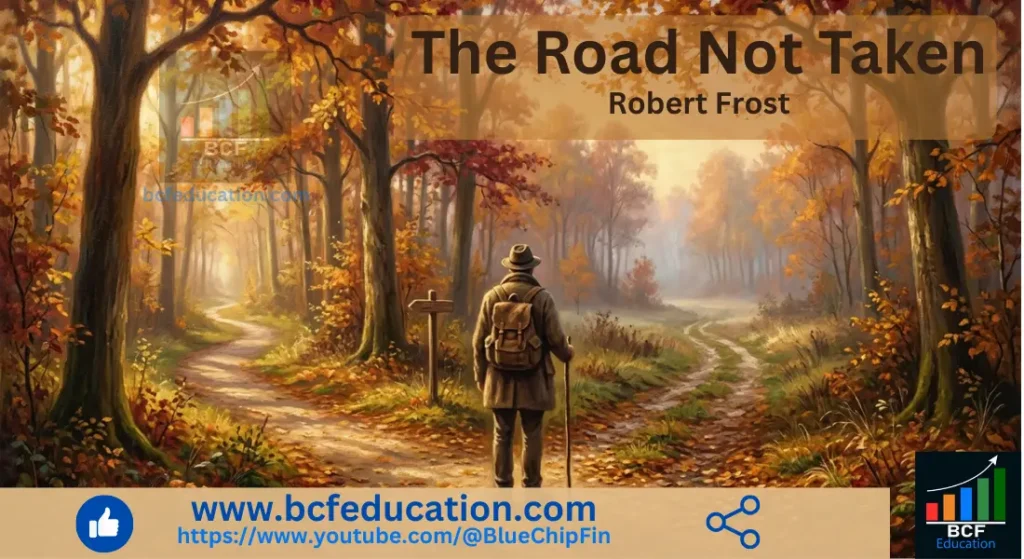
Two roads diverged in a yellow wood,
And sorry I could not travel both
And be one traveler, long I stood
And looked down one as far as I could
To where it bent in the undergrowth;
Then took the other, as just as fair,
And having perhaps the better claim,
Because it was grassy and wanted wear;
Though as for that the passing there
Had worn them really about the same,
And both that morning equally lay
In leaves no step had trodden black.
Oh, I kept the first for another day!
Yet knowing how way leads on to way,
I doubted if I should ever come back.
I shall be telling this with a sigh
Somewhere ages and ages hence:
Two roads diverged in a wood, and I—
I took the one less traveled by,
And that has made all the difference.
1. Introduction of the Poet
Robert Frost (1874–1963) was one of the greatest American poets of the 20th century. He was born in San Francisco, California, but is closely associated with New England’s rural landscapes. Frost won the Pulitzer Prize for Poetry four times – more than any other poet. His famous poems include “The Road Not Taken,” “Stopping by Woods on a Snowy Evening,” “Mending Wall,” and “Fire and Ice.” Frost’s poetry often looks simple on the surface but explores deep themes like choices, loneliness, nature, and human psychology. He is known for using everyday language and rural settings to ask big philosophical questions.
2. Type of Poem
“The Road Not Taken” is a narrative poem (it tells a short story) and a lyric poem (it expresses personal feelings). It is written in four stanzas of five lines each (quintains). The poem uses a first-person speaker who looks back on a past decision. It is often mistakenly read as a celebration of individuality, but careful readers see it as a more complex, slightly ironic meditation on choice and memory.
3. Summary of the Poem
The speaker is walking through a yellow wood in autumn. He comes to a point where two roads split in different directions. He feels sad that he cannot travel both roads because he is only one person. He stands for a long time, looking at one road as far as he can see until it bends into the bushes.
Then he takes the other road. It looks just as fair as the first one. In fact, it seems to have a better claim because it is grassy and looks less worn. But actually, both roads had been worn about the same amount by people passing.
That morning, both roads were covered in yellow leaves that no one had stepped on yet (so both were fresh). He thinks he will save the first road for another day. However, he knows that one road leads to another, and he doubts he will ever come back.
In the future, he imagines telling this story with a sigh, many years from now. He will say that two roads diverged in a wood, and he took the one less traveled by – and that has made all the difference.
4. Paraphrasing Stanza Wise
| Stanza | Paraphrase |
| Stanza 1 | Two roads split into different directions in a forest with yellow autumn leaves. I felt sad because I could not travel both roads since I am only one traveler. I stood there for a long time, looking at one road as far as I could see until it turned and disappeared into the bushes. |
| Stanza 2 | Then I took the other road. It looked just as nice and fair as the first one. Actually, it seemed even better because it was grassy and looked like fewer people had used it. But honestly, both roads had been worn about the same amount by people walking on them. |
| Stanza 3 | That morning, both roads were covered with leaves that no one had turned black by stepping on them. I told myself I would save the first road for another day. But I knew that one road leads to another road, and I doubted I would ever be able to come back to take the first road. |
| Stanza 4 | Someday, many many years from now, I will tell this story with a sigh. I will say that two roads split in a forest, and I – I took the one that fewer people had traveled on. And that decision has made all the difference in my life. |
5. Paraphrasing Line by Line
| Line(s) | Original Text | Paraphrase |
| 1 | Two roads diverged in a yellow wood | Two roads separated and went in different directions in an autumn forest with yellow leaves |
| 2 | And sorry I could not travel both | I felt sad because I could not walk on both roads |
| 3 | And be one traveler, long I stood | Since I am only one person, I stood there for a long time |
| 4 | And looked down one as far as I could | And I looked at one road as far as my eyes could see |
| 5 | To where it bent in the undergrowth | Until it turned a corner and disappeared into the bushes and small plants |
| 6 | Then took the other, as just as fair | Then I took the other road, which looked equally nice and good |
| 7 | And having perhaps the better claim | And maybe it had a stronger reason to be chosen |
| 8 | Because it was grassy and wanted wear | Because it had grass growing on it and looked like it needed to be walked on (less used) |
| 9 | Though as for that the passing there | But honestly, when it came to how many people had walked there |
| 10 | Had worn them really about the same | Both roads had been worn down about equally |
| 11 | And both that morning equally lay | And that morning, both roads were lying there equally |
| 12 | In leaves no step had trodden black | Covered with leaves that no footstep had turned black (fresh, untouched) |
| 13 | Oh, I kept the first for another day! | Oh, I decided to save the first road for some other day in the future |
| 14 | Yet knowing how way leads on to way | But knowing how one road leads to another road after that |
| 15 | I doubted if I should ever come back | I was not sure if I would ever be able to return to this spot |
| 16 | I shall be telling this with a sigh | Someday in the future, I will be telling this story with a sigh (of regret? nostalgia? reflection?) |
| 17 | Somewhere ages and ages hence | Many, many years from now, somewhere far in the future |
| 18 | Two roads diverged in a wood, and I— | Two roads split in a forest, and I – I (he pauses for emphasis) |
| 19 | I took the one less traveled by | I chose the road that fewer people had walked on |
| 20 | And that has made all the difference | And that choice has made a huge difference in how my life turned out |
6. Difficult Words and Their Meanings
| Word/Phrase | Meaning in Easy English |
| Diverged | Separated, split into different directions |
| Yellow wood | A forest in autumn when the leaves have turned yellow |
| Undergrowth | Bushes, small plants, and shrubs growing beneath the large trees |
| Just as fair | Equally nice, attractive, or good |
| Better claim | Stronger reason to be chosen |
| Wanted wear | Needed to be walked on (as if it was asking for use) |
| Passing there | People walking on that road |
| Had worn them | Had made them smooth and packed down by footsteps |
| Trodden black | Stepped on so many times that leaves turned dark/black |
| Way leads on to way | One road or path leads to another, and then another – you can’t easily go back |
| Hence | From now, in the future |
| Ages and ages hence | Many, many years from now |
| Sigh | A long, deep breath showing sadness, reflection, or nostalgia |
| Less traveled by | Walked on by fewer people |
7. Important Short Questions and Their Answers
Q1: Where does the speaker find himself at the beginning of the poem?
A: The speaker is in a “yellow wood” – a forest in autumn with yellow leaves.
Q2: Why is the speaker sorry?
A: He is sorry because he cannot travel both roads. He is only one person.
Q3: What does the speaker do after standing for a long time?
A: He looks at one road as far as he can until it bends into the undergrowth. Then he takes the other road.
Q4: Why does the speaker choose the second road?
A: Because it was grassy and “wanted wear” – it looked less used and more inviting. But he admits both roads were actually worn about the same.
Q5: What condition were both roads in that morning?
A: Both roads were covered with leaves that no footsteps had turned black yet. Both were fresh.
Q6: Does the speaker plan to come back to take the first road?
A: He says he will save the first road for another day, but he doubts he will ever come back because one road leads to another.
Q7: What does the speaker imagine saying in the future?
A: He imagines telling the story “with a sigh” that he took the road less traveled by, and that made all the difference.
Q8: Is the speaker happy or sad about his choice?
A: The poem is famously ambiguous. The “sigh” could be regret or satisfaction. He says it “made all the difference” but doesn’t say if it was good or bad.
Q9: What does the “yellow wood” symbolize?
A: It symbolizes autumn – a time of change, maturity, or even the later stage of life.
Q10: What is the main theme of the poem?
A: The main theme is choice – how we make decisions, how we remember them, and how we shape our life stories.
8. Important Long Questions and Their Answers
Q1: Many people read “The Road Not Taken” as a celebration of non-conformity (being different). Do you agree? Explain with evidence from the poem.
Answer:
This is a very interesting question. Many people believe the poem says, “Be different! Take the road less traveled!” But a careful reading shows it’s more complicated.
Evidence that it is NOT simply about non-conformity:
| Line | What it says | What it means |
| Line 6 | “Then took the other, as just as fair” | The second road was equally good, not necessarily better. |
| Line 9-10 | “Though as for that the passing there / Had worn them really about the same” | Both roads were actually worn equally. The “less traveled” idea might be an illusion or exaggeration. |
| Line 13-15 | He doubts he will ever come back | The choice is permanent, but not because one road was special. |
| Line 16 | “I shall be telling this with a sigh” | The sigh could mean regret, not pride. |
What the poem is really about:
Frost is actually making fun of how we tell stories about our lives. In reality, both roads were almost the same. But later, the speaker will claim he took the “less traveled” road to make his life sound more adventurous and meaningful. The poem is about self-deception and the way we romanticize our past choices.
Conclusion: The poem is not a simple celebration of individuality. It is a subtle, ironic look at how humans create meaning out of random choices.
Q2: Explain the significance of the “sigh” in the last stanza. What does it reveal about the speaker’s feelings?
Answer:
The “sigh” in line 16 (“I shall be telling this with a sigh”) is one of the most debated words in American poetry. Frost never tells us exactly what the sigh means. Here are the possible interpretations:
| Interpretation | Explanation |
| Sigh of regret | The speaker wishes he had taken the other road. He wonders “what if?” |
| Sigh of satisfaction | He is proud of his choice and sighs with contentment or relief. |
| Sigh of nostalgia | He looks back fondly on a younger self making an important decision. |
| Sigh of irony | He knows the roads were almost the same, but he enjoys telling the story dramatically. |
What the sigh reveals about the speaker:
- He is human – we all look back at our choices with mixed feelings.
- He is unreliable – he might be exaggerating or romanticizing the past.
- He is reflective – he thinks deeply about how small decisions change lives.
Frost intentionally left the sigh ambiguous so that every reader can project their own feelings onto it. That’s why the poem remains so popular – everyone sees their own life in it.
9. Central Idea & Theme of the Poem
Central Idea:
Life is full of choices. Sometimes two options look almost the same, but we have to pick one. Later, when we look back, we often tell a story that makes our choice seem meaningful and brave – whether it really was or not.
Main Themes:
| Theme | Explanation |
| Choice and decision-making | The poem is about a single moment of choosing between two paths. |
| Individuality vs. conformity | The speaker claims he took the “less traveled” road, suggesting he is different. |
| Memory and self-deception | We often reshape our memories to make our lives seem more dramatic. |
| Regret and nostalgia | The “sigh” suggests looking back with mixed emotions. |
| Permanence of choices | Once you choose a path, you cannot go back and try the other. |
| The road as a metaphor for life | Life is like a journey with many forks in the road. |
| Irony | The roads were almost the same, but the speaker claims one was “less traveled.” |
10. Literary Devices / Figures of Speech / Poetic Devices
| Device | Example from Poem | Explanation |
| Metaphor (extended) | The two roads | The roads represent life choices and paths in life. |
| Personification | “wanted wear” | The road is given a human desire – it “wanted” to be walked on. |
| Personification | “way leads on to way” | Paths are given the ability to lead. |
| Symbolism | Yellow wood | Symbolizes autumn, change, or middle age. |
| Symbolism | Roads | Symbolize life choices and directions. |
| Symbolism | Leaves | Symbolize untrodden opportunities. |
| Alliteration | “wanted wear” | Repetition of the ‘w’ sound. |
| Alliteration | “way leads on to way” | Repetition of the ‘w’ sound. |
| Assonance | “long I stood / And looked” | Repetition of vowel sounds (‘oo’ and ‘ou’). |
| Anaphora | “I took the one less traveled by, / And that has made all the difference” | Repetition of “I” and “and” for emphasis. |
| Caesura | “Two roads diverged in a wood, and I— / I took the one less traveled by” | A pause (dash) for dramatic effect. |
| Enjambment | Lines run into the next without punctuation | Creates a natural, conversational flow. |
| Irony | Claiming one road was “less traveled” when both were “worn really about the same” | The speaker’s memory is unreliable or exaggerated. |
| Ambiguity | The sigh | The reader doesn’t know if it’s regret, pride, or nostalgia. |
| First-person point of view | “I” throughout | Makes the poem feel personal and relatable. |
11. Rhyme Scheme for Each Stanza
This poem uses a ABAAB rhyme scheme for each stanza. (The first, third, and fourth lines rhyme; the second and fifth lines rhyme.)
| Stanza | Rhyme Scheme | Rhyming Words |
| Stanza 1 | ABAAB | wood / both / stood / could / undergrowth |
| Stanza 2 | ABAAB | fair / claim / wear / there / same |
| Stanza 3 | ABAAB | lay / day / black / way / back |
| Stanza 4 | ABAAB | sigh / hence / I / by / difference |
Note: In Stanza 4, “sigh” rhymes with “I” (sight rhyme/eye rhyme – they look like they should rhyme but don’t perfectly). “Hence” rhymes with “difference” (partial rhyme).
12. Important MCQs of the Poem (Including Figures of Speech)
| Question | A | B | C | D | Correct Answer |
| Who wrote “The Road Not Taken”? | Walt Whitman | Emily Dickinson | Robert Frost | William Wordsworth | C |
| In which season does the poem take place? | Spring | Summer | Autumn (Fall) | Winter | C |
| What color is the wood described as? | Green | Yellow | Red | Brown | B |
| Why is the speaker sorry? | He is lost | He cannot travel both roads | It is raining | He has no companion | B |
| “Two roads diverged” – “diverged” means? | Came together | Separated | Disappeared | Became muddy | B |
| What does the speaker do “long” (for a long time)? | Sings | Cries | Stood and looked | Runs away | C |
| Why does the speaker choose the second road? | It is shorter | It is grassy and “wanted wear” | Someone told him to | The first road is blocked | B |
| What does the speaker admit about both roads? | One is much longer | One is dangerous | They were worn about the same | Both lead to the same place | C |
| “Because it was grassy and wanted wear” – “wanted wear” is an example of? | Simile | Personification | Hyperbole | Metaphor | B |
| What covered both roads that morning? | Snow | Mud | Yellow leaves | Water | C |
| What does the speaker say he will do with the first road? | Forget it | Save it for another day | Curse it | Build a house on it | B |
| Why does the speaker doubt he will ever come back? | He will get lost | One road leads to another (way leads on to way) | He is moving away | The road will disappear | B |
| “I shall be telling this with a sigh” – the sigh suggests? | Happiness only | Regret or reflection (ambiguous) | Anger | Excitement | B |
| “Ages and ages hence” means? | Long ago | Many years from now | Never | Right now | B |
| What does the speaker claim he took? | The road less traveled by | The shorter road | The road to the left | The road his friend took | A |
| What does the speaker say about the outcome? | He regrets it | It was a mistake | It has made all the difference | He doesn’t care | C |
| The poem is written in which rhyme scheme? | ABAB | AABB | ABAAB | ABCB | C |
| “Two roads diverged in a yellow wood” is an example of? | Metaphor (roads = life choices) | Simile | Onomatopoeia | Oxymoron | A |
| The tone of the poem is mostly? | Angry and bitter | Joyful and excited | Reflective and slightly ironic | Confused and scared | C |
| What is the main theme of the poem? | The importance of following others | The difficulty of choices and how we remember them | The beauty of autumn | The danger of forests | B |