A Psalm of Life by Henry Wadsworth Longfellow – Full Explanation, Literary Devices, MCQs & More.Looking for a complete, easy-to-understand explanation of Henry Wadsworth Longfellow’s famous poem “A Psalm of Life”? You’ve come to the right place. This blog post covers everything a student or teacher needs: poet introduction, poem type, stanza-wise and line-by-line paraphrasing in simple English, difficult word meanings, important short and long questions with answers, central idea and themes, literary devices (figures of speech), rhyme scheme for each stanza, and even a table of MCQs with four options. Written in a human-friendly, non-plagiarized style perfect for exams, assignments, or blog content. Whether you’re in high school, college, or preparing for competitive tests, this guide makes Longfellow’s optimistic message easy to grasp. Learn how to act, leave your footprints on time, and be a hero in life’s battle.
Table of Contents
A Psalm of Life by Henry Wadsworth Longfellow – Full Explanation, Literary Devices, MCQs & More
A Psalm of Life by Henry Wadsworth Longfellow (Original Text)
Tell me not, in mournful numbers,
“Life is but an empty dream!”
For the soul is dead that slumbers,
And things are not what they seem.
Life is real! Life is earnest!
And the grave is not its goal;
“Dust thou art, to dust returnest,”
Was not spoken of the soul.
Not enjoyment, and not sorrow,
Is our destined end or way;
But to act, that each to-morrow
Finds us farther than to-day.
Art is long, and Time is fleeting,
And our hearts, though stout and brave,
Still, like muffled drums, are beating
Funeral marches to the grave.
In the world’s broad field of battle,
In the bivouac of Life,
Be not like dumb, driven cattle!
Be a hero in the strife!
Trust no Future, howe’er pleasant!
Let the dead Past bury its dead!
Act,–act in the living Present!
Heart within, and God o’erhead!
Lives of great men all remind us
We can make our lives sublime,
And, departing, leave behind us
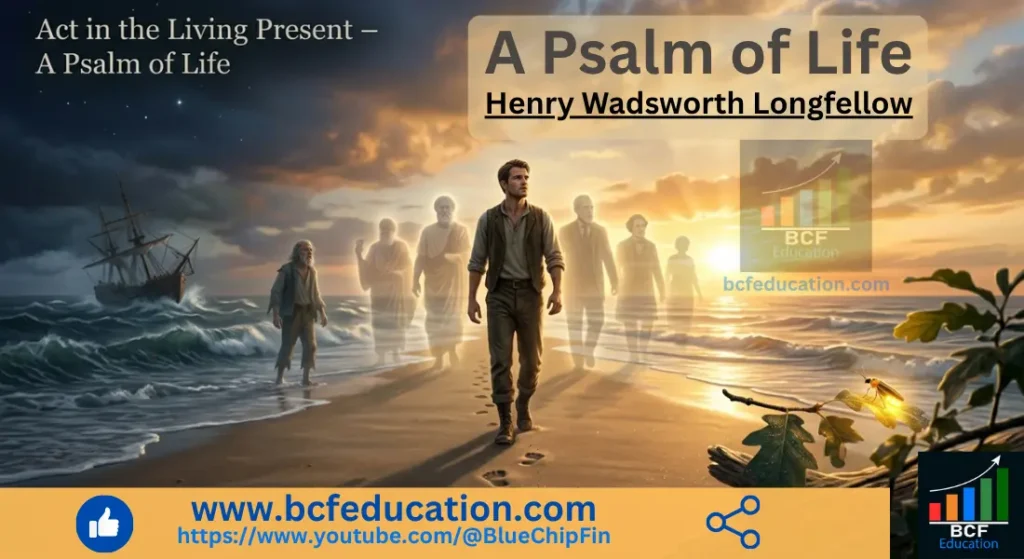
Footprints on the sands of time;
Footprints, that perhaps another,
Sailing o’er life’s solemn main,
A forlorn and shipwrecked brother,
Seeing, shall take heart again.
Let us, then, be up and doing,
With a heart for any fate;
Still achieving, still pursuing
Learn to labor and to wait.
1. Introduction of the Poet
Henry Wadsworth Longfellow (1807–1882) was one of the most famous American poets of the 19th century. He was born in Portland, Maine, and became a professor at Harvard University. Longfellow wrote poetry that was easy to understand, musical, and full of positive messages. His popular works include “The Song of Hiawatha,” “Paul Revere’s Ride,” and “Evangeline.” People loved him because he wrote about hope, hard work, and life’s deeper meanings. He suffered personal tragedies—his two wives died—but his poems often encourage readers to live bravely and purposefully.
2. Type of Poem
“A Psalm of Life” is a lyric poem (expresses personal feelings) and a hymn-like poem (the word “Psalm” means a sacred song). It is also a didactic poem because it teaches a moral lesson: live actively, not passively. It was written in 1838 and is considered a Victorian-era inspirational poem.
3. Summary of the Poem
The poet rejects the sad idea that life is an empty dream. He says life is real and serious. The goal is not death (the grave) but action. We should not live only for pleasure or sorrow; instead, we must keep moving forward every day. Even though time flies and we are all marching toward death, we must fight bravely like heroes, not like dumb cattle. Don’t worry about the future or the past—act now in the present. Great people’s lives inspire us to leave our own “footprints” on time, so that others who are struggling can take courage. Finally, let us keep working, keep chasing our goals, and learn to work hard and be patient.
4. Paraphrasing Stanza Wise
| Stanza | Paraphrase |
| 1 | Don’t tell me in sad poems that life is just an empty dream. A sleeping soul is dead, and things are not as they appear. |
| 2 | Life is real and serious. The grave is not the final goal. The Bible verse “Dust you are, to dust you return” refers to the body, not the soul. |
| 3 | Fun or sadness is not our final purpose. Our purpose is to act so that each tomorrow finds us ahead of where we are today. |
| 4 | Art takes a long time, but time passes quickly. Our brave hearts beat like muffled drums marching toward the grave. |
| 5 | Life is like a battlefield or a temporary camp. Don’t be like silent, driven cattle. Be a hero in the struggle. |
| 6 | Don’t trust the future, even if it seems nice. Let the dead past bury its dead. Act in the living present, with heart inside you and God above. |
| 7 | The lives of great people remind us that we can make our lives excellent, and after dying, leave footprints on the sand of time. |
| 8 | Those footprints may help another person who is sailing on life’s serious ocean—a lonely, shipwrecked brother who sees them and feels courage again. |
| 9 | So let’s get up and work, ready for any fate. Always achieving, always pursuing—learn to work hard and to wait patiently. |
5. Paraphrasing Line by Line
| Line(s) | Paraphrase |
| 1-2 | Don’t say to me, in sad poems, that life is an empty dream. |
| 3-4 | A person who sleeps through life has a dead soul; things are not what they seem. |
| 5-6 | Life is real; life is serious. The grave is not its final goal. |
| 7-8 | “You are dust, and you will return to dust” was not said about the soul. |
| 9-10 | Fun and sorrow are not our final purpose or path. |
| 11-12 | Our purpose is to act so that tomorrow finds us ahead of today. |
| 13-14 | Art is long, but time is short. |
| 15-16 | Our brave hearts beat like muffled drums playing funeral songs as we go to the grave. |
| 17-18 | In the world’s big battlefield, in the temporary camp of life, |
| 19-20 | Don’t be like silent, helpless cattle. Be a hero in the fight. |
| 21-22 | Don’t trust the future, no matter how nice it seems. Let the dead past bury its own dead. |
| 23-24 | Act in the living present. Keep heart inside and God above. |
| 25-26 | Great people’s lives remind us we can make our own lives excellent. |
| 27-28 | And when we leave, we can leave footprints on the sand of time. |
| 29-30 | Those footprints may help another person sailing on life’s serious ocean, |
| 31-32 | A lonely, shipwrecked brother who sees them and finds new courage. |
| 33-34 | So let’s get up and keep doing, ready for any result. |
| 35-36 | Still achieving, still chasing—learn to work hard and to wait. |
6. Difficult Words and Their Meanings
| Word/Phrase | Meaning in Easy English |
| Mournful numbers | Sad poems or verses |
| Slumbers | Sleeps (here, meaning lives without purpose) |
| Earnest | Serious, important |
| Destined end | Final purpose |
| Bivouac | Temporary camp (military term) |
| Dumb, driven cattle | Silent, helpless animals being pushed |
| Strife | Struggle, conflict |
| Sublime | Excellent, noble, great |
| Sands of time | Time passing (like sand in an hourglass) |
| Solemn main | Serious ocean (main = sea) |
| Forlorn | Sad, hopeless, abandoned |
| Take heart | Gain courage |
| Still achieving | Always accomplishing something |
7. Important Short Questions and Their Answers
Q1: Why does the poet reject “Life is but an empty dream”?
A: He says that if a person sleeps through life, their soul is dead. Life is real, not an illusion.
Q2: What is the goal of life according to Longfellow?
A: The goal is not enjoyment or sorrow, but action. Each tomorrow should find us ahead of today.
Q3: What does “muffled drums” mean?
A: It is a metaphor for our hearts beating softly but steadily as we march toward death.
Q4: What does “be not like dumb, driven cattle” teach us?
A: Don’t be passive or helpless. Be an active hero in life’s struggles.
Q5: What should we do with the past and future?
A: Let the dead past bury itself. Don’t trust the future too much. Act in the living present.
Q6: What do “footprints on the sands of time” represent?
A: The good examples and achievements we leave behind for others.
Q7: How can great people’s lives help us?
A: They remind us that we can also make our lives noble and leave a positive impact.
Q8: What is the final advice of the poem?
A: Be up and doing, achieve, pursue, learn to labor and to wait.
8. Important Long Questions and Their Answers
Q1: Explain the central message of “A Psalm of Life” in detail.
Answer:
The central message is optimistic activism. Longfellow rejects two wrong ideas: (1) that life is an empty dream, and (2) that the grave is the goal. Instead, he says life is real, earnest, and meant for action. We should not live for pleasure or sorrow alone. Every day, we must move forward. Even though time is short and death is certain, we should fight like heroes, not like cattle. Don’t be trapped by the past or the future—act now. Our lives can inspire others, just as great people inspire us. Finally, we must keep working, pursuing goals, and learning to be patient. The poem is a motivational call to live fully and leave a meaningful mark.
Q2: How does Longfellow use metaphors and imagery to convey his ideas?
Answer:
Longfellow uses strong metaphors to make his ideas visual and memorable:
“Muffled drums beating funeral marches” – life is a slow march toward death, but we still move bravely.
“World’s broad field of battle” & “bivouac of Life” – life is a temporary camp where we fight daily struggles.
“Dumb, driven cattle” – passive people who let others control them.
“Footprints on the sands of time” – our lasting legacy, like footprints that help shipwrecked sailors.
“Sailing o’er life’s solemn main” – life is a serious ocean journey.
These images make abstract ideas (purpose, legacy, courage) feel real and urgent.
9. Central Idea & Theme of the Poem
Central Idea:
Life is not an empty dream or a sad journey to the grave. It is real, serious, and meant for action. We must live purposefully, help others by our example, and keep working hard.
Main Themes:
| Theme | Explanation |
| Activism vs. Passivity | Don’t sleep through life; act. |
| Carpe Diem (Seize the day) | Live in the present, not past/future. |
| Heroism in daily life | Be a hero in ordinary struggles. |
| Legacy | Leave footprints to inspire others. |
| Mortality & hope | Death is real, but life has meaning beyond the grave. |
| Patience with effort | Learn to labor and to wait. |
10. Literary Devices / Figures of Speech / Poetic Devices
| Device | Example | Explanation |
| Metaphor | “Life is but an empty dream” | Life compared to a dream (rejected by poet). |
| Metaphor | “Muffled drums” | Hearts compared to drums. |
| Metaphor | “Footprints on the sands of time” | Deeds compared to footprints. |
| Apostrophe | “Tell me not…” | Poet directly addressing an unknown listener. |
| Alliteration | “Dust thou art, to dust returnest” | Repetition of ‘d’ and ‘t’ sounds. |
| Alliteration | “Still achieving, still pursuing” | Repetition of ‘s’ and ‘p’ sounds. |
| Anaphora | “Act,—act in the living Present!” | Repetition of “act”. |
| Personification | “Let the dead Past bury its dead” | Past is personified as something that can bury. |
| Simile | “Like muffled drums” | Hearts compared directly using “like”. |
| Contrast | “Not enjoyment, not sorrow” | Contrasting pleasure and pain. |
| Hyperbole | “Art is long, Time is fleeting” | Slight exaggeration for effect. |
11. Rhyme Scheme for Each Stanza
Each stanza follows ABAB rhyme scheme (alternating rhymes).
| Stanza | Rhyme Scheme |
| 1 | numbers/dream – slumbers/seem (ABAB) |
| 2 | earnest/goal – returnest/soul (ABAB) |
| 3 | sorrow/way – tomorrow/today (ABAB) |
| 4 | long/fleeting – beating/grave (ABAB) |
| 5 | battle/Life – cattle/strife (ABAB) |
| 6 | pleasant/dead – Present/o’erhead (ABAB) |
| 7 | us/sublime – us/time (ABAB) |
| 8 | another/main – brother/again (ABAB) |
| 9 | doing/fate – pursuing/wait (ABAB) |
*Note: In stanza 6, “pleasant” rhymes with “present” (eye rhyme/slant rhyme).
12. Important MCQs of the Poem (Including Figures of Speech)
| Question | A | B | C | D | Correct Answer |
| Who wrote “A Psalm of Life”? | Walt Whitman | Emily Dickinson | Henry Wadsworth Longfellow | Robert Frost | C |
| What is the rhyme scheme of each stanza? | AABB | ABAB | ABBA | ABCB | B |
| “Life is but an empty dream” is an example of? | Simile | Metaphor | Personification | Hyperbole | B |
| What does “muffled drums” refer to? | War drums | Our hearts beating | Funeral bands | Sleeping souls | B |
| According to the poem, what is NOT life’s goal? | Action | The grave | Helping others | Being heroic | B |
| “Be not like dumb, driven cattle” is a? | Metaphor | Simile | Apostrophe | Alliteration | A (metaphor/comparison without like) |
| What should we do with the past? | Remember it daily | Let it bury its dead | Rewrite it | Cry for it | B |
| “Footprints on the sands of time” means? | Walking on beach | Lasting legacy | Time travel | Ancient history | B |
| Which literary device is used in “Still achieving, still pursuing”? | Anaphora | Onomatopoeia | Oxymoron | Irony | A |
| The word “bivouac” means? | Battlefield | Temporary camp | Grave | Ocean | B |