
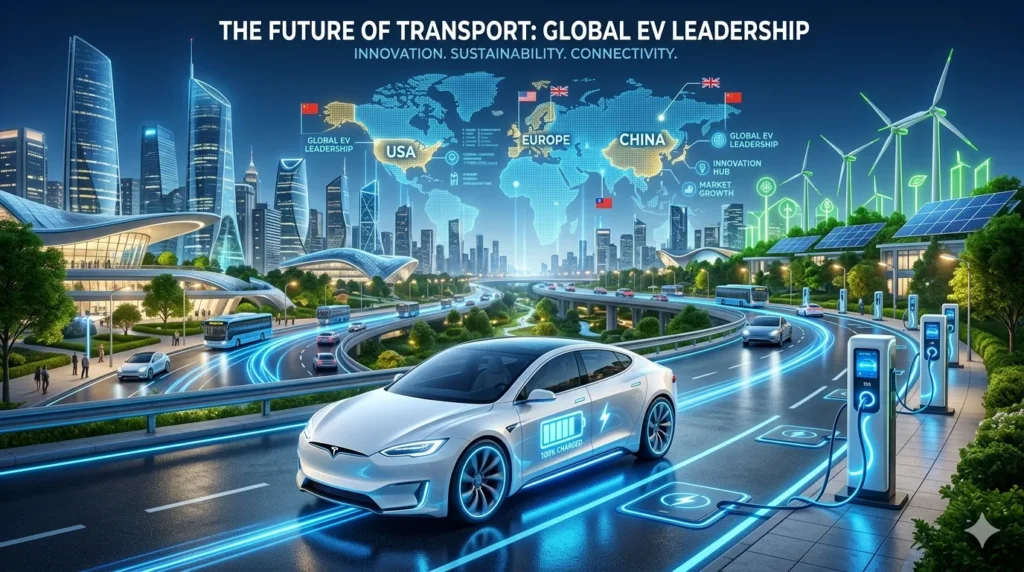
The EV Revolution in 2026: Technology, Global Investment Boom, and the Race for Supremacy
The automotive industry is experiencing a transformation unlike anything we have witnessed since Henry Ford introduced the moving assembly line. Electric vehicles are no longer a niche product for early adopters—they have firmly entered the mainstream, reshaping how we think about transportation, energy consumption, and global economic power.
As we journey through 2026, the EV landscape presents a compelling story of technological breakthroughs, massive financial flows, and fierce competition among nations. Whether you are considering your first electric purchase, looking for investment opportunities, or simply curious about where this revolution is headed, understanding the current state of play is essential.
Let us explore what EV technology actually means today, where the billions of dollars in global investment are flowing, and which country has emerged as the true leader in this high-stakes race.
Table of Contents
What Exactly is EV Technology Today?
At its heart, electric vehicle technology represents a fundamental departure from the internal combustion engines that have dominated transportation for over a century. Instead of burning fossil fuels to create explosive pressure that moves pistons, EVs use electricity stored in advanced batteries to power electric motors that turn the wheels. Simple in concept, yet revolutionary in practice.
But in 2026, EV technology has evolved far beyond that basic definition. Modern electric vehicles are increasingly being described as “computers on wheels”—sophisticated machines where software often matters as much as hardware.
The Three Types of Electric Vehicles You Need to Know
Not all electric vehicles are created equal. Understanding the differences helps clarify what you are buying or investing in.
Battery Electric Vehicles (BEVs)
These are the pure electric vehicles that most people picture when they think of EVs. They have no internal combustion engine, no tailpipe, and produce zero direct emissions. Running entirely on electricity stored in large battery packs, modern BEVs offer typical ranges of 150 to 300 miles on a full charge. They represent the most energy-efficient EV technology available today and are the focus of most automakers’ long-term strategies.
Plug-in Hybrid Electric Vehicles (PHEVs)
PHEVs offer a bridge between traditional cars and fully electric ones. They combine an internal combustion engine with an electric motor and a larger battery pack that can be recharged by plugging into external charging equipment. For daily commutes of 20 to 40 miles, they can operate in all-electric mode, switching to hybrid mode for longer journeys. This gives them total ranges of 450 to 550 miles, addressing range anxiety while still offering significant electric-only driving.
Hybrid Electric Vehicles (HEVs)
The original EV technology that brought electrification to the mass market, HEVs like the Toyota Prius combine a gasoline engine with an electric motor and a relatively small battery. The battery charges primarily through regenerative braking rather than plugging in. While highly fuel-efficient, they cannot operate on electric power alone for extended periods and represent a more conservative approach to vehicle electrification.
Breakthrough Technologies Reshaping EVs in 2026
Next-Generation Battery Systems
While lithium-ion batteries remain the industry standard, 2026 is witnessing the scaled adoption of two significant advancements. Solid-state batteries are finally reaching commercial viability, offering higher energy density, faster charging times, and improved safety compared to conventional lithium-ion cells. Meanwhile, LFP (Lithium Iron Phosphate) chemistries have gained tremendous ground, particularly in China, where they have helped drive down costs significantly.
The emergence of 800-volt architecture has also become a game-changer. This technology allows vehicles to charge from 10 percent to 80 percent in under 15 minutes, dramatically reducing one of the most persistent barriers to EV adoption.
Software-Defined Vehicles
Perhaps the most profound shift in 2026 is the recognition that modern EVs are fundamentally software platforms. Using artificial intelligence for energy management, these vehicles can predict traffic patterns and analyze terrain to optimize battery usage in real time. Over-the-air updates mean your car can improve adding features, refining performance, and fixing issues without ever visiting a dealership.
Vehicle-to-Grid Technology
One of the most exciting developments is V2G technology. Your electric vehicle can now function as a mobile power bank. When plugged in, it can feed electricity back into your home during peak hours or even supply power to the national grid. This transforms the global EV fleet from a collection of consumers into a massive distributed battery network that can help stabilize energy systems.
Global Investment Perspective: A Three-Speed World
The financial scale of the EV transition is nothing short of staggering. Global investment in clean energy and electrification is projected to reach approximately $2.2 trillion in 2026. But this investment is not flowing evenly across the globe. Instead, we are witnessing what analysts describe as a “three-speed” world.
China: The Undisputed Leader
China dominates the global EV market with a combination of scale, momentum, and strategic vision that no other country can match. Battery electric vehicles are expected to reach 30 percent market penetration in 2026, and when including hybrids and extended-range EVs, the total electrified vehicle share in China could approach 60 percent.
Chinese manufacturers have achieved what Western automakers are still striving for—price parity with internal combustion vehicles. In fact, many EVs in China now sell for less than comparable gasoline-powered cars. This achievement rests on China’s control of the supply chain, from mining critical minerals to manufacturing advanced LFP batteries through industry giants like BYD and CATL.
Investment flows reflect this dominance. Chinese automakers continue to capture market share globally, particularly in Southeast Asia and the Middle East, where import tariffs are lower and domestic competition is less intense. The country’s mature supply chain, accessible vehicle models, and dense charging infrastructure create a virtuous cycle that accelerates adoption further.
China accounts for an astonishing 68 percent of installed EV charging capacity worldwide, with charger deployment keeping pace with EV sales. This infrastructure density effectively eliminates range anxiety the concern that 71 percent of potential EV buyers cite as their primary hesitation.
Europe: Accelerating with Policy Support
Europe demonstrates strong momentum in 2026, with EV sales increasing by 30 percent in 2025 compared to the previous year. Projections suggest European EV penetration could reach 19 to 20 percent by the end of the year.
The European market benefits from multiple converging factors. Strong policy support, including stringent fleet emissions standards, has created a regulatory environment that favors electrification. The introduction of more affordable EV options has expanded the market beyond early adopters. And substantial progress in charging infrastructure has addressed practical concerns.
Europe reached one million public chargers in 2025, with installation rates growing at 33 percent year over year. Perhaps most encouraging is the rapid expansion of ultra-fast chargers, which represented 20 percent of new installations in 2024. Charger costs have fallen by 80 percent since 2020, dramatically improving the economics of infrastructure deployment.
United States: Facing Headwinds with Optimism
The United States market presents a more complicated picture. EV penetration is expected to remain around 10 percent in 2026, with policy uncertainty creating genuine headwinds for growth. The phase-out of point-of-purchase EV credits and the freezing of vehicle emissions standards at 2020 to 2021 levels have slowed momentum.
However, the United States leads in an area that may prove equally important: software and autonomy. Companies like Tesla and Waymo continue to set global standards for autonomous driving capabilities and over-the-air software updates. While lagging in total sales volume compared to China, the US excels in the high-tech aspects of EV innovation.
General Motors CEO Mary Barra recently reaffirmed that electric vehicles remain “the end game” despite policy rollbacks, emphasizing the importance of maintaining flexibility through balanced investment in both hybrids and EVs. This pragmatic approach may serve the US market well as the transition continues.
Global Investment Trends and Projections
Despite regional variations, global EV investment continues to surge across multiple sectors. According to securities analysis, global EV sales are projected to reach approximately 24.5 million units in 2026, representing 14 percent growth year over year.
The charging infrastructure market is hitting $41 billion, growing at a 23 percent compound annual rate. Battery manufacturing is shifting toward localized “gigafactories” in Europe and North America as nations seek to secure their supply chains. Venture capital has entered a “flight to quality” phase, where fewer but larger deals are funding AI-integrated mobility startups.
Perhaps most significantly, analysts project that EV costs will decrease by approximately 20 percent by 2027, bringing electric vehicles close to cost parity with internal combustion vehicles in Western markets. This cost reduction will be driven by advances in battery chemistry, improved pack densities, and powertrain efficiency gains.
Which Country is Leading the Race?
The answer depends entirely on how you measure success. Different nations lead in different aspects of the EV ecosystem.
China: The Volume and Supply Chain King
By most objective measures, China is the global leader in EV technology and market adoption. It accounts for nearly 60 percent of global EV sales and has achieved what no other major market has making EVs more affordable than gasoline cars for the average consumer.
Chinese automakers, particularly BYD, have developed exceptional vertical integration capabilities that create substantial cost advantages and supply chain resilience. BYD employs 110,000 engineers who continue pushing technological boundaries, with breakthrough innovations like five-minute charging technology that can add 400 kilometers of range.
China controls the refining of critical minerals and dominates LFP battery manufacturing through companies like BYD and CATL. This supply chain dominance gives China strategic advantages that will be difficult for other nations to overcome quickly.
Norway: The Adoption Champion
If you want to see the future of EV adoption, look to Norway. EVs now account for over 90 percent of new vehicle sales in the country, making Norway the first nation to successfully transition its passenger fleet away from fossil fuels.
This remarkable achievement demonstrates what is possible with consistent policy support, consumer education, and sustained infrastructure investment over decades. While Norway lacks the manufacturing scale of China or the technological innovation of the United States, its adoption rates show where the rest of the world is heading.
United States: The Software and Autonomy Hub
While lagging in total sales volume compared to China, the United States leads in the software dimension of EVs. American companies continue to set global standards for autonomous driving, artificial intelligence integration, and over-the-air software updates.
At the 2026 Consumer Electronics Show, Mercedes-Benz demonstrated Level 3 autonomous capabilities powered by NVIDIA technology, signaling that self-driving EVs are approaching commercial reality. This convergence of EV technology with autonomous capabilities represents the next frontier, and American companies are positioned at its leading edge.
Honorable Mention: Japan and South Korea
These nations deserve recognition as global leaders in battery technology and hybrid vehicle development. Their contributions to the EV supply chain, particularly in advanced battery chemistries and manufacturing quality, remain essential to the global ecosystem.
The Road Ahead: What to Watch
Battery Technology and Costs
Battery costs remain the single most important factor in EV affordability. Analysts project that adjustments to battery chemistries, enhanced pack densities, and improved powertrain efficiency will deliver the largest cost reductions by 2027. Solid-state battery technology continues progressing, with commercialization expected within the next few years.
The Rise of Affordable EVs
The narrative of 2026 is increasingly about affordability. We are witnessing a surge in “small EVs” compact, technologically sophisticated city cars priced under $25,000. As charging networks become as common as gas stations, the range anxiety that defined the early years of EVs is becoming a relic of the past.
Global Supply Chain Dynamics
The EV industry faces ongoing supply chain challenges, particularly regarding critical minerals like lithium and rare earth elements. While China currently controls over 90 percent of global rare earth refining capacity, the United States has seen venture capital investment in domestic rare earth production surge by nearly 3,000 percent to over $628 million in 2025. This signals a serious push for supply chain diversification that will shape the industry’s evolution.
Conclusion: An Irreversible Transition
The transition to electric vehicles has passed the point of no return. The question is no longer whether EVs will replace internal combustion vehicles, but how quickly the transformation will unfold and which nations and companies will capture the greatest value.
For investors, the opportunities extend far beyond automakers to include battery manufacturers, charging infrastructure providers, critical mineral suppliers, and software companies. For consumers, the value proposition of EVs continues improving with falling prices, expanding range, and growing charging networks.
While regional variations exist with China leading in scale and manufacturing, Europe accelerating through policy support, and the United States navigating policy uncertainty while excelling in software the steady march toward vehicle electrification appears irreversible.
Chinese manufacturers like BYD are exceptionally well-positioned to capitalize on this transition with their strong technological advantages and low-cost bases. However, successful Western automakers can thrive by combining precise technological focus with strategic flexibility. As one industry analyst aptly noted, the key is recognizing that EVs are no longer about the future they are about the present.
The EV revolution is here, it is accelerating, and it is reshaping not just transportation but global economic power. Whether you are looking to invest, purchase, or simply understand this transformative technology, there has never been a more important time to pay attention.
This article reflects market conditions and data available in March 2026.