
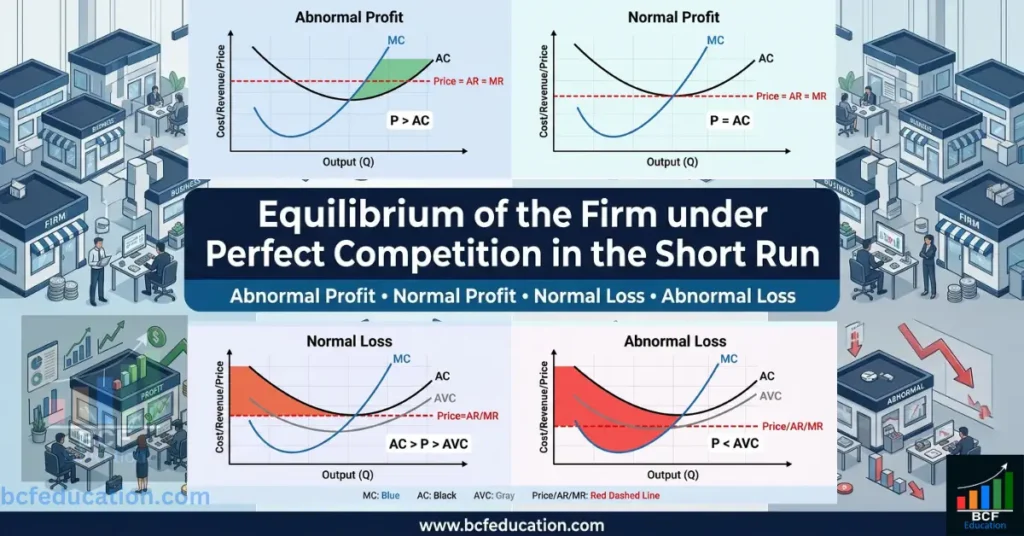
Equilibrium of a Firm Under Perfect Competition in Short Run. Learn the equilibrium of a firm under perfect competition in the short run, including abnormal profit, normal profit, normal loss, and abnormal loss with clear explanations.
Table of Contents
Equilibrium of a Firm Under Perfect Competition in the Short Run
In perfect competition, a firm reaches equilibrium when it maximizes profits or minimizes losses, which occurs when its marginal cost (MC) equals its marginal revenue (MR). Because firms in perfect competition are “price takers” (unable to influence market prices), the price (P) is determined by the market and is constant for each firm. We can conclude that there are two conditions for the firm equilibrium under perfect competition:
(1) Level of output at Marginal Cost MC becomes equal to Marginal Revenue MR.
(2) Marginal Cost MC curve should cuts Marginal Revenue MR line from below.
Firm sets its level of output for the equilibrium at which firm’s marginal profit equals to zero.
Marginal Profit = 0 means MR – MC = 0
For more detail follow below given diagram and explanation:
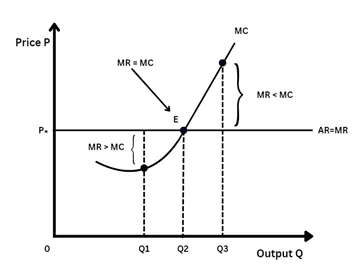
- In above diagram, output Q is taken on x-axis and price P is taken on y-axis.
- straight horizontal line from left to right is average revenue and marginal revenue line.
- Line moving below and finally above the marginal revenue line is marginal cost MC line.
- At the level of output Q1 firm’s marginal revenue is greater than marginal cost MR > MC so the firm keeps increasing its output until its marginal revenue MR becomes equal to marginal MC.
- At Q2 level of output, Price P*, firm’s marginal revenue MR becomes equal to marginal cost MC which is presented in above diagram at point E. This is the point where firms marginal profit is zero.
- Beyond point E and output Q2 firm’s marginal revenue MR is less than marginal cost MC such as at Q3 level of out which is not favorable for the firm.
- So we can conclude that at point E, Q2 level of output, firm’s total profit is maximum because here the marginal profit which is the difference of marginal revenue MR and marginal cost MC is zero and E is the equilibrium point for the firm.
- Logic behind this point is as we studied in law of diminishing marginal utility that the point where marginal utility is zero, the total utility becomes maximum at that point.
Difference between Short-Run & Long-Run
Short-Run
Short-Run is a time period in which number of firms remain fix in the industry and they keep some factors constant in their total cost TC and some variable. They may experience following possibilities under perfect competition:
(1) Super Normal or Abnormal Profit
(2) Normal Profit
(3) Normal Loss or Loss Minimization
(4) Abnormal Loss or Shut Down Point
Long-Run
Long-Run is a time period in which number of firms may increase or decrease in the industry and there is no fixed factor of production in the total cost TC but all the factors remains variable.
Equilibrium of the Firm under Perfect Competition in the Short-Run
Case A Super Normal/Abnormal Profit
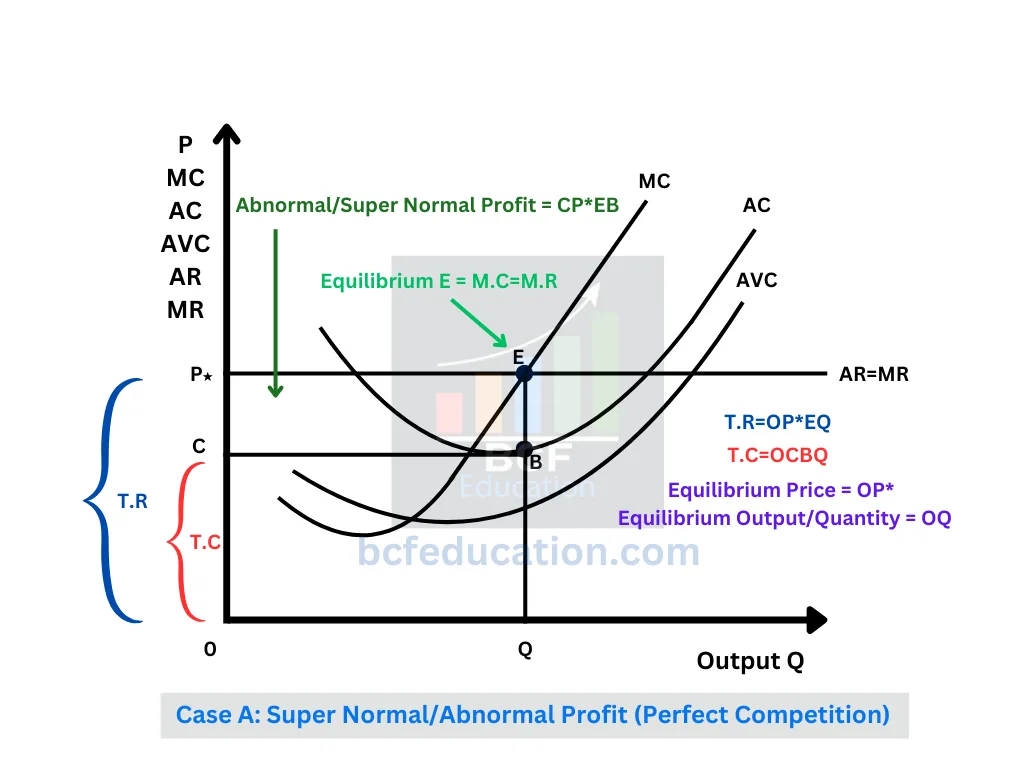
Explanation Case A: Super Normal/Abnormal Profit
- The Situation: The market price is very high.
- Equilibrium Point: The firm produces at point E, where MC = MR.
- Price & Output: The equilibrium price is OP* and the output is OQ.
- The Profit: The price (AR) is greater than the Average Cost (AC) at output OQ.
- Result: Because AR > AC, the firm makes a profit on every unit sold. The total profit is the area of the rectangle between the price line and the AC curve. This is called Super Normal Profit.
- Decision: The firm is doing very well and will continue producing.
Case B Normal Profit
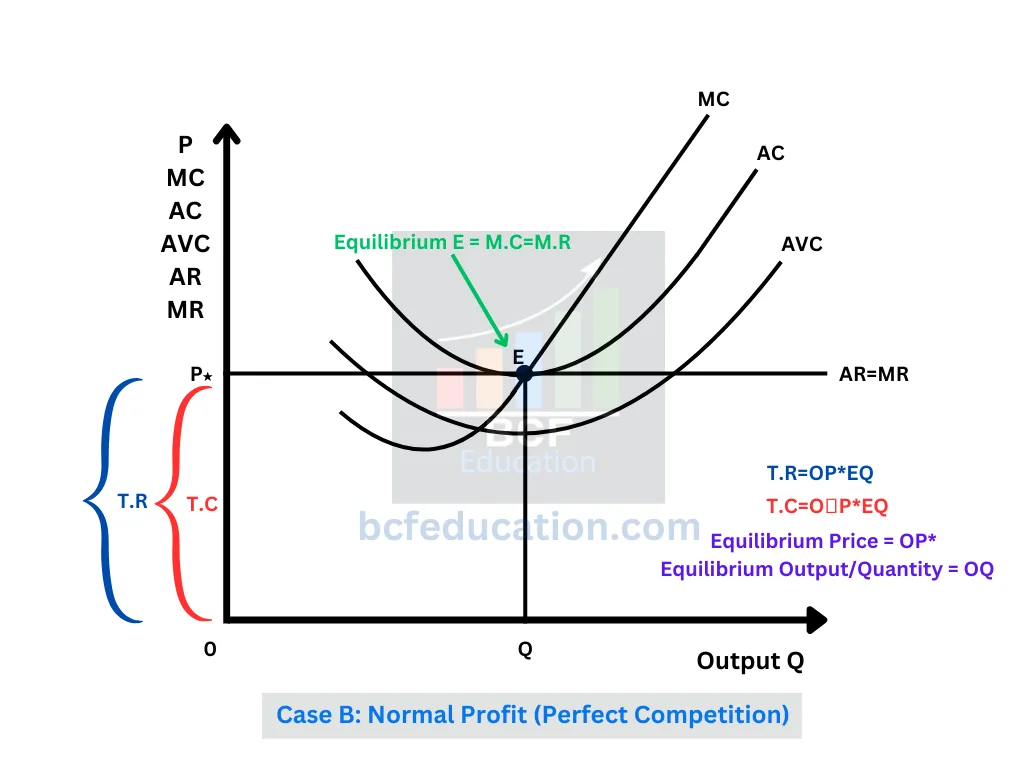
Explanation Case B: Normal Profit (Break-Even Point)
(This is the diagram where AC touches AR)
- The Situation: The market price is average.
- Equilibrium Point: The firm produces at point E, where MC = MR.
- Price & Output: The equilibrium price is OP* and the output is OQ.
- The Profit: The price (AR) is exactly equal to the Average Cost (AC) at output OQ.
- Result: The firm is covering all its costs (including the opportunity cost of the owner’s time and capital). It makes zero economic profit (Normal Profit).
- Decision: The firm is breaking even. It has no reason to leave the industry, but it isn’t attracting new competitors either.
Case C: Normal Loss
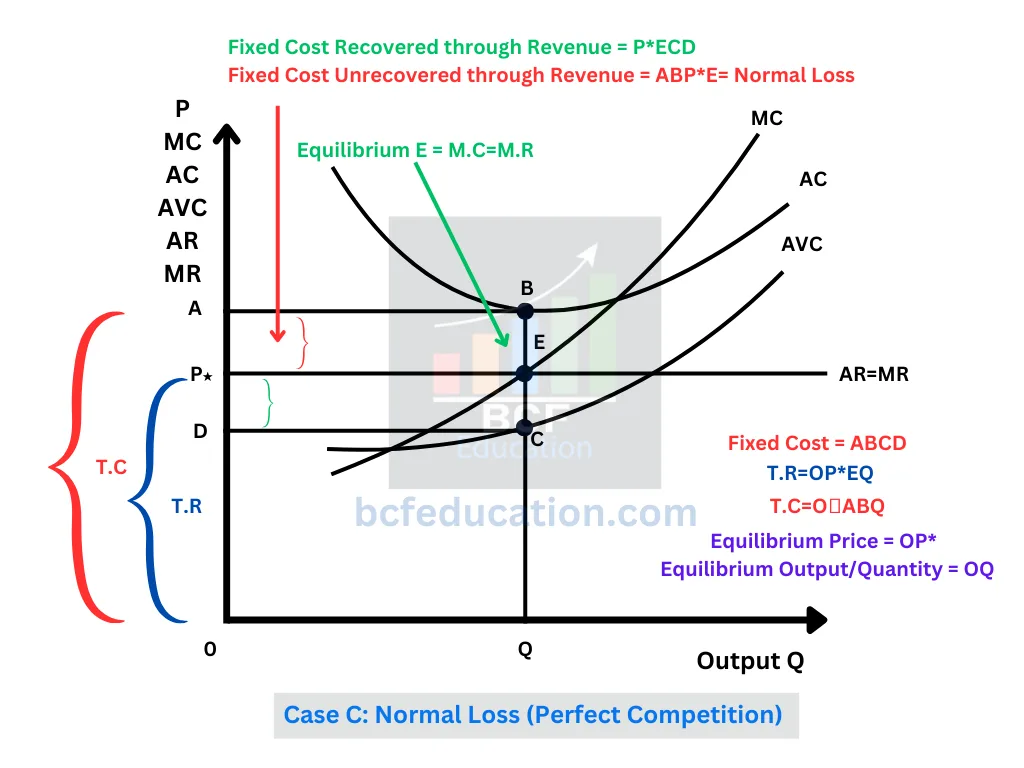
Explanation Case C: Normal Loss (Loss Minimization)
(This is the diagram where AC is above AR, but AVC is below AR)
- The Situation: The market price is low.
- Equilibrium Point: The firm produces at point E, where MC = MR.
- Price & Output: The equilibrium price is OP* and the output is OQ.
- The Loss: The Average Cost (AC) is higher than the price (AR). Therefore, the firm is making a loss on every unit sold.
- Recovering Costs: Even though the firm is losing money overall, the price is still higher than the Average Variable Cost (AVC).
- Revenue covers: All Variable Costs + a portion of Fixed Costs.
- Revenue does NOT cover: The remaining portion of Fixed Costs (shown by the rectangle ABP*E).
- Result: The firm incurs a loss (Normal Loss), but it is smaller than its total fixed costs.
- Decision: Continue producing. If they shut down, they would lose their entire Fixed Cost. By producing, they at least cover their variable costs and some fixed costs, meaning they lose less money.
Case D: Abnormal Loss
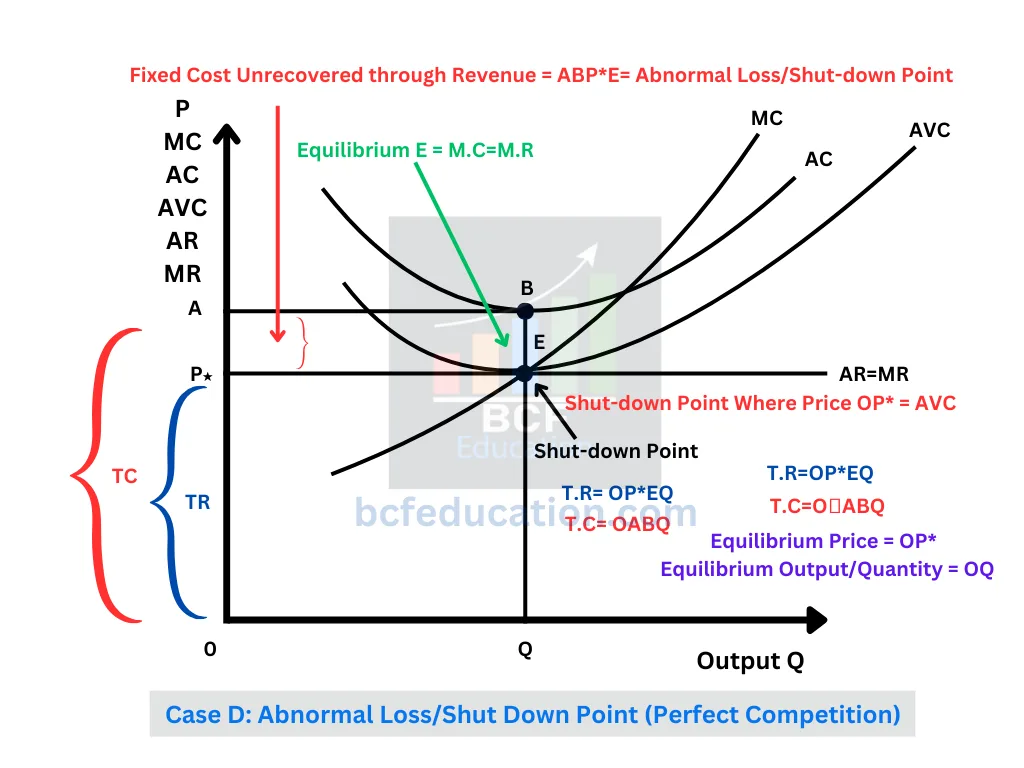
Explanation Case D: Abnormal Loss / Shut-Down Point
(This is the diagram where AR = AVC)
- The Situation: The market price is extremely low.
- Equilibrium Point: The firm produces at point E, where MC = MR.
- Price & Output: The equilibrium price is OP* (very low) and the output is OQ.
- The Loss: The Average Cost (AC) is much higher than the price. The loss is the entire rectangle ABP*E.
- The Shut-Down Point: The price (OP*) is exactly equal to the Average Variable Cost (AVC). This is the “Shut-down Point” marked in the diagram.
- Recovering Costs: Revenue exactly covers Variable Costs, Revenue covers Zero Fixed Costs.
- Result: The firm’s loss is exactly equal to its Total Fixed Costs.
- Decision: Indifferent/Shut Down. At this price, it doesn’t matter if they produce or shut down, because they lose the same amount of money (the fixed costs). If the price falls any lower, the firm must shut down immediately to prevent losing more money.