
English Lesson 1 Family Values in Pakistan English I FBISE. Are you a Class 11 student of the Federal Board of Intermediate and Secondary Education (FBISE), Islamabad, looking for complete solved exercises of Lesson 1: Family Values in Pakistan from your English I (HSSC I) textbook? This blog post is exactly what you need.
This lesson highlights the beautiful traditions of the Pakistani family system—respect for elders, love for younger ones, joint family structures, mutual support, and strong moral values. Understanding these concepts is not only important for your exams but also for appreciating your own culture. Find more resources about English 1 HSSC 1 FBISE.
In this post, you will find:
- Answers to all textbook exercise questions (short questions, long questions, and comprehension checks)
- Vocabulary and grammar exercises solved (fill in the blanks, synonyms, antonyms, sentence making)
- Important translation and explanation passages from the lesson
- Exam-ready Q&A designed according to the FBISE paper pattern
English Lesson 1 Family Values in Pakistan English I FBISE
Table of Contents
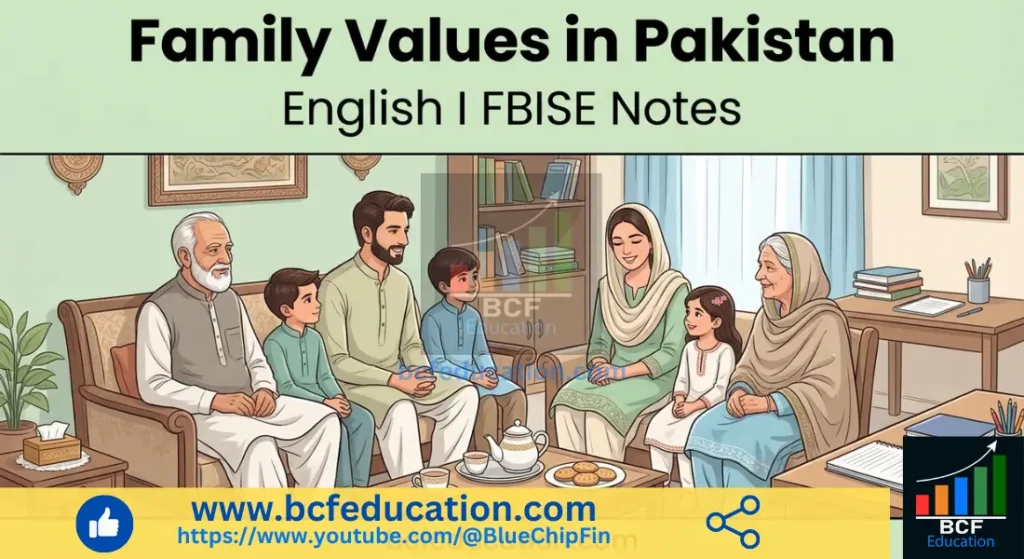
In Pakistan, family is a “bond of relationships”, which strengthens the relationships of a family. Family member love and respect each other without any expectations.
The tenets of Islam further strengthen this bond.The existing family ties, based on selflessness, are well watered by the injunctions of Islam. According to Islam, we must look after our parents, especially in their old age, when they are gone perish minded. It can be said that universal teachings of our religion are the essential part of our family values.
People in Pakistan mostly follow the joint family system and live their lives with their parents. They give much respect to their customs and traditions and pay due attention to family values.
The value of a strong family system has played an important role in influencing an individual’s way of living, social role, choice of profession and decision-making. A strong family unit creates a safe, positive and supportive place for all members to thrive in. They are able to utilize resources and live together in a fairly healthy manner.
Each member of a Pakistani family has respect for the elder family members. The grandparents form a central beacon in a traditional Pakistani family.
They are treated with reverence and hold an authoritative place. They work together with other elder family members to solve problems and pass their skills and experiences to the next generation. They are good “role models” and are looked upon as the primary source of guidance. Accordingly, they are provided with care and support from their family members.
The male members of the family are generally considered to be the guardians of the family and play a significant role for the well-being of their family. The major decisions, in the family, are taken by them and their words go unquestioned. Their dream is to support their family members and work fortheir social and financial well-being. When all the male members work together and contribute equally to the family, the financial burden is minimized and the elements of jealousy and evil also remain under control. The family members are able to prosper and thrive together.
In joint family units all the family members live together and share joys and sorrows with each other. The elders, in the family, set the tone by reaching out to their friends and community and teach their children the importance of doing the same.
All the female members of the family handle jointly the household responsibilities and support each other in the· household chores. As children spend most of their time under their custody, the entire grooming of children is also done by them. Women consider their family as their entire world and jointly fulfill their family needs and wants.
At the same time, the families in Pakistan never fail to look at children in the family as “gifts from Allah. All the elder family members are responsible for teaching the children the basic beliefs of religion. Family values, customs and traditions are also transferred to children by their elders and they are also taught to respect and honour their elders.
The children watch their parents taking care of their grandparents and also make well-thought-out decisions over the years. This role guides the children to be supportive and good decision -makers. Among the children of strong families, the moral and emotional problems are lesser. They tend to go on to have strong, healthy families. of their own, having learned examples from their elders.
Our family values look to us dreamlike and we thank Allah, for we are tied into a cohesive whole of the family system. Sometimes, poverty and other problems happen to overshadow some of our family units, but, with the role of the state and education of the people, we can easily avert these dangers. Nevertheless., such bitter phenomena are rarely found. Tersely, in Pakistan, people absorb the traditional and cultural family values and they demonstrate respect and regard to their elders. People’s main objective is “living together, growing together and surviving together”.
Here, giving physical and emotional support is quite usual in a joint family system. This leads to a happy, healthy and prospering family which benefits the society as a whole. It is said that one good family builds a good community, then all good communities build a good society and at the end all good societies jointly make a successful nation.
Important Questions
1. What is the concept of a family? Identify some family values.
A family is a bond of relationships based on love, care, and respect. Family values include respect for elders, selflessness, care for parents, cooperation, and strong religious beliefs.
2. Why is family taken as a “bond of relationship”?
Family is called a bond of relationship because members are connected through love, mutual respect, and responsibilities toward each other.
3. Who is the guardian of a family?
The male members of the family are generally considered the guardians of the family.
4. How do children make well-thought-out decisions?
Children learn decision-making by observing their elders, especially how parents care for grandparents and solve problems wisely.
5. What is the main objective of Pakistani people while living together?
The main objective is living together, growing together, and supporting each other physically and emotionally.
6. Discuss the characteristics of family as a “bond of relationships”.
A family bond is based on love, respect, care, cooperation, selflessness, and strong religious teachings that keep members united.
7. Explain the way elderly family members are given respect in Pakistani society.
Elderly members are treated with respect, given care and support, and consulted for guidance and decision-making.
8. The joint family system helps children grow with positivity. Give reasons.
Children grow positively because they receive love, guidance, moral training, and support from elders in a joint family.
9. Describe the way children are brought up and nursed in the traditional Pakistani family.
Children are raised collectively by elders and women of the family, who teach them religion, morals, traditions, and respect.
10. Describe how physical and emotional support is a strength in a joint family system.
Family members help each other in times of need, share responsibilities, and provide emotional comfort, which strengthens unity.
11. Who can play a positive role to keep family values in Pakistan intact and how?
Parents, elders, the state, and educational institutions can promote family values through education, guidance, and awareness.
12. Analyze the text carefully and identify the theme of the unit.
The theme of the unit is “The importance of family values and the joint family system in Pakistani society.”
b) Choose the correct option:
i. Family values, customs and traditions are transferred to children by:
a) extended family b) their elders c) their close friends
ii. The central beacon in a Pakistani traditional family is created by
a) aunts and uncles b) cousins c) grandparents
iii. The tenets of Islam further_______ this bond
a) weakens b) threatens c) strengthens d) finishes
iv. Universal teachings of our religion are the ______ part of our family values
a) negligible b) essential c) moderate d) minimal
v. Our family values look to us:
a) an eye-wash b) unimportant c) dreamlike d) disappointing
Vocabulary & Grammar
a. Identify correct spellings of the words by looking them up in a dictionary.
Pursue, Peruse Marely, Marily Social, Socail Traditions, treditions
Beacon, Beakon Honour, oonor Erode, aerode Prosper, Procepar
Sentence: A sentence is a set of words that is complete in itself, typically containing a subject and predicate, conveying a statement, question, exclamation, or command, and consisting of a main clause and sometimes one or more subordinate clauses. (Oxford Dictionary).
Kinds of sentences:
Declarative Sentences
Adeclarative sentence is the most basic type-of sentence. Its purpose is to relay information, and it is punctuated with a period. For example:
The boy walked home.
I love honey.
Interrogative Sentences
Interrogative sentences interrogate, or ask questions. These are direct questions, and they are punctuated with a question mark. For example:
Why does the sun shine?
Whose dog is that?
Will you go to Lahore?
Exclamatory Sentences
Exclamatory sentences are like declarative sentences. They make a statement instead of asking a question, but their main purpose is to express strong emotion. They have an exclamation point instead of a period. For example:
I said I wanted tacos instead of pizza!
How well he sings!
Wow, he just won a gold medal!
Imperative Sentences
Imperative sentences do not simply state a fact but rather tell someone to do something. These can be in the form of friendly advice, basic instructions or more forceful commands. For example:
Please shut the door to keep out the bugs.
Tum left at the bridge.
Stop bothering me!
Optative Sentences
Optative sentences express a prayer, wish, curse, etc. For example:
May Allah bless us all.
May you become successful in life.
Long live Pakistan.
Activity: Make one sentence each according to the types given above.
Declarative Sentence:
Family values play an important role in our lives.
Interrogative Sentence:
Why should we respect our elders?
Exclamatory Sentence:
What a loving family we have!
Imperative Sentence:
Respect your parents and elders.
Optative Sentence:
May Allah bless our families with peace and unity.
b) Write two sentences of each type given in Information box.
Declarative Sentences, Interrogative Sentences, Exclamatory Sentences, Imperative Sentences
Answer:
1) Declarative Sentences:
• Family values are very important in Pakistani society.
• A joint family system provides support to all family members.
2) Interrogative Sentences:
• Why should we respect our elders?
• How does a joint family system help children?
3) Exclamatory Sentences:
• What a happy and caring family this is!
• How beautiful our family traditions are!
4) Imperative Sentences:
• Always obey and respect your parents.
• Take care of your grandparents in their old age.
Phrasal Verbs
a) Phrasal verbs: A verb combined with an adverb or a preposition or sometimes both, to give a new meaning is called phrasal verb.
Examples: left over, break out, see off
i) Fill in the blanks with the correct phrasal verbs in the following sentences.
Please _______ your shoes before entering the house.
a) takeup b) takeoff c) takeover
ii) The storm forced us to _______ our camping trip.
a) call off b) callout c) callup
iii) I need to _______ on my math homework before I can go out.
a) catchon b) catch up c) catchout
iv) Weneed to _______ with a plan to address this issue.
a) come up with b) come over with it c) come around with
b) Use the following phrasal verbs in sentences.
ask for, aim at, backup, believe in, blow away, blowup
Answer:
• ask for:
She asked for help from her teacher.
• aim at:
He aimed at improving his English skills.
• backup:
Please back up your work before closing the computer.
• believe in:
I believe in hard work and honesty.
• blow away:
The strong wind blew away the papers.
• blow up:
The balloon blew up when too much air was filled in it.
c) Punctuate the given lines.
“at the same time, the families in pakistan never fail to look at the children in the family as gifts from allah
Answer:
“At the same time, the families in Pakistan never fail to look at the children in the family as gifts from Allah.”
d) Give antonyms of the following words.
Join, complete, respect, Strong, positive, deep
Answer:
• Join — separate
• Complete — incomplete
• Respect — disrespect
• Strong — weak
• Positive — negative
• Deep — shallow
Paragraph Writing
a- Write a paragraph about “A Pakistani Wedding Ceremony givingfull information, observation and preparation of the whole function.
b- Explain in a paragraphs how are the marriage formalities carried on in a Pakistani family.
Answer:
a) A Pakistani Wedding Ceremony
A Pakistani wedding ceremony is a colorful and joyful event that reflects culture, traditions, and family values. It usually consists of several functions such as Mayun, Mehndi, Baraat, and Walima. Before the wedding, families make full preparations including shopping for clothes, jewelry, decorations, and food arrangements. Relatives and friends are invited, and the house is decorated with lights and flowers. On the wedding day, guests are warmly welcomed, traditional music is played, and delicious food is served. The ceremony is observed with happiness, prayers, and social gathering, making it a memorable occasion for both families.
b) Marriage Formalities in a Pakistani Family
In a Pakistani family, marriage formalities are carried out according to religious and cultural traditions. The process usually starts with a proposal and engagement (Mangni). After mutual consent of both families, the Nikah ceremony is performed in the presence of elders and witnesses, following Islamic teachings. The Nikah Nama is signed, and prayers are offered for the couple’s happy life. Later, the Rukhsati takes place when the bride goes to her husband’s home. Finally, the Walima is arranged by the groom’s family. These formalities strengthen family bonds and ensure social and religious responsibilities are fulfilled.