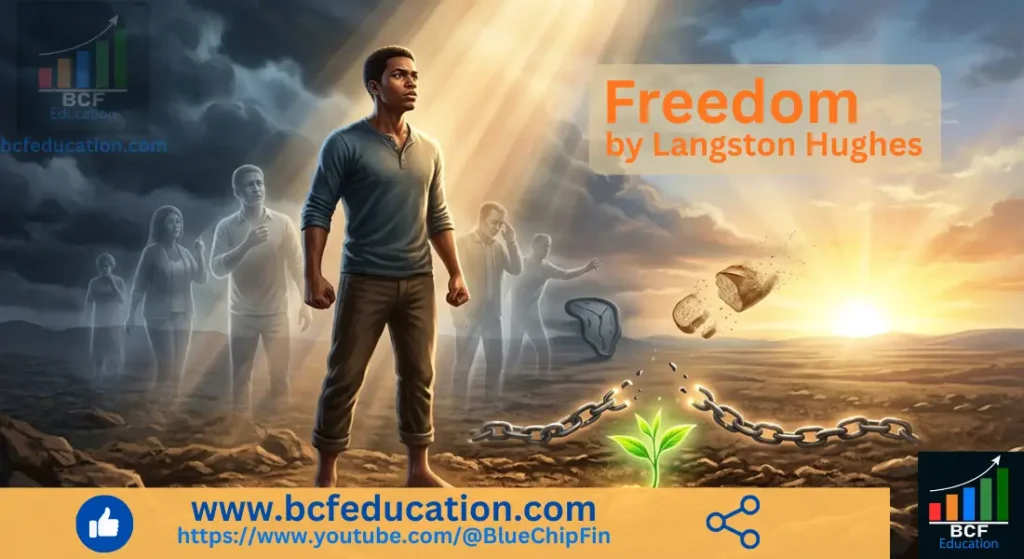
Understanding “Freedom” by Langston Hughes: A Complete Student Guide. Langston Hughes was a famous poet of the Harlem Renaissance. He often wrote about the struggles and hopes of African Americans. His poem “Freedom” is short but powerful. It speaks about the urgent need for real freedom, not just a promise for the future.
Let’s dive into the poem in the easiest way possible.
Table of Contents
Understanding “Freedom” by Langston Hughes: A Complete Student Guide
Poem Freedom by Langston Hughes (Original Text)
Freedom will not come
Today, this year
Nor ever
Through compromise and fear.
I have as much right
As the other fellow has
To stand
On my two feet
And own the land.
I tire so of hearing people say,
Let things take their course.
Tomorrow is another day.
I do not need my freedom when I’m dead.
I cannot live on tomorrow’s bread.
Freedom
Is a strong seed
Planted
In a great need.
I live here, too.
I want my freedom
Just as you.
1. Summary of the Poem
In this poem, Langston Hughes says that true freedom cannot come from fear or compromise. He declares that he has the same right as anyone else to stand on his own feet and own land. He is tired of people saying, “Wait,” or “Let things happen naturally.” He says he cannot live on “tomorrow’s bread” or wait until he is dead to be free. Freedom is like a strong seed planted in deep need. He lives here, and he wants his freedom now, just like anyone else.
In one line: Don’t wait for freedom—demand it now, because you deserve it equally.
2. Paraphrasing Stanza wise
| Stanza | Paraphrase |
| Stanza 1 | Freedom will never come today, this year, or ever, if we try to get it through compromise (giving up some things) and fear. |
| Stanza 2 | I have the same right as any other person to stand on my own two feet and to own the land I live on. |
| Stanza 3 | I am tired of hearing people say, “Don’t rush, let things happen on their own. There’s always tomorrow.” I don’t need my freedom when I am dead. I can’t survive on the hope of tomorrow’s food. |
| Stanza 4 | Freedom is like a strong seed. It is planted when people are in great need. I live here too. I want my freedom just like you want yours. |
3. Paraphrasing Line by Line
| Original Line | Paraphrase |
| Freedom will not come | You cannot get freedom |
| Today, this year | Not now, not this year |
| Nor ever | And not ever |
| Through compromise and fear. | By being scared or by giving up some of your rights. |
| I have as much right | I deserve equally |
| As the other fellow has | Like any other person |
| To stand | To live with dignity |
| On my two feet | Being independent and strong |
| And own the land. | And have my own property and place in society. |
| I tire so of hearing people say, | I am really fed up with others telling me: |
| Let things take their course. | Don’t push for change; just wait. |
| Tomorrow is another day. | There is always future to fix things. |
| I do not need my freedom when I’m dead. | Being free after death is useless to me. |
| I cannot live on tomorrow’s bread. | I cannot survive today by hoping for food tomorrow. |
| Freedom | True liberty |
| Is a strong seed | Is like a tough, powerful seed |
| Planted | Placed deep |
| In a great need. | Inside a huge, urgent necessity. |
| I live here, too. | I also exist in this world, in this country, right now. |
| I want my freedom | I desire my liberty |
| Just as you. | Exactly like you do. |
4. Difficult Words / Meanings Used in the Poem
| Word / Phrase | Easy Meaning |
| Compromise | Giving up something you want to reach an agreement |
| Fear | Being scared |
| The other fellow | Any other person |
| Stand on my two feet | Be independent, not relying on others |
| Own the land | Have legal rights to property and a place in society |
| Take their course | Let things happen naturally without interfering |
| Tomorrow’s bread | Future promises that do not feed you today |
| Strong seed | A powerful beginning that will grow |
| Great need | Deep, urgent necessity |
5. Important Short Questions and their Answers
Q1: According to the poet, how will freedom NOT come?
A: Freedom will not come through compromise and fear.
Q2: What right does the poet claim in stanza 2?
A: He claims the right to stand on his own two feet and own the land, just like any other person.
Q3: What is the poet tired of hearing?
A: He is tired of hearing people say, “Let things take their course” and “Tomorrow is another day.”
Q4: Why can’t the poet live on “tomorrow’s bread”?
A: Because future promises do not solve today’s hunger or oppression. He needs freedom now.
Q5: How does the poet describe freedom in the last stanza?
A: He describes freedom as “a strong seed planted in a great need.”
Q6: Who does the poet say “I live here, too” to?
A: He says this to everyone, especially those who already have freedom, to remind them that he belongs here equally.
6. Important Long Questions and their Answers
Q1: Explain the meaning of “Freedom is a strong seed planted in a great need.”
Answer:
This metaphor means that freedom is not weak or small. It is like a strong seed that has the power to grow into something big. But this seed is planted only when people truly need it — when they suffer from injustice, hunger, or oppression. That “great need” is like the soil. The more urgent the need, the stronger freedom grows. Hughes is saying that because his need for freedom is so deep, his fight for it will be powerful and unstoppable.
Q2: Why does Langston Hughes reject the idea of “waiting for tomorrow” in this poem?
Answer:
Langston Hughes rejects waiting because waiting is a trick used by oppressors to keep people quiet. When people say, “Let things take their course” or “Tomorrow is another day,” they are really saying, “Don’t fight now.” Hughes argues that he cannot eat “tomorrow’s bread” — meaning promises of future freedom don’t fill his stomach or heal his pain today. Also, freedom after death is useless. He wants his freedom now, in this life, on this earth, because he lives here, too. This makes the poem very urgent and powerful.
Q3: How does this poem reflect the theme of equality?
Answer:
Equality is at the heart of this poem. In stanza 2, Hughes says, “I have as much right / As the other fellow has.” He rejects any idea that some people deserve freedom more than others. By saying “I live here, too” and “I want my freedom / Just as you,” he reminds everyone that people who are oppressed are not outsiders — they are part of the same society. True equality means no one has to beg or wait for basic rights.
7. Central Idea & Theme of the Poem
Central Idea:
Freedom cannot be achieved through fear or compromise, nor by waiting for the future. It must be demanded now, because every person has an equal right to live with dignity and independence.
Themes:
Urgency of Freedom – Freedom is not a future dream; it is a present need.
Equality – Everyone has the same right to stand on their own feet and own land.
Rejection of Patience – Waiting for “tomorrow” is a form of oppression.
Freedom as a Natural Right – It is not a gift; it is a seed planted by need and struggle.
8. Literary Devices / Figures of Speech / Poetic Devices
| Device | Example from Poem | Explanation |
| Metaphor | “Freedom is a strong seed” | Freedom is compared to a seed (without using “like” or “as”) |
| Metaphor | “I cannot live on tomorrow’s bread” | Future promises are compared to bread that doesn’t exist today |
| Repetition | “Freedom” (said multiple times) | Emphasizes the main subject |
| Anaphora | “I do not need… I cannot live…” | Repeated “I” structure at line starts for emphasis |
| Contrast | Freedom vs. compromise/fear | Shows opposite ideas to create tension |
| Direct Address | “Just as you” | Speaks directly to the reader or oppressor |
| Symbolism | “Stand on my two feet” | Symbolizes independence and dignity |
| Symbolism | “Own the land” | Symbolizes economic and social rights |
| Enjambment | Lines break without punctuation (e.g., “To stand / On my two feet”) | Creates flow and urgency |
9. Rhyme Scheme for Each Stanza
| Stanza | Rhyme Scheme | Explanation |
| Stanza 1 (4 lines) | ABCB | “come” (A) – “year” (B) – “ever” (C) – “fear” (B) |
| Stanza 2 (5 lines) | ABCDD? (irregular) | “right” / “has” / “stand” / “feet” / “land” — no strict rhyme, free verse |
| Stanza 3 (6 lines) | AABBCC | “say” (A) – “day” (A) – “dead” (B) – “bread” (B) – “need” (C) – “you” (C) [note: need/you = near rhyme] |
| Stanza 4 (7 lines) | Irregular / free verse | More modern, loose structure |
Note: Langston Hughes often used free verse (no fixed rhyme). Stanza 3 has the clearest rhyme.
10. Important MCQS of the Poem (including Figure of Speech related)
| # | Question | Option A | Option B | Option C | Option D | Correct Answer |
| 1 | According to the poem, freedom will NOT come through | War and violence | Compromise and fear | Love and peace | Education and money | B |
| 2 | “I have as much right / As the other fellow has” shows which theme? | Jealousy | Revenge | Equality | Loneliness | C |
| 3 | “I cannot live on tomorrow’s bread” is an example of | Simile | Metaphor | Personification | Hyperbole | B |
| 4 | What does “stand on my two feet” symbolize? | Physical strength | Independence and dignity | Running away | Fighting | B |
| 5 | “Freedom is a strong seed” is what literary device? | Simile | Metaphor | Alliteration | Onomatopoeia | B |
| 6 | The poet is tired of hearing people say | Fight now | Give up | Let things take their course | Run away | C |
| 7 | According to Hughes, when is freedom useless? | When you are rich | When you are old | When you are dead | When you are young | C |
| 8 | The line “I live here, too” suggests | Migration | Belonging and equal presence | Loneliness | Anger only | B |
| 9 | The tone of the poem is mostly | Joyful and relaxed | Urgent and determined | Sad and hopeless | Confused | B |
| 10 | “Just as you” at the end is an example of | Direct address | Irony | Sarcasm | Euphemism | A |
I hope this guide helps you understand Langston Hughes’ “Freedom” in a simple, clear, and human way. This poem reminds us that waiting for justice is not justice at all — freedom is a seed, but it only grows when we plant it with courage today.