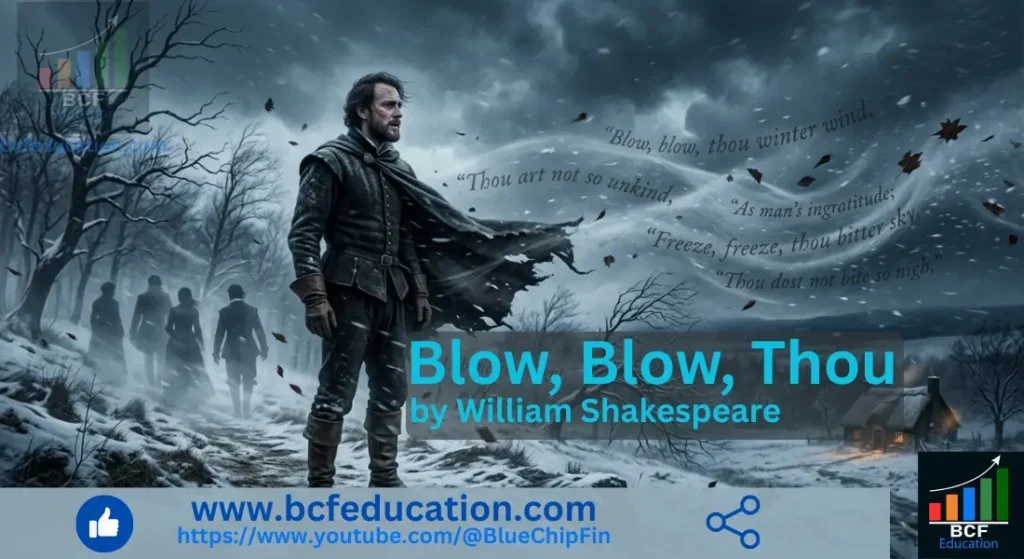
Blow, Blow, Thou Winter Wind by William Shakespeare Full Analysis, Summary, MCQs & Literary Devices.
Easy, student-friendly analysis of Shakespeare’s poem Blow, Blow, Thou Winter Wind. Includes summary, line by line paraphrase, MCQs, literary devices, and Q&A.
Need help with Shakespeare’s poem “Blow, Blow, Thou Winter Wind”? Get a complete guide with stanza wise paraphrase, central idea, rhyme scheme, figures of speech, important questions, and 20 MCQs in a table.
(Original Text)
Stanza 1
Blow, blow, thou winter wind,
Thou art not so unkind
As man’s ingratitude;
Thy tooth is not so keen,
Because thou art not seen,
Although thy breath be rude.
Heigh-ho! sing, heigh-ho! unto the green holly:
Most friendship is feigning, most loving mere folly:
Then heigh-ho, the holly!
This life is most jolly.
Stanza 2
Freeze, freeze, thou bitter sky,
That does not bite so nigh
As benefits forgot:
Though thou the waters warp,
Thy sting is not so sharp
As a friend remembered not.
Heigh-ho! sing, heigh-ho! unto the green holly:
Most friendship is feigning, most loving mere folly:
Then heigh-ho, the holly!
This life is most jolly.
1. Summary of the Poem
In this poem, Shakespeare compares the harsh winter wind and freezing sky to human betrayal. He says that even the coldest wind is not as cruel as a person’s ingratitude (not saying thank you) or a forgotten benefit (when someone forgets a good deed you did for them). The winter wind might be rude and sharp, but at least it is honest and invisible. Human beings, however, pretend to be friends but often lie and forget kindness. The poem ends with a cheerful “heigh-ho” chorus about the holly tree, as if the speaker is trying to stay positive despite human cruelty. The final message: life is still jolly if you accept that most friendships are fake and most love is foolish.
2. Paraphrasing Stanza Wise
| Stanza | Paraphrase |
| Stanza 1 | Go ahead, winter wind, blow as hard as you want. You are still not as unkind as a human being who is ungrateful. Your cold “tooth” isn’t that sharp because no one can see you, even if your breath is rough. (Chorus) Let’s sing happily about the green holly tree. Most friendships are fake, and most love is stupid. So let’s sing again for the holly. This life is actually very joyful. |
| Stanza 2 | Keep freezing, bitter sky. Your cold doesn’t hurt as much as when people forget the good things you did for them. You can twist the water into ice, but your sting is nothing compared to a friend who forgets you. (Same chorus) So let’s sing for the holly again. Fake friendships and foolish love don’t matter. Life is still jolly. |
3. Paraphrasing Line by Line
| Line | Paraphrase |
| Blow, blow, thou winter wind | Go ahead, winter wind, keep blowing strongly. |
| Thou art not so unkind | You are not as cruel |
| As man’s ingratitude; | As a human being’s thanklessness. |
| Thy tooth is not so keen, | Your sharp bite (cold) is not so painful, |
| Because thou art not seen, | Because nobody can see you, |
| Although thy breath be rude. | Even though your wind feels harsh. |
| Heigh-ho! sing, heigh-ho! unto the green holly | Hey-ho! Let’s sing happily to the green holly tree. |
| Most friendship is feigning, | Most friendships are just pretending/fake, |
| most loving mere folly: | Most love is just foolishness. |
| Then heigh-ho, the holly! | So again, hey-ho for the holly! |
| This life is most jolly. | This life is actually very cheerful. |
| Freeze, freeze, thou bitter sky | Keep freezing, bitter sky. |
| That does not bite so nigh | Your cold doesn’t hurt as directly/close |
| As benefits forgot: | As when people forget the good deeds done for them. |
| Though thou the waters warp, | Even though you freeze and twist the waters into ice, |
| Thy sting is not so sharp | Your painful sting is not as sharp |
| As a friend remembered not. | As a friend who is forgotten. |
| (Chorus repeats) | (Same as above) |
4. Difficult Words/Meanings Used in the Poem
| Word/Phrase | Meaning in Easy English |
| Thou | You (old English) |
| Unkind | Cruel, harsh |
| Ingratitude | Not saying thank you; forgetting someone’s kindness |
| Keen | Sharp, painful |
| Rude | Rough, harsh in manner |
| Feigning | Pretending, faking |
| Folly | Foolishness, stupidity |
| Bite so nigh | Hurt so directly/close to the heart |
| Benefits forgot | Good deeds that people forget |
| Warp | Twist, freeze and distort (water into ice) |
| Sting | Painful prick (like a bee sting) |
| Friend remembered not | A friend who is forgotten |
5. Important Short Questions and Their Answers
Q1: Who is the poet of Blow, Blow, Thou Winter Wind?
A: William Shakespeare.
Q2: What does the speaker compare the winter wind to?
A: He compares it to man’s ingratitude (thanklessness).
Q3: According to the poem, which is worse – winter wind or human betrayal?
A: Human betrayal (ingratitude and forgotten benefits) is worse.
Q4: What does the chorus say about friendship and love?
A: Most friendship is fake (feigning), and most love is foolish (mere folly).
Q5: What is the holly tree a symbol of in this poem?
A: The holly is a symbol of cheerfulness, endurance, and joy despite difficulties.
Q6: Why does the speaker say the wind’s tooth is not keen?
A: Because the wind cannot be seen, so its bite feels less personal than human betrayal.
Q7: What does “benefits forgot” mean?
A: It means when people forget the good things you have done for them.
Q8: What is the overall mood of the poem?
A: It is bittersweet – sad about human nature but trying to be cheerful (jolly).
Q9: What does “a friend remembered not” mean?
A: A friend who is forgotten or ignored.
Q10: Why does the speaker still say “This life is most jolly”?
A: Because he accepts that people are fake, so he chooses to find joy in nature and simple things like the holly.
6. Important Long Questions and Their Answers
Q1: Explain the central contrast in the poem between nature’s cruelty and human cruelty.
Answer:
Shakespeare contrasts two types of “unkindness.” The winter wind is physically harsh – it blows rudely and freezes water. However, its cruelty is honest, invisible, and impersonal. On the other hand, human ingratitude is morally worse. When a person forgets a benefit or a friend, that betrayal cuts deeper because it comes from someone you trusted. The wind’s tooth is sharp, but man’s ingratitude is sharper because it attacks the heart, not just the body. The poet concludes that even the worst winter is better than fake friendship.
Q2: Discuss the significance of the refrain “Heigh-ho, sing heigh-ho, unto the green holly.”
Answer:
The refrain acts as a cheerful break from the poem’s bitter complaints. The holly is an evergreen plant that stays green even in winter. By singing to it, the speaker shows resilience – he refuses to be destroyed by human betrayal. The repeated “heigh-ho” sounds like a happy folk song. This contrast is intentional: the verses are dark, but the chorus is light. Shakespeare is teaching us that life is still “jolly” if we lower our expectations of people and find joy in nature and simple pleasures.
Q3: How does Shakespeare use personification in this poem? Give examples.
Answer:
Personification means giving human qualities to non-human things. Shakespeare personifies the winter wind (calling it “thou” and saying it has a “tooth” and “breath”) and the sky (telling it to “freeze” as if it can hear). He also gives the wind “rudeness” and a “sting.” This makes nature feel like a living character. By doing this, Shakespeare makes the comparison to humans stronger: even a personified, rude wind is still better than a real ungrateful person.
7. Central Idea & Theme of the Poem
Central Idea:
Human betrayal (ingratitude and forgotten friendship) is worse than the harshest winter weather.
Themes:
| Theme | Explanation |
| Ingratitude | People forget kindness easily; this hurts more than cold wind. |
| Fake friendship | Most friendships are pretending, not real. |
| Foolish love | Love is often stupid and unreliable. |
| Resilience/Joy | Despite everything, life can still be jolly if you accept reality. |
| Nature vs. Humanity | Nature’s cruelty is honest; human cruelty is hidden and worse. |
8. Literary Devices / Figures of Speech / Poetic Devices
| Device | Example from Poem | Explanation |
| Personification | “Blow, blow, thou winter wind” / “Freeze, freeze, thou bitter sky” | Wind and sky are addressed as if they are persons. |
| Metaphor | “Thy tooth is not so keen” | The wind’s coldness is compared to a sharp tooth. |
| Simile (implied) | Comparison between wind’s unkindness and man’s ingratitude | Not direct “like” or “as” but a clear comparison. |
| Hyperbole | “Most friendship is feigning, most loving mere folly” | Exaggeration – not all friendship is fake, but the poet says “most” for effect. |
| Repetition | “Heigh-ho! sing, heigh-ho!” / “Then heigh-ho, the holly!” | Refrain repeats for musical effect. |
| Antithesis | Winter wind’s unkindness vs. man’s ingratitude | Opposite ideas placed together for contrast. |
| Irony | “This life is most jolly” after talking about betrayal | Saying life is joyful in a sarcastic, bitter-sweet way. |
| Alliteration | “Blow, blow” / “Freeze, freeze” / “friendship is feigning” | Repetition of same beginning sounds. |
9. Rhyme Scheme for Each Stanza
Stanza 1:
Lines: 1–6 → A B A B C C
Lines: 7–10 → D E D E
| Line | Rhyme Letter |
| 1 (wind) | A |
| 2 (unkind) | A |
| 3 (ingratitude) | B |
| 4 (keen) | C |
| 5 (seen) | C |
| 6 (rude) | B |
| 7 (holly) | D |
| 8 (folly) | D |
| 9 (holly) | E |
| 10 (jolly) | E |
Stanza 2: Same rhyme scheme as Stanza 1.
Final Rhyme Scheme: A A B C C B | D D E E
10. Important MCQs of the Poem (including Figures of Speech)
| Question | A | B | C | D | Correct Answer |
| Who wrote “Blow, Blow, Thou Winter Wind”? | John Donne | William Wordsworth | William Shakespeare | Robert Frost | C |
| What does the winter wind lack that man has? | Coldness | Visibility | Ingratitude | Sharpness | C |
| “Thy tooth is not so keen” is an example of? | Simile | Metaphor | Personification | Hyperbole | B |
| What does the holly symbolize? | Death | Sadness | Cheerfulness & endurance | Winter only | C |
| According to the poem, most friendship is? | True | Feigning (fake) | Eternal | Helpful | B |
| What is “benefits forgot”? | Lost money | Forgotten good deeds | Cold weather | Winter wind | B |
| Which line repeats in both stanzas? | Blow, blow | Freeze, freeze | Heigh-ho, sing heigh-ho unto the green holly | Thy sting is not so sharp | C |
| “Most loving mere folly” means love is? | Wonderful | Foolish | Deep | Warm | B |
| The wind’s breath is described as? | Sweet | Kind | Rude | Gentle | C |
| “Freeze, freeze, thou bitter sky” is an example of? | Apostrophe | Simile | Oxymoron | Alliteration only | A |
| What hurts more than the sky’s bite? | Winter wind | A forgotten friend | A sharp knife | Cold water | B |
| The tone of the chorus is? | Angry | Sad | Cheerful/ironic | Fearful | C |
| “Heigh-ho” is an example of? | Onomatopoeia | Interjection | Both A and B | Metaphor | C |
| What does “warp” mean in the poem? | Weave cloth | Freeze and twist | Travel | Break | B |
| The poem suggests that nature’s cruelty is ____ than man’s. | Worse | Better/less cruel | Same | More visible | B |
| “This life is most jolly” is an example of? | Dramatic irony | Verbal irony | Situational irony | No irony | B |
| How many stanzas are in the poem? | 1 | 2 | 3 | 4 | B |
| The wind is compared to a creature with a? | Tooth | Claw | Tail | Wing | A |
| What is the rhyme scheme of lines 1-6? | ABABCC | AABBCC | ABABAB | ABCABC | A |
| The central theme is? | Love is beautiful | Winter is dangerous | Human ingratitude is worse than nature | Nature is evil | C |