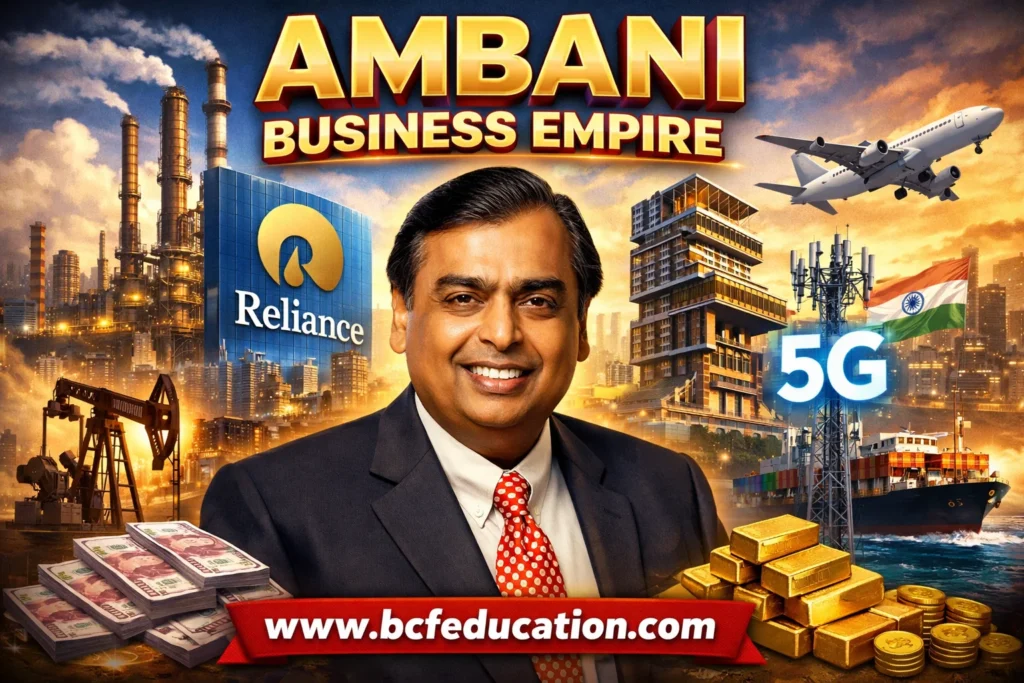
Ambani Business Empire
From Small Trading Firm to Global Conglomerate
The Ambani business story is one of the most remarkable entrepreneurial journeys in modern India. From a small trading company started by Dhirubhai Ambani, the empire grew into Reliance Industries, one of the largest and most profitable companies in India, now led by his son Mukesh Ambani.
This article explains how the Ambani business started, expanded, diversified, and reached massive global success — along with a detailed timeline and overview of their products and businesses.
1. The Beginning: Humble Origins (1950s–1960s)
Dhirubhai Ambani’s Early Life
- Born in 1932 in Gujarat, India.
- Came from a modest family background.
- Worked at a petrol station in Yemen in his early years.
After returning to India in 1958, Dhirubhai started a small trading business in Mumbai with limited capital.
1958 – Formation of Reliance Commercial Corporation
- Started as a small firm trading spices and polyester yarn.
- Focused on imports and exports.
- Operated from a small office in Mumbai.
Dhirubhai believed in scale, risk-taking, and investing in manufacturing instead of just trading.
2. Entry into Textiles – The First Big Break (1966–1980)
1966 – First Textile Mill
Dhirubhai established a textile mill in Ahmedabad.
Brand: Vimal
- Launched textile brand “Vimal”
- Famous tagline: “Only Vimal”
- Built a strong retail network across India
This was the first major success of Reliance.
Why It Worked
- High-quality fabric
- Aggressive marketing
- Wide distribution
- Affordable pricing
Reliance became a trusted name in Indian households.
3. Public Investment Revolution (1977)
In 1977, Reliance became a publicly listed company.
Key Achievement:
- Thousands of small Indian investors invested in Reliance.
- Dhirubhai created an “equity culture” in India.
This public trust helped Reliance raise capital for expansion.
4. Petrochemicals & Refining Expansion (1980s–2000s)
Dhirubhai’s strategy was backward integration — controlling raw materials.
1980s – Entry into Petrochemicals
- Polyester fibers
- Plastics
- Chemicals
1991 – Economic Liberalization
India opened its economy. Reliance expanded aggressively.
Jamnagar Refinery (1999)
- Built one of the world’s largest oil refineries in Jamnagar, Gujarat.
- Made Reliance a global energy player.
After Dhirubhai’s death in 2002, the business split between his sons:
- Mukesh Ambani – Oil, Petrochemicals, Telecom
- Anil Ambani – Telecom, Power, Infrastructure
Mukesh’s company retained the name Reliance Industries.
5. Digital Revolution – Jio Era (2016 Onwards)
The biggest transformation came under Mukesh Ambani.
2016 – Launch of Jio
Brand: Jio
Impact:
- Free data and calls initially
- Revolutionized Indian telecom
- Made internet affordable for millions
- Forced competitors to reduce prices
Jio became India’s largest telecom operator within a few years.
6. Retail Expansion – Consumer Empire
Reliance expanded into retail through Reliance Retail.
Business Areas:
- Grocery stores
- Fashion brands
- Electronics
- Digital commerce
Reliance Retail is now one of India’s largest retail chains.
7. Global Investments & Partnerships
Between 2020–2023:
- Facebook (Meta) invested in Jio Platforms.
- Google invested in Jio.
- Global investors invested billions in Reliance.
Reliance became debt-free in record time by raising massive capital.
8. Major Products & Business Segments
Reliance Industries operates in multiple sectors:
1. Oil & Energy
- Crude oil refining
- Petroleum products
- Fuel stations
2. Petrochemicals
- Polymers
- Polyester
- Chemicals
3. Telecom
- Jio SIM services
- JioFiber broadband
- 5G services
- JioPhone
4. Retail
- Reliance Fresh
- Reliance Trends
- Digital electronics stores
- Online shopping platforms
5. Digital Services
- JioCinema
- JioTV
- Cloud services
- Financial services
9. Detailed Timeline of Ambani Business
| Year | Event |
|---|---|
| 1958 | Reliance Commercial Corporation started |
| 1966 | First textile mill established |
| 1977 | Reliance IPO launched |
| 1980s | Entry into petrochemicals |
| 1999 | Jamnagar refinery commissioned |
| 2002 | Dhirubhai Ambani passed away |
| 2005 | Business split between brothers |
| 2016 | Jio launched |
| 2020 | Major global investments in Jio |
| 2023–2025 | Expansion into green energy and global retail |
10. Revenue & Global Position
- Reliance Industries is among India’s largest companies by revenue.
- Mukesh Ambani is consistently among the richest people in Asia.
- Reliance operates in more than 100 countries.
The company generates billions of dollars annually across oil, telecom, retail, and digital services.
11. Why the Ambani Business Succeeded
1. Visionary Leadership
Dhirubhai focused on scale and long-term growth.
2. Backward Integration
Controlled supply chain from raw materials to retail.
3. Risk-Taking
Entering telecom with Jio was a bold move.
4. Capital Raising Strategy
Public investors + global investors.
5. Innovation
Affordable internet changed India’s digital landscape.
Mukesh Ambani: The Visionary Architect of Modern India’s Industrial Landscape
Mukesh Dhirubhai Ambani stands as a colossus in the world of business. As the chairman and managing director of Reliance Industries Limited (RIL), he has not only inherited an empire but has fundamentally reshaped it, steering India’s most valuable company into diverse sectors ranging from petrochemicals to a nation-wide digital revolution. As of early 2026, while his net worth experiences typical market fluctuations, his influence on the Indian economy and his ambitious vision for its future remain unparalleled .
Early Life and Foundational Years
Born on April 19, 1957, in Aden, Yemen, Mukesh Ambani’s story is intrinsically linked to the entrepreneurial spirit of his father, Dhirubhai Ambani. The family returned to India in 1958, settling in a modest two-bedroom apartment in Bhuleshwar, Mumbai. It was here that Dhirubhai laid the foundation of what would become a global conglomerate, starting with a textiles trading business .
Mukesh’s early life was grounded in humility and hard work. He attended the Hill Grange High School in Mumbai before pursuing a bachelor’s degree in chemical engineering from the University of Bombay (now the University of Mumbai) . His academic prowess took him to Stanford University in the United States to pursue an MBA. However, in a pivotal moment that defined his future, he dropped out in 1980 at his father’s request to return to India and help manage the family’s fast-growing but still-nascent business. His father famously believed that real-world experience was a more valuable classroom . At just 24, Mukesh was handed the reins to build a polyester filament yarn plant in Patalganga, a project that marked the beginning of Reliance’s backward integration from textiles to petrochemicals .
The Succession and the Sibling Rivalry
Following Dhirubhai Ambani’s death in 2002 without a clear will, the reins of the empire passed to his two sons, Mukesh and Anil. However, the brothers’ differing visions and growing tensions soon led to a highly publicized feud. In 2005, their mother, Kokilaben, brokered a peace deal that split the conglomerate. Under the agreement, Mukesh took control of the flagship Reliance Industries Limited, which included the crown jewel—the petrochemical, oil and gas refining assets. Anil received control of Reliance Communications, Reliance Energy, and Reliance Capital . This division allowed Mukesh to consolidate his focus on the industrial core of the business.
The Energy Behemoth: Building the Jamnagar Refinery
Mukesh Ambani’s first monumental achievement was the creation of the world’s largest grassroots petroleum refinery at Jamnagar, Gujarat. Commissioned in 1999 and expanded with a second unit in 2008, the complex is not just a refinery but a fully integrated petrochemicals plant with its own power generation and port facilities . This $6 billion project was a testament to his ability to execute projects of staggering scale and complexity. The Jamnagar refinery became the profit engine for RIL, providing the financial firepower for all future diversification. His engineering and business leadership in this sector was so profound that he was elected as a foreign associate of the U.S. National Academy of Engineering in 2016 .
Disrupting the Digital Landscape: The Jio Revolution
If the refineries were about industrial might, the launch of Reliance Jio in 2016 was about audacious vision. Ambani took the biggest risk of his career, investing over $25 billion to create a pan-India 4G network . At the time, data was expensive and slow, and many analysts were skeptical. Ambani’s philosophy, inherited from his father, was clear: focus on impacting a billion people, and success will follow. He later recounted telling his board, “In the worst case, we will not earn much return… But then, as Reliance, this will be the best philanthropy that we will have ever done in India because we will have digitised India” .
Jio offered free voice calls and drastically low-cost data, democratizing internet access for hundreds of millions of Indians. It forced a massive consolidation in the telecom sector and turned India into one of the world’s largest data markets. By August 2023, Jio’s customer base had crossed 450 million, and it was among the first to roll out 5G services across the country .
A Diversified Empire: Retail, Sports, and Media
Beyond energy and telecom, Ambani has methodically built a presence in almost every aspect of Indian consumer life.
- Reliance Retail, launched in 2006, has become India’s largest retailer, serving a customer base of over 249 million by 2023 .
- Through a subsidiary, he purchased the Mumbai Indians cricket team in 2008 for $111.9 million. Under his ownership, it became the most valuable franchise in the Indian Premier League (IPL) .
- In early 2024, he orchestrated a massive $8.5 billion joint venture between Reliance-controlled Viacom18 and Disney, creating one of India’s leading media companies to compete for over 750 million viewers .
Leadership Philosophy and Personal Sacrifice
Ambani’s leadership style is defined by long-term thinking and a focus on the “North Star”—the goal of creating national value. In a 2025 interview with McKinsey, he emphasized that organizations must be flexible enough to reinvent themselves every few years, and that “character is more important than competence” when building a team .
This commitment to the organization is mirrored in his personal financial discipline. Since the 2008-09 fiscal year, he has voluntarily capped his annual salary at ₹15 crore to set an example of moderation in managerial compensation. In the wake of the COVID-19 pandemic in 2020, he went a step further and decided to forego his entire salary—including allowances and commissions—entirely. He has maintained this for five consecutive years as of 2025, a rare example in the corporate world .
His personal life, however, often makes headlines for its opulence. He resides in Antilia, a 27-story, 400,000-square-foot private home in Mumbai, considered one of the most expensive residences in the world . The lavish wedding celebrations of his children, particularly his younger son Anant in 2024, have featured performances by global stars like Rihanna and Justin Bieber, attended by a who’s who of global tech and business leaders .
Navigating Challenges and Recent Setbacks
The path to the top has not been without controversy. Ambani and RIL have faced scrutiny over the years. In 2007, the company was fined by the Securities and Exchange Board of India (SEBI) for manipulating shares of a former Reliance subsidiary . More recently, RIL has faced criticism for importing large volumes of Russian oil following the invasion of Ukraine, a move that has drawn international attention, though it is in line with India’s national policy of securing affordable energy .
Financially, the beginning of 2026 presented a short-term challenge. A sustained fall in Reliance Industries’ share price led to an over $6.5 billion drop in Ambani’s net worth in the first few days of the year, briefly pushing him out of the exclusive $100 billion club . While this made him one of the biggest losers in the global wealth charts for that period, analysts viewed it as a market correction rather than a fundamental shift, with all eyes on the company’s quarterly performance .
The Next Frontier: Green Energy and the “Intelligence Era”
Never one to rest on past laurels, Mukesh Ambani has already charted the course for Reliance’s next transformation. He has committed to making RIL a net-zero carbon company by 2035, investing heavily in a green energy ecosystem encompassing solar PV modules, advanced battery storage, and electrolysers for green hydrogen .
Most recently, in February 2026, he unveiled his most ambitious vision yet: the “Intelligence Era.” Ambani pledged a massive investment of ₹10 lakh crore (over $115 billion) over the next seven years to build AI infrastructure in India . Echoing the Jio strategy, he aims to make AI affordable and accessible for every citizen, from farmers to small businesses. “India cannot afford to rent intelligence,” he declared. “Therefore, we will reduce the cost of intelligence as dramatically as we did the case of data” .
This initiative, Jio Intelligence, will build gigawatt-scale data centers powered by green energy in Jamnagar and create a nationwide network to deliver low-latency AI services. It is a fitting next chapter for a businessman whose philosophy remains rooted in a lesson from his father: “If you want to start a business to impact a billion people, then you have a good chance of success” .
Conclusion
The Ambani business journey is a story of ambition, risk, scale, and transformation. From a small trading company in 1958 to a global conglomerate spanning energy, telecom, retail, and digital services, the growth of Reliance Industries reflects strategic expansion and bold leadership.
From Dhirubhai’s dream to Mukesh Ambani’s digital revolution, the Ambani empire continues to shape India’s economy and global business landscape.