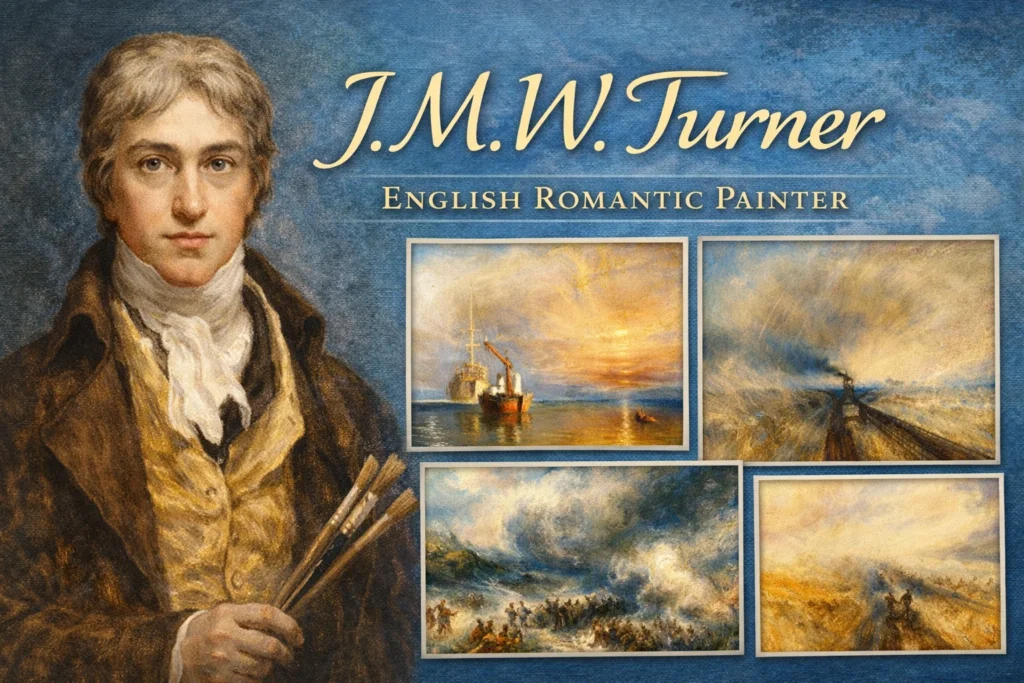
Joseph Mallord William Turner (1775–1851) was one of the greatest landscape painters in history. He is often called “the painter of light” because of his extraordinary ability to capture sunlight, storms, fire, sea, and atmosphere. His work influenced Impressionism and modern art many years after his death.
Early Life and Training (1775–1800)
Turner was born on April 23, 1775, in London, England. His father was a barber, and he proudly displayed his son’s drawings in his shop window.
At the age of 14, Turner entered the Royal Academy Schools in London. He first trained as a topographical draftsman, making detailed drawings of buildings and landscapes.
Early Style:
- Careful detail
- Accurate architectural drawing
- Influenced by classical landscape painters
- Mostly watercolor works
Important Early Works:
- 1796 – Fishermen at Sea (his first exhibited oil painting)
- 1798–1800 – Early coastal and architectural landscapes
Development of Style (1800–1820)
In this period, Turner traveled widely across Britain and Europe. He studied mountains, rivers, ruins, and seascapes.
He was inspired by:
- Claude Lorrain
- Nicolas Poussin
He began combining classical composition with dramatic natural light.
Techniques Used:
- Layered glazing in oils
- Strong contrasts between light and dark
- Dramatic skies
- Atmospheric perspective
Major Paintings:
- 1805 – The Shipwreck
- 1807 – The Sun Rising through Vapour
- 1812 – Snow Storm: Hannibal and His Army Crossing the Alps
Turner became famous for painting powerful natural forces — storms, wind, and light.
Mature Period – Master of Light (1820–1835)
This is considered Turner’s golden period. His brushwork became looser and more expressive. Light became the main subject of his paintings.
Mediums Used:
- Oil on canvas
- Watercolor on paper
- Gouache
- Ink sketches
Materials and Tools:
- Hog bristle brushes for thick paint
- Sable brushes for detail
- Palette knives
- Linseed oil for glazing
- Turpentine for thinning paint
- Natural pigments such as:
- Lead white
- Vermilion
- Ultramarine
- Chrome yellow
He experimented boldly with color and texture.
Major Paintings (1820–1835)
- 1822 – The Battle of Trafalgar
- 1829 – Ulysses Deriding Polyphemus
- 1834 – The Burning of the Houses of Lords and Commons
His painting of the burning Parliament shows his fascination with fire and glowing light.
Late Period – Almost Abstract (1835–1851)
In his later years, Turner’s paintings became more experimental. Forms dissolved into light and color. Many critics at the time did not understand his work.
Today, this period is considered revolutionary because it predicted Impressionism.
Characteristics of Late Style:
- Soft, blurred shapes
- Swirling brushwork
- Bright yellows and glowing whites
- Minimal detail
- Emotional atmosphere over realism
Famous Late Works:
- 1839 – The Fighting Temeraire
- 1840 – Slave Ship (Slavers Throwing Overboard the Dead and Dying)
- 1844 – Rain, Steam and Speed – The Great Western Railway
- 1842–1845 – Late Venetian watercolors
These paintings focus more on light and feeling than exact details.
Turner’s Painting Techniques
1. Glazing
Turner used thin transparent layers of oil paint to create glowing light effects. This technique made his skies look luminous.
2. Impasto
He sometimes applied thick paint using palette knives to create texture, especially in highlights.
3. Scraping and Wiping
Turner often scratched into wet paint or wiped sections away to create mist, rain, and light effects.
4. Watercolor Mastery
Turner was one of the greatest watercolor artists ever. He used:
- Wet-on-wet technique for soft skies
- Layering washes
- Controlled color bleeding
- Rapid sketching outdoors
His watercolor technique was revolutionary.
Chronological Timeline of Major Paintings
1796 – Fishermen at Sea
1805 – The Shipwreck
1812 – Snow Storm: Hannibal Crossing the Alps
1818 – The Field of Waterloo
1822 – The Battle of Trafalgar
1828 – The Bay of Baiae
1829 – Ulysses Deriding Polyphemus
1834 – The Burning of the Houses of Parliament
1839 – The Fighting Temeraire
1840 – Slave Ship
1842 – Peace – Burial at Sea
1844 – Rain, Steam and Speed
1845–1850 – Late abstract seascapes and Venetian scenes
Death and Legacy
Turner died in 1851 in London. He left many of his paintings to the British nation. Today, his works are displayed mainly in the Tate Britain in London.
He influenced:
- Claude Monet
- Camille Pissarro
- Later abstract painters
Turner is now considered one of the greatest Romantic painters and a pioneer of modern art.
Conclusion
William Turner transformed landscape painting forever. Through oil paints, watercolor mastery, glazing techniques, and bold experiments with light, he moved from detailed realism to near abstraction.
His art shows:
- The power of nature
- The beauty of light
- The emotion of storms, fire, and sea
More than a landscape painter, Turner was a visionary who painted the invisible forces of nature — light, atmosphere, and movement.