Volkswagen: From Origins to Global Success
1. Introduction
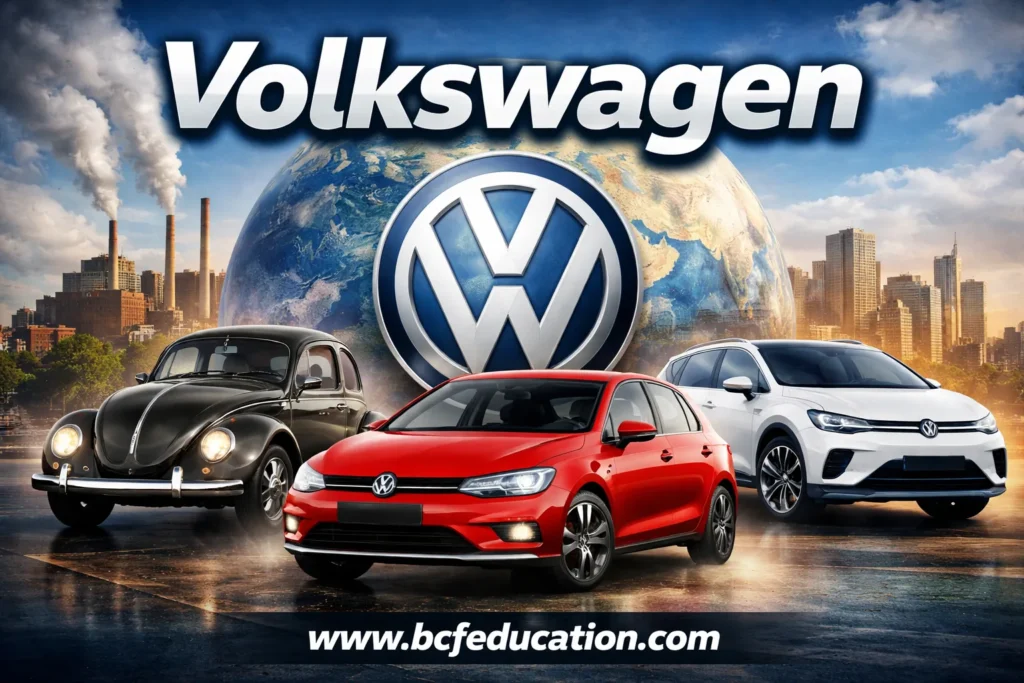
Volkswagen—often shortened to “VW”—is one of the world’s largest and most influential automobile manufacturers. Known for iconic cars, engineering innovation, and global reach, the company’s journey from political beginnings to industrial dominance is both complex and fascinating.
Table of Contents
2. The Beginning: A “People’s Car” Vision
Volkswagen was founded in 1937 in Berlin under the direction of the German government. The name “Volkswagen” literally means “people’s car” in German.
The idea was strongly supported by Adolf Hitler, who wanted an affordable car for ordinary German citizens. He commissioned automotive engineer Ferdinand Porsche to design this vehicle.
The result was the Volkswagen Beetle, a simple, reliable, and economical car that would later become one of the most famous automobiles in history.
3. World War II and Setbacks
During World War II, Volkswagen’s production shifted from civilian cars to military vehicles. The factory suffered heavy damage due to bombings, and production nearly stopped.
At this point, Volkswagen’s future seemed uncertain.
4. Post-War Revival and the Beetle’s Rise
After the war, the company was revived under British supervision, particularly by Ivan Hirst, who played a key role in restarting production.
The Volkswagen Beetle became a global success in the 1950s and 1960s. Its:
- Affordable price
- Unique design
- Durability
made it extremely popular, especially in markets like the United States.
By the 1970s, the Beetle had become one of the best-selling cars of all time.
5. Expansion and Diversification
Volkswagen didn’t stop with one model. The company began expanding its product line and acquiring other brands.
Key developments included:
- Introduction of the Volkswagen Golf (a modern compact car)
- Acquisition of brands like:
- Audi
- Porsche
- Lamborghini
- Bentley
This transformed Volkswagen into a multi-brand automotive group catering to different market segments—from economy cars to luxury and sports vehicles.
6. Innovation and Globalization
Volkswagen invested heavily in:
- Research and development
- Fuel efficiency technologies
- Safety systems
- Electric vehicles
The company expanded production facilities across Europe, Asia, and the Americas, becoming a truly global manufacturer.
Its strategy focused on:
- Standardized platforms (cost efficiency)
- Strong brand portfolio
- Global market penetration
7. Challenges and the Diesel Scandal
In 2015, Volkswagen faced a major crisis known as the Volkswagen emissions scandal.
The company was found to have installed software in diesel vehicles to cheat emissions tests. This led to:
- Billions of dollars in fines
- Loss of public trust
- Leadership changes
Despite this, Volkswagen took corrective actions and began focusing more on sustainability and transparency.
8. Transition to Electric Future
After the scandal, Volkswagen shifted its strategy toward electric mobility.
Key initiatives include:
- Development of electric vehicles like the ID series
- Investment in battery technology
- Commitment to reducing carbon emissions
Volkswagen aims to become a leader in the global electric vehicle market.
9. Reasons Behind Volkswagen’s Success
Volkswagen’s rise can be attributed to several key factors:
1. Strong Vision
The idea of a “people’s car” created a clear and powerful mission.
2. Iconic Products
Cars like the Beetle and Golf built strong brand recognition.
3. Strategic Expansion
Acquiring multiple brands allowed VW to dominate different market segments.
4. Innovation
Continuous investment in technology kept the company competitive.
5. Global Presence
Operating worldwide helped diversify risks and increase revenue.
6. Resilience
Even after major crises, Volkswagen adapted and recovered.
This expansion is built on three main pillars: Electrification, Software, and Battery Sovereignty.
1. Regional Expansion: “In Region, For Region”
Volkswagen is moving away from importing European designs to other markets. Instead, it is establishing massive local hubs to tailor products to regional tastes and dodge geopolitical trade barriers.
- China: VW is doubling down despite fierce local competition. They have established a massive R&D hub in Hefei with over 3,000 engineers to speed up development cycles by 30%. They are launching 30 new electric models in China by 2027 to regain market share from domestic rivals like BYD.
- North America: VW is aggressively expanding its footprint to qualify for U.S. tax credits. This includes:
- Scout Motors: Reviving the iconic American brand with a new EV plant in South Carolina, targeting production in 2026.
- St. Thomas Gigafactory: Building its largest battery plant to date in Ontario, Canada, to supply the entire North American market.
- India & SE Asia: With the Skoda brand exiting China in mid-2026, VW is shifting its “volume” focus to India and Southeast Asia, aiming to capture the growing middle-class market in these regions.
2. Vertical Expansion: PowerCo and Batteries
To stop being dependent on Asian battery suppliers (like CATL), Volkswagen created PowerCo. This is a dedicated battery company that is expanding globally:
- Unified Cell: VW has developed a “Unified Cell” design that will power 80% of its future EVs.
- Gigafactories: It is currently scaling production at plants in Salzgitter (Germany), Valencia (Spain), and St. Thomas (Canada).
- Energy Market: Through its subsidiary Elli, VW is expanding into the energy sector, offering stationary energy storage and bidirectional charging (using your car to power your house).
3. The Digital Expansion: The Rivian Partnership
Recognizing that its internal software unit, CARIAD, struggled to meet deadlines, VW recently expanded its capabilities through a $5.8 billion joint venture with Rivian.
- Objective: To integrate Rivian’s world-class “zonal” electrical architecture into future VW, Audi, and Porsche models.
- Outcome: This partnership allows VW to bypass years of software development delays, enabling “software-defined vehicles” that can be updated over-the-air just like a smartphone.
Summary of Targets (2026–2030)
| Area | Goal |
| EV Share | Aiming for 20–25% of global sales by 2026. |
| Battery Cost | Target 50% reduction in battery costs via the Unified Cell. |
| Profitability | Targeted operating margin of 8–9% by the late 2020s. |
Note: This expansion comes at a high cost. In 2025, VW’s profits were significantly impacted by U.S. tariffs and high R&D spending, proving that the transition from a “car maker” to a “tech driver” is a high-stakes gamble.