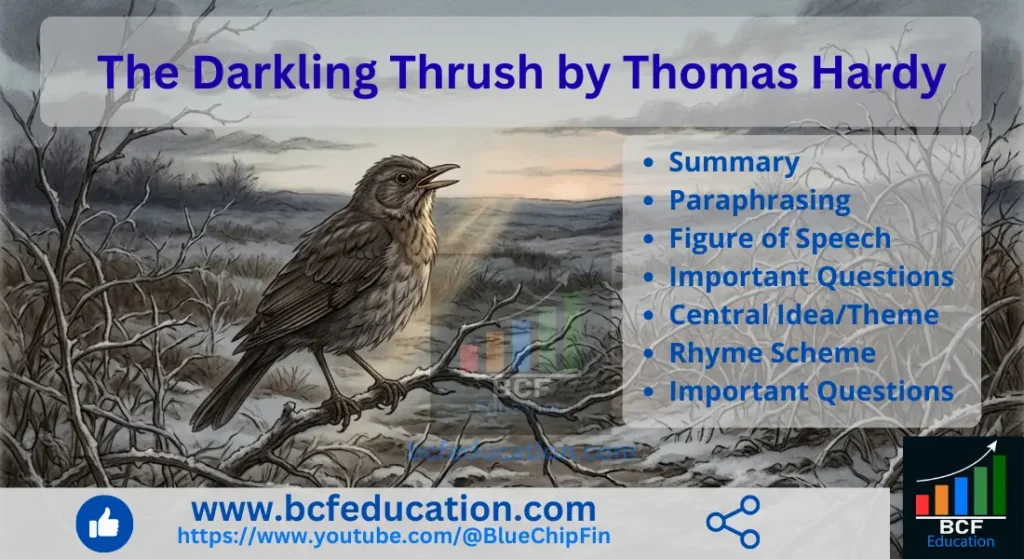
The Darkling Thrush by Thomas Hardy Summary Paraphrasing and Figure of Speech
“The Darkling Thrush” by Thomas Hardy is a thought-provoking poem included in the English I (HSSC I FBISE) syllabus. The poem presents a gloomy winter evening where the poet sees nature as lifeless and hopeless, symbolizing the end of an era. However, the sudden joyful song of a weak and aged thrush brings a contrast to this sadness. Through this, Hardy highlights the idea that even in times of despair, there may still be hope—though it is not always visible to everyone. The poem beautifully explores themes of pessimism, change, and the quiet presence of hope.
Table of Contents
Poem The Darkling Thrush by Thomas Hardy
| Poem The Darkling Thrush by Thomas Hardy |
| I leant upon a coppice gate |
| When Frost was spectre-grey, |
| And Winter’s dregs made desolate |
| The weakening eye of day. |
| The tangled bine-stems scored the sky |
| Like strings of broken lyres, |
| And all mankind that haunted nigh |
| Had sought their household fires. |
| The land’s sharp features seemed to be |
| The Century’s corpse out leant, |
| His crypt the cloudy canopy, |
| The wind his death-lament. |
| The ancient pulse of germ and birth |
| Was shrunken hard and dry, |
| And every spirit upon earth |
| Seemed fervourless as I. |
| At once a voice arose among |
| The bleak twigs overhead |
| In a full-hearted evensong |
| Of joy illimited; |
| An aged thrush, frail, gaunt, and small, |
| In blast-beruffled plume, |
| Had chosen thus to fling his soul |
| Upon the growing gloom. |
| So little cause for carolings |
| Of such ecstatic sound |
| Was written on terrestrial things |
| Afar or nigh around, |
| That I could think there trembled through |
| His happy good-night air |
| Some blessed Hope, whereof he knew |
| And I was unaware. |
1: Summary of the Poem
Imagine a cold, gloomy evening on December 31st, 1899 (the last day of the 19th century). The poet is leaning on a gate in the countryside. Everything looks dead, gray, and hopeless. The land feels like a corpse, and the wind sounds like a funeral song. Suddenly, a weak, old, scruffy bird (a thrush) starts singing a happy song with full energy. The poet is shocked because there is no reason to be happy—everything is sad. He then wonders if the bird knows about some “Hope” that he, the poet, cannot see. The poem is about finding a tiny spark of joy in a world full of despair.
2: Paraphrasing Stanza Wise (Easy Language)
Stanza 1: I was leaning on a wooden gate in the countryside. The frost looked ghostly gray. The last leftover parts of winter were making the daylight weak and sad. The tangled plant stems scratched across the sky like broken musical instruments. All the people who lived nearby had gone inside their warm homes to sit by their fires.
Stanza 2: The sharp, cold features of the land looked like the dead body of the 19th century (the 1800s) lying there. The cloudy sky was its tomb, and the wind was the sad song played at its funeral. The old energy of life, seeds, and birth had become dry and hard. Every living spirit on earth seemed as empty of excitement and passion as I was.
Stanza 3: Suddenly, a bird’s voice came from the bare, cold branches above my head. It was singing an evening song full of unlimited joy. It was an old thrush—weak, skinny, and small—with its feathers ruffled by the windstorm. It had chosen to pour its entire soul into the growing darkness.
Stanza 4: There was so little reason for such an ecstatic, happy song anywhere on earth, near or far. So, I started to think that perhaps some blessed Hope was trembling through its happy “good-night” song—a hope that the bird knew about, but I did not.
3: Paraphrasing Line by Line
| Original Line | Easy Paraphrase |
| I leant upon a coppice gate | I rested my body on a small wooden gate in the woods |
| When Frost was spectre-grey | When the frost looked ghostly gray |
| And Winter’s dregs made desolate | And the last dirty remains of winter made empty and sad |
| The weakening eye of day. | The weak, setting sun. |
| The tangled bine-stems scored the sky | The messy, twisted plant stems scratched lines across the sky |
| Like strings of broken lyres | Like the broken strings of an ancient guitar/harp |
| And all mankind that haunted nigh | And all the people who lived nearby |
| Had sought their household fires. | Had gone back to their warm home fires. |
| The land’s sharp features seemed to be | The sharp, cold hills and valleys of the land looked like |
| The Century’s corpse out leant | The dead body of the 19th century lying there |
| His crypt the cloudy canopy | Its tomb was the cloudy sky above |
| The wind his death-lament. | The wind was the funeral song for it. |
| The ancient pulse of germ and birth | The old, natural heartbeat of seeds growing and new life being born |
| Was shrunken hard and dry | Had become small, hard, and completely dry (like a dried-up raisin) |
| And every spirit upon earth | And every soul or living being on earth |
| Seemed fervourless as I. | Seemed as lacking in passion, energy, and hope as me. |
| At once a voice arose among | Suddenly, a singing voice came from inside |
| The bleak twigs overhead | The bare, cold, and sad small branches above me |
| In a full-hearted evensong | In a completely sincere and emotional evening song |
| Of joy illimited; | Full of unlimited / endless joy; |
| An aged thrush, frail, gaunt, and small | An old thrush bird, weak, very thin/skinny, and little |
| In blast-beruffled plume | With its feathers all messed up and ruffled by the strong wind |
| Had chosen thus to fling his soul | Had decided to throw his entire spirit and emotion |
| Upon the growing gloom. | Into the darkness that was getting stronger around him. |
| So little cause for carolings | There was so little reason for happy, Christmas-like songs |
| Of such ecstatic sound | That sounded so full of extreme joy |
| Was written on terrestrial things | Was visible or present in any physical thing on earth |
| Afar or nigh around, | Far away or close by, |
| That I could think there trembled through | That I started to believe there was shaking / vibrating through |
| His happy good-night air | His happy evening melody |
| Some blessed Hope, whereof he knew | Some holy or wonderful Hope, which the bird knew about |
| And I was unaware. | But I did not know about. |
4: Difficult Words & Their Meanings
| Word | Meaning (Student Friendly) |
| Coppice | A small group of trees or bushes that are cut back regularly. |
| Spectre-grey | Ghostly gray. |
| Dregs | The last leftover bits at the bottom of a cup (here, the worst part of winter). |
| Tangled bine-stems | Twisted, messy stems of climbing plants. |
| Scored | Scratched lines into. |
| Lyres | An ancient Greek musical instrument like a small harp. |
| Haunted nigh | Lived nearby or frequently visited the area. |
| Household fires | Home fireplaces. |
| The Century’s corpse | The dead body of the 19th century. |
| Crypt | An underground room where a dead body is kept (a tomb). |
| Death-lament | A sad funeral song for someone who has died. |
| Fervourless | Without passion, energy, or strong emotion. |
| Bleak | Cold, bare, empty, and sad. |
| Full-hearted evensong | A sincere evening song of prayer/praise (like church). |
| Illimited | Unlimited, without any boundary. |
| Gaunt | Extremely thin and bony (due to age or hunger). |
| Blast-beruffled plume | Feathers messed up by a strong windstorm. |
| Fling his soul | To throw all his emotion and energy into something. |
| Gloom | Darkness, sadness, hopelessness. |
| Carolings | Joyful songs (like Christmas carols). |
| Ecstatic | Overwhelming joy and happiness. |
| Terrestrial things | Earthly things, physical objects on land. |
| Good-night air | Evening tune or melody. |
5: Important Short Questions & Answers (2 marks each)
Q1: When does the poem take place?
A: The poem takes place on a cold winter evening, specifically at the end of the 19th century (December 31, 1899).
Q2: What is the condition of the thrush?
A: The thrush is old, weak, skinny (gaunt), small, and has its feathers ruffled by the wind.
Q3: Where are all the humans at the start of the poem?
A: All the humans have gone inside their homes to sit by their warm household fires.
Q4: What does the poet compare the tangled stems to?
A: He compares them to the broken strings of lyres (ancient harp-like instruments).
Q5: What is the “Century’s corpse”?
A: It is a metaphor for the dead 19th century (the 1800s), which is ending as the poem takes place.
Q6: Why is the poet surprised by the bird’s song?
A: He is surprised because everything in nature looks dead and hopeless. There seems to be “so little cause” for such a joyful song.
Q7: What does the poet finally think the bird might have?
A: The poet thinks the bird might have some “blessed Hope” that the poet himself is unaware of.
Q8: What is the rhyme scheme of the poem?
A: The rhyme scheme for each stanza is ABAB CDCD.
6: Important Long Questions & Answers (5-8 marks each)
Q1: Explain the contrast between the setting and the thrush’s song. Why is this contrast important?
Answer: The main contrast in the poem is between the dead, hopeless winter setting and the joyful, energetic song of the old thrush.
- The Setting: Hardy uses words like “spectre-grey,” “desolate,” “corpse,” “crypt,” “death-lament,” “shrunken hard and dry,” and “fervourless.” The land looks like a dead body. The wind sounds like a funeral song. Everything feels like the end of the world.
- The Thrush’s Song: Despite being “frail, gaunt, and small” with ruffled feathers, the bird sings a “full-hearted evensong / Of joy illimited.” The song is “ecstatic” and happy.
Importance: This contrast creates the central tension of the poem. Hardy shows that even in the darkest, most hopeless moments (the end of a century, the middle of winter), nature can produce a spark of irrational joy. The bird does not have a logical reason to be happy, but it sings anyway. This forces the poet (and the reader) to question their own despair and wonder if hope exists even when we cannot see it.
Q2: What is the significance of the “Hope” mentioned in the last line? Does the poet believe in it?
Answer: The “Hope” in the last line is mysterious and very important. Hardy writes that the bird knows about a “blessed Hope” that the poet is “unaware” of.
- Significance: This Hope represents the possibility of optimism, faith, or meaning in a world that looks completely meaningless. It is not a logical hope based on evidence (because the poet sees “so little cause” for it). Instead, it is a spiritual or emotional hope that comes from inside a living creature (the bird). The thrush represents the blind, persistent will to live and be joyful, even when life is hard.
- Does the poet believe? This is a tricky question. Hardy was known as a pessimist. The poet says he is “unaware” of this Hope—meaning he does not feel it himself. However, by even suggesting the possibility (“I could think there trembled through”), Hardy leaves the door open. He does not fully believe, but he is humble enough to admit that the bird might know something he doesn’t. It’s a moment of doubt about his own doubt.
7: Central Idea & Theme of the Poem
Central Idea (One sentence):
Even in a world that appears completely dead, hopeless, and despairing, a tiny spark of irrational joy and hope can still exist, often coming from the most unexpected and fragile sources.
Themes (Big ideas in the poem):
- Despair vs. Hope: The main battle in the poem. The setting shows total despair, but the bird’s song represents unexpected hope.
- Nature’s Resilience: Even when winter is harsh, nature (the thrush) finds a way to sing and survive.
- The End of an Era (Fin de Siècle): The poem was written in 1899, at the end of the 19th century. Hardy uses the dead land to represent the “dead” century and the uncertainty of the new one.
- Pessimism vs. Faith: The poet represents a pessimistic, logical view (no reason to be happy). The bird represents blind faith or instinctive joy.
- Isolation: The poet is alone, separated from mankind (who are inside by their fires), and even separated from understanding the bird’s joy.
8: Literary Devices / Figures of Speech / Poetic Devices
| Device | Definition | Example from Poem |
| Metaphor | Comparing two things without using “like” or “as” (direct comparison). | “The Century’s corpse” (The land is compared to a dead body). |
| Simile | Comparing two things using “like” or “as”. | “Like strings of broken lyres” (Stems are compared to broken strings). |
| Personification | Giving human qualities to non-human things. | “Frost was spectre-grey” (Frost is given a ghostly personality); “the weakening eye of day” (the sun is given an eye). |
| Imagery | Language that creates a picture in your mind (visual, auditory, etc.). | Visual: “spectre-grey,” “tangled bine-stems.” Auditory: “death-lament,” “full-hearted evensong.” |
| Alliteration | Repetition of the same starting sound in nearby words. | “dregs desolate,” “blast-beruffled,” “happy good-night” (consonance). |
| Synecdoche | Using a part to represent the whole. | “The weakening eye of day” (the eye represents the entire sun/day). |
| Oxymoron | Two opposite words placed together. | “Happy good-night air” (air is usually silent, but here it has a song). Also, “joy illimited” (joy is abstract but given space). |
| Contrast (Juxtaposition) | Placing two opposite things close together. | The dead land vs. the joyful bird; the poet’s hopelessness vs. the thrush’s ecstasy. |
| Symbolism | Using an object to represent an idea. | The thrush = unexpected hope and resilience. The winter = death and despair. |
9: Rhyme Scheme for Each Stanza
The rhyme scheme is exactly the same for all 4 stanzas. It is a ballad meter or alternating rhyme scheme.
| Stanza | Rhyme Scheme | Pattern |
| Stanza 1 | A B A B / C D C D | line 1 ends with “gate” (A), line 2 ends with “grey” (B), line 3 ends with “desolate” (A), line 4 ends with “day” (B). Then line 5 “sky” (C), line 6 “lyres” (D), line 7 “nigh” (C), line 8 “fires” (D). |
| Stanza 2 | A B A B / C D C D | Same pattern: outleant/canopy (A/B), lament/dry (A/B), earth/I (C/D). |
| Stanza 3 | A B A B / C D C D | Same pattern: among/illimited (A/B), small/plume (A/B), soul/gloom (C/D). |
| Stanza 4 | A B A B / C D C D | Same pattern: carolings/sound (A/B), around/unaware (C/D). |
Note: Hardy uses a slant rhyme (half rhyme) sometimes, like “outleant” and “canopy” – they don’t sound perfect, but they feel close enough.
10: Important MCQS of the Poem (Including Figure of Speech Related)
| No. | Question | Option A | Option B | Option C | Option D | Correct Answer |
| 1 | What is the poet leaning upon at the start of the poem? | A garden wall | A coppice gate | A church door | A tree trunk | B |
| 2 | What color is the frost described as? | White | Black | Spectre-grey | Silver | C |
| 3 | What does the poet compare the tangled bine-stems to? | Broken chains | Dead snakes | Strings of broken lyres | Old spider webs | C |
| 4 | Where have all the “mankind” gone? | To the church | To the fields | To their household fires | To the river | C |
| 5 | What does the land’s “sharp features” seem to be? | A sleeping giant | The Century’s corpse | A winter painting | An old map | B |
| 6 | What is the “cloudy canopy” described as? | A blanket | A roof | A crypt (tomb) | A curtain | C |
| 7 | What type of bird sings in the poem? | A robin | A nightingale | A thrush | A sparrow | C |
| 8 | Which of these words describes the bird’s physical condition? | Young and fat | Frail, gaunt, and small | Colorful and large | Fast and strong | B |
| 9 | What is the rhyme scheme of each stanza? | AABB CCDD | ABAB CDCD | ABBA ABBA | ABC ABC | B |
| 10 | “The ancient pulse of germ and birth / Was shrunken hard and dry” is an example of? | Simile | Hyperbole | Metaphor | Onomatopoeia | C |
| 11 | “Like strings of broken lyres” is an example of which literary device? | Metaphor | Simile | Personification | Alliteration | B |
| 12 | What does the bird “fling” upon the growing gloom? | A feather | His voice | His soul | A seed | C |
| 13 | What does the poet think is trembling through the bird’s song? | Fear | Cold wind | Some blessed Hope | A memory | C |
| 14 | What is the mood of the first two stanzas? | Joyful and excited | Hopeful and bright | Dark, hopeless, and dead | Angry and violent | C |
| 15 | What does “fervourless” mean? | Full of fire | Extremely cold | Without passion or energy | Bright and shiny | C |