English The Wind – by Robert Louis Stevenson
Introduction
English Themes
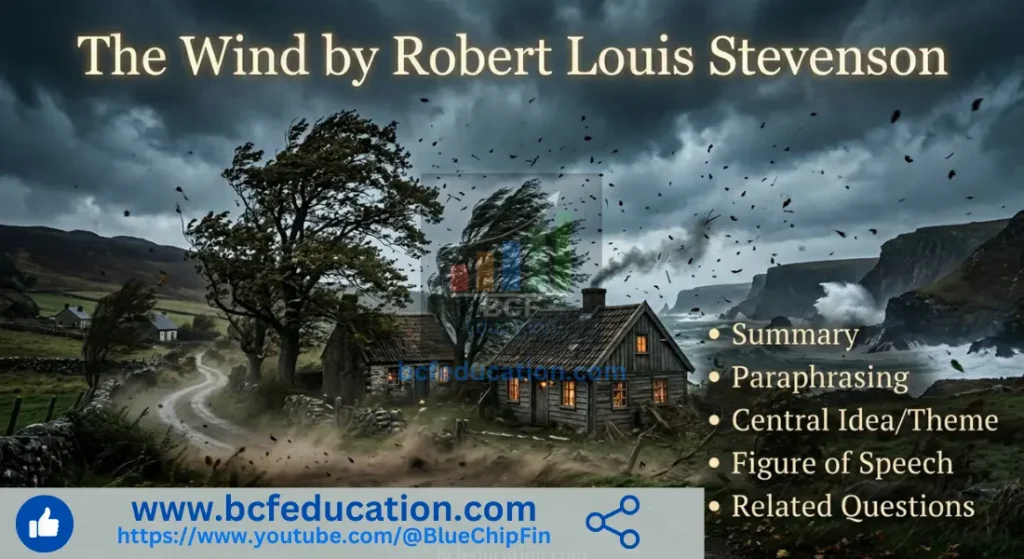
English poem, “The Wind” is a short, beautiful poem by the Scottish writer Robert Louis Stevenson. Written from a child’s point of view, the poem talks about how the wind is invisible yet powerful. We can see what the wind does—like moving kites, birds, and grass—but we can never see the wind itself. The poem captures a child’s natural curiosity and wonder about the world around us.
Summary
The speaker (a child) directly talks to the wind. He says he saw the wind lift kites high up and push birds across the sky. He heard the wind moving everywhere, making a soft sound like ladies’ dresses brushing over grass. But no matter how much he felt or heard the wind, he could never see it. In the last part, he asks playful questions: Is the wind young or old? Is it an animal? Or just a stronger child like him? The poem celebrates the unseen but very real forces of nature.
Stanza-wise Paraphrasing
Stanza 1
The speaker says he saw the wind throw kites high into the air and blow birds around the sky. He heard the wind passing all around him, moving softly across the grass like women’s skirts. Then he calls out to the wind, saying it blows all day long and sings a very loud song.
Stanza 2
The speaker saw many different things the wind did, but the wind always hid itself. He felt the wind push him, and he heard it call out, but he could not see it at all. Again, he addresses the wind as a constant, loud singer.
Stanza 3
The speaker asks the wind directly: You are strong and cold—are you young or old? Are you a wild animal of the fields and trees? Or are you just a child who is stronger than me? He ends again by calling the wind a loud, all-day singer.
Line-by-Line Paraphrasing
| Original Line | Meaning in Simple Words |
| I saw you toss the kites on high | I saw you throw the kites high up. |
| And blow the birds about the sky | And push the birds around in the sky. |
| And all around I heard you pass | I heard you moving everywhere around me. |
| Like ladies’ skirts across the grass | Like the soft rustle of women’s dresses on grass. |
| O wind, a-blowing all day long | O wind, you keep blowing the whole day. |
| O wind, that sings so loud a song! | O wind, you sing very loudly! |
| I saw the different things you did | I noticed all the actions you performed. |
| But always you yourself you hid | But you always stayed hidden. |
| I felt you push, I heard you call | I felt you push me and heard you shout. |
| I could not see yourself at all | I could not see you at all. |
| O you that are so strong and cold | O wind, you are very powerful and chilly. |
| O blower, are you young or old? | O wind, are you young or old? |
| Are you a beast of field and tree | Are you some animal from the fields and trees? |
| Or just a stronger child than me? | Or just a child stronger than me? |
Rhyming Scheme
Each stanza follows the same pattern: A A B B C C
- Stanza 1: high/sky (A), pass/grass (B), long/song (C)
- Stanza 2: did/hid (A), call/all (B), long/song (C)
- Stanza 3: cold/old (A), tree/me (B), long/song (C)
Tip: The last two lines of every stanza are exactly the same (refrain).
Central Idea
The poem teaches us that nature is powerful and mysterious. We cannot see everything (like the wind), but we can feel its effects. The poem encourages us to be curious and wonder about the natural world around us.
Themes
Invisible forces of nature – The wind can be felt and heard but never seen.
- Childlike wonder – The speaker asks innocent, imaginative questions.
- Power and softness – The wind is both strong (tossing kites) and gentle (like skirts on grass).
- Personification – The wind is treated like a living person or animal that hides, sings, and blows.
Poem-Related Questions with Answers
Q1. Who is the speaker addressing in the poem?
A1. The speaker is directly addressing the wind as if it were a living person or creature.
Q2. What does the wind do in the first stanza?
A2. It tosses kites high, blows birds around the sky, and moves softly across the grass like ladies’ skirts.
Q3. Why can’t the speaker see the wind?
A3. Because the wind is naturally invisible. We can only see its effects, not the wind itself.
Q4. What questions does the speaker ask in the last stanza?
A4. He asks if the wind is young or old, if it is a beast of the field and tree, or just a stronger child than him.
Q5. What is the rhyme scheme of the poem?
A5. The rhyme scheme of each stanza is AABBCC.
Q6. What literary device is used in “Like ladies’ skirts across the grass”?
A6. Simile – because it compares the wind’s movement to ladies’ skirts using the word “like.”
Q7. What is the tone of the poem?
A7. The tone is curious, playful, imaginative, and full of wonder.
Q8. Why does the poet repeat the lines “O wind, a-blowing all day long, / O wind, that sings so loud a song!”?
A8. The repetition creates rhythm, emphasizes that the wind is always present, and acts as a refrain that connects all three stanzas.
Q9. What is the central idea of the poem in your own words?
A9. The central idea is that nature’s forces may be invisible but are very real and powerful. We should observe and wonder about them.
Q10. How does the poet personify the wind?
A10. The poet calls the wind a “blower,” says it “sings,” “hides,” “calls,” and asks if it is young or old—all human or living qualities.
Multiple Choice Questions (MCQs)
- Who is the poet of “The Wind”? A) William Wordsworth B) Robert Frost C) Robert Louis Stevenson ✅ D) John Keats
- What does the wind do to the kites? A) Breaks them B) Lifts them high ✅ C) Tears them D) Hides them
- The wind is described as: A) Visible B) Silent C) Invisible ✅ D) Weak
- What comparison is used in the poem? A) Like fire B) Like water C) Like ladies’ skirts ✅ D) Like clouds
- What literary device is used in “wind sings”? A) Metaphor B) Personification ✅ C) Hyperbole D) Irony
- What is the rhyme scheme of each stanza? A) ABAB B) ABCABC C) AABBCC ✅ D) ABBA
- What is the tone of the poem? A) Sad and gloomy B) Angry and harsh C) Curious and playful ✅ D) Boring and dull
- What does the speaker ask in the last stanza? A) Where does the wind live? B) Is the wind young or old? ✅ C) Why is the wind cold? D) Does the wind have a family?
Short Questions
Q1. Why can’t the wind be seen? Answer: The wind is naturally invisible. We can only see its effects—like moving kites or blowing birds—but we cannot see the wind itself.
Q2. What things does the wind affect? Answer: The wind affects kites, birds, and grass. It tosses kites high, blows birds around the sky, and moves softly across the grass.
Q3. Why does the poet compare wind to a child? Answer: The poet compares the wind to a child to show curiosity and imagination. He wonders if the wind is just a stronger version of a child, which makes nature feel more playful and relatable.
Q4. What sound does the wind make? Answer: The wind makes a loud, musical sound that the poet calls “singing.” It is not a soft whisper but a strong, noticeable song.
Q5. What literary device is used in “Like ladies’ skirts across the grass”? Answer: This is a simile because it compares the wind’s movement to ladies’ skirts using the word “like.”
Long Questions
Q1. Describe the theme of the poem “The Wind.” Answer: The main themes of the poem are:
Invisible but powerful nature – The wind cannot be seen, but its effects are everywhere. This teaches us that some forces are real even if we cannot see them.
Childlike wonder and curiosity – The speaker asks playful questions like whether the wind is young or old, or if it is a beast or a child. This shows a child’s natural desire to understand the world.
Personification of nature – The wind is treated as a living being that sings, hides, calls, and blows. This makes nature feel alive and friendly.
Power and gentleness together – The wind is strong enough to toss kites but also soft like ladies’ skirts on grass. This balance shows nature’s many moods.
Q2. How does the poet describe the wind? Answer: The poet describes the wind in three main ways:
By its actions: It tosses kites high, blows birds about the sky, and passes across grass like ladies’ skirts.
By its invisible nature: The speaker sees what the wind does but never sees the wind itself. He feels it push and hears it call, but cannot find it.
By asking questions about it: In the last stanza, he wonders if the wind is young or old, a beast of field and tree, or just a stronger child than him.
Overall, the wind is shown as powerful, mysterious, cold, and constantly present.
🧾 Important Literary Devices (with Examples) Device Meaning Example from Poem Personification Giving human qualities to non-human things “O wind, that sings so loud a song!” (Wind cannot really sing) Simile Comparison using “like” or “as” “Like ladies’ skirts across the grass” Repetition Repeating same lines for rhythm and emphasis “O wind, a-blowing all day long, / O wind, that sings so loud a song!” (repeated in every stanza) Refrain A repeated line or group of lines The last two lines of each stanza are exactly the same Rhyme Scheme Pattern of rhyming words at line ends AABBCC in each stanza Imagery Creating a picture in the reader’s mind “I saw you toss the kites on high” – we can picture kites flying up 🖊️ Essay (Exam Ready – 150–200 Words) Title: The Mystery of Nature in “The Wind” Introduction “The Wind” by Robert Louis Stevenson is a simple but meaningful poem. It is written from a child’s point of view and explores how the wind is invisible yet powerful. The poet shows us that we can see what the wind does, but we can never see the wind itself.
Body The poem describes the wind lifting kites high, pushing birds around the sky, and moving softly across the grass like ladies’ skirts. The speaker feels the wind pushing him and hears it calling, but he cannot see it anywhere. This creates a sense of mystery. In the final stanza, the speaker asks playful questions: Is the wind young or old? Is it a wild animal? Or just a stronger child? These questions show a child’s natural curiosity about nature.
The poet uses personification (wind sings), simile (like ladies’ skirts), and repetition (the refrain “O wind…”) to make the poem lively and musical. The rhyme scheme AABBCC gives it a sing-song quality that fits a child’s voice.
Conclusion
In conclusion, the poem teaches us that not everything in nature can be seen, but it can still be experienced. The wind is invisible, but its presence is everywhere. Stevenson beautifully captures the wonder, mystery, and power of the natural world through a child’s innocent eyes.