Let’s Get Connected: A Super Simple Guide to Conjunctions (With Tons of Examples). Do you struggle with joining words, ideas, or sentences in English? Don’t worry! In this post, we’ll break down conjunctions into three easy types. You’ll learn what they are, how to use them, and see lots of real-life examples.
By the end, you’ll be joining sentences like a pro. Perfect for students, beginners, or anyone who wants to write better. You can explore more for HSSC I English. Prepared according to all boards, as FBISE, BISERWP, BISE LHR etc.
Table of Contents
Let’s Get Connected: A Super Simple Guide to Conjunctions (With Tons of Examples)
Conjunction
Have you ever tried to build a bridge? Not a real one made of steel, but a bridge between words and sentences? That’s exactly what a conjunction does.
A conjunction is a small word (or sometimes a pair of words) that connects two or more parts of a sentence. Without conjunctions, we would speak like robots:
“I like tea. I like coffee. I don’t like milk.”
With conjunctions:
“I like tea and coffee, but I don’t like milk.”
Much better, right?
Let’s explore the three main types of conjunctions in simple English, with plenty of examples for each.
Type 1: Coordinating Conjunctions (The Equal Friends)
These connect two equal parts of a sentence — like two words, two phrases, or two short sentences of the same importance.
There are only seven, and you can remember them with the word FANBOYS:
- F = For (explains reason)
- A = And (adds something)
- N = Nor (negative addition)
- B = But (shows contrast)
- O = Or (shows choice)
- Y = Yet (shows contrast, similar to “but”)
- S = So (shows result)
Examples for Coordinating Conjunctions:
- I wanted to play outside, but it was raining.
- She is smart and hardworking.
- You can have tea or coffee.
- He didn’t study, so he failed the test.
- I don’t like apples, nor do I like oranges.
- He is tired, yet he keeps working.
- I stayed home, for I was feeling sick.
- Hurry up, or you will miss the bus.
- She loves music, so she joined the school band.
- The room was small but very clean.
Type 2: Subordinating Conjunctions (The Boss and the Helper)
These connect a main sentence (which can stand alone) with a dependent sentence (which cannot stand alone). The subordinating conjunction shows a relationship like time, cause, condition, or contrast.
Common subordinating conjunctions:
because, although, if, when, while, since, unless, until, as, than, that, whereas, wherever, before, after
Examples for Subordinating Conjunctions:
- Because it was cold, I wore a jacket.
- You will pass if you study hard.
- Although he was tired, he finished his homework.
- I felt happy when she called me.
- Wait here until I come back.
- Since you are here, let’s start the meeting.
- He eats junk food as if he has no care in the world.
- She stayed quiet while the teacher was speaking.
- Before you go to bed, brush your teeth.
- Unless you apologize, I won’t talk to you.
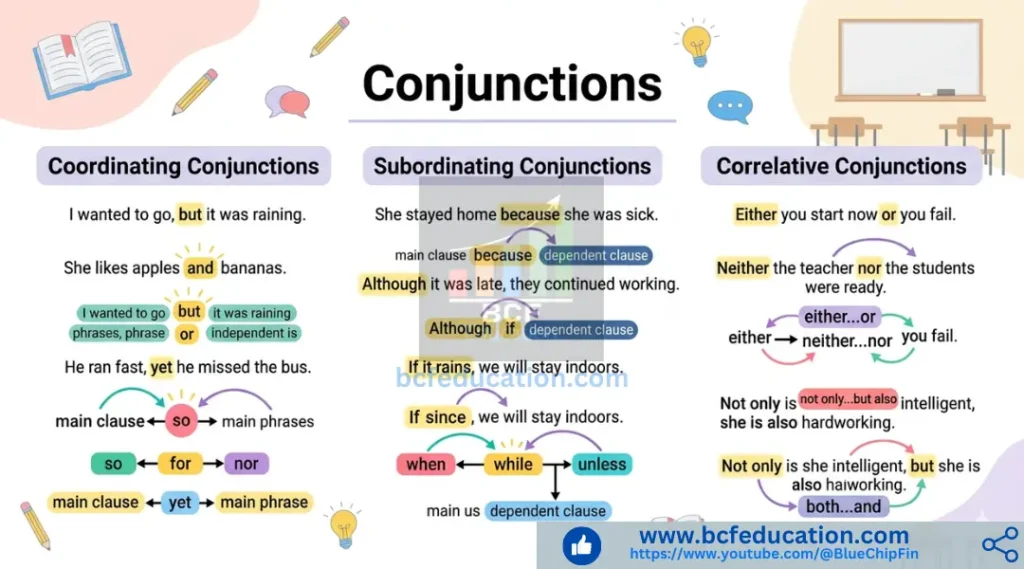
Type 3: Correlative Conjunctions (The Twins)
These come in pairs. They work together to connect two equal parts of a sentence.
Common pairs:
- either…or
- neither…nor
- both…and
- not only…but also
- whether…or
Examples for Correlative Conjunctions:
- You can either pay by cash or use a credit card.
- She is both kind and intelligent.
- Neither John nor Peter came to the party.
- He not only sings but also plays the guitar.
- I can’t decide whether to go or stay home.
- Both my brother and my sister love pizza.
- Either you finish your work or you cannot watch TV.
- She is not only a doctor but also a great writer.
- Neither the blue shirt nor the red one fits me.
- Whether it rains or shines, we will go to the park.
Quick Summary Table for You
| Type | Function | Example |
| Coordinating (FANBOYS) | Joins two equal parts | I like tea, but she likes coffee. |
| Subordinating | Joins main + dependent clause | Because I was late, I ran fast. |
| Correlative | Pairs of words working together | Both Ali and Sara are here. |
Final Tip
- Don’t try to memorize every conjunction today. Just remember:
- Use and to add.
- Use but or yet to contrast.
- Use or to give a choice.
- Use so or because to show reason or result.
- Use pairs like either/or and neither/nor to show options or negatives.
Once you start looking for conjunctions in the sentences you read or speak, you’ll notice them everywhere. And soon, you’ll use them like a natural.