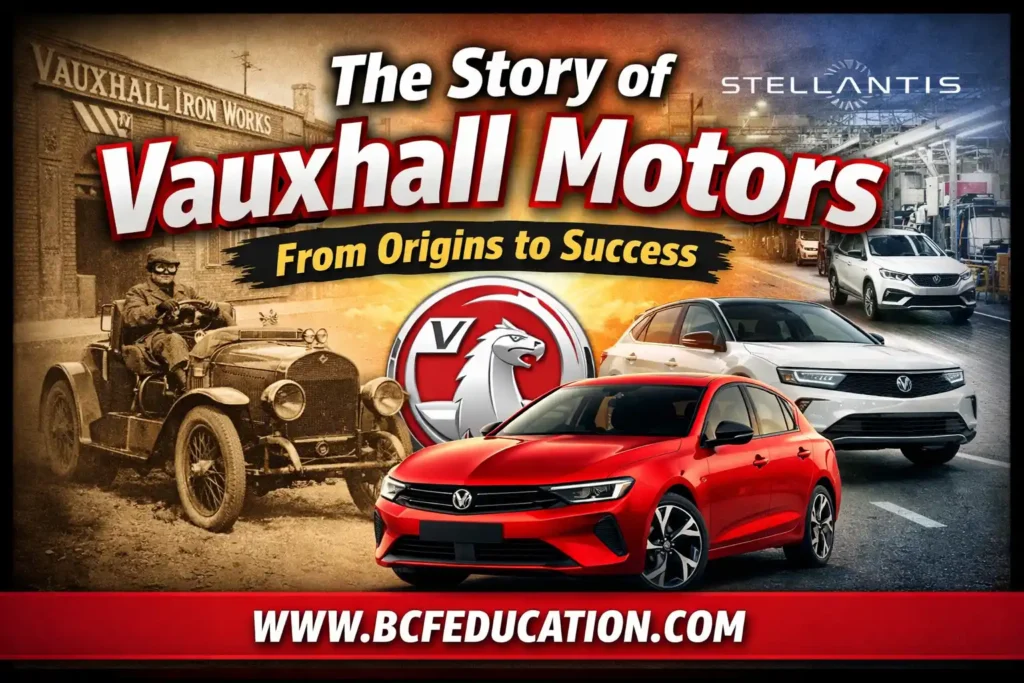
Vauxhall Motors – From Humble Beginnings to Automotive Success
Vauxhall Motors is one of the most historic automobile manufacturers in the United Kingdom. Over more than a century, the company evolved from a small engineering workshop into a well-known automobile brand producing vehicles sold across Britain and Europe. Today, Vauxhall is part of the global automotive group Stellantis and remains a recognizable brand in the UK car market.
Early Beginnings (1857–1903)
The origins of Vauxhall Motors date back to 1857 when Scottish engineer Alexander Wilson founded a company in London called Alex Wilson and Company.
Initially, the business did not manufacture cars. Instead, it produced marine engines and pumps for boats and industrial machinery. The factory was located in the Vauxhall district of London, which later inspired the company’s name.
In 1897, the company was renamed Vauxhall Iron Works, reflecting its growing engineering capabilities.
Entry into Automobile Manufacturing (1903)
The company entered the automobile industry in 1903, producing its first car, a 5-horsepower single-cylinder vehicle. This marked the beginning of Vauxhall’s transition from industrial engineering to automobile production.
Soon after, the company moved its manufacturing operations to Luton, which became the long-term home of Vauxhall manufacturing.
The early vehicles were known for:
- Strong engineering quality
- Reliable engines
- Performance suitable for racing and road use
Growth and Racing Success (1910s–1920s)
One of the key figures behind the early success of Vauxhall was engineer Laurence Pomeroy.
He designed the famous Prince Henry model, inspired by the Prince Henry Trials motor race in Europe.
The Prince Henry Vauxhall became one of the most admired sports cars of the early 20th century, helping establish the company’s reputation for performance and engineering excellence.
Acquisition by General Motors (1925)
A major turning point came in 1925, when the American automotive giant General Motors acquired Vauxhall.
This partnership transformed the company by providing:
- Large-scale production technology
- Financial investment
- Access to international markets
Under General Motors, Vauxhall shifted toward mass-production vehicles aimed at everyday consumers rather than luxury cars.
Post-War Expansion (1945–1970s)
After World War II, demand for cars grew rapidly in the UK.
Vauxhall responded by producing practical family vehicles, including models such as:
- Vauxhall Victor
- Vauxhall Viva
These vehicles became extremely popular among British families during the 1950s and 1960s, helping the company expand its market share.
During this period, Vauxhall became one of the largest car manufacturers in Britain.
Modernization and European Integration (1980s–2000s)
In the late 20th century, General Motors integrated Vauxhall more closely with its German brand Opel.
This meant that many vehicles were shared designs between the two brands, with:
- Opel models sold in Europe
- Vauxhall versions sold in the UK
Popular modern models included:
- Vauxhall Astra
- Vauxhall Corsa
- Vauxhall Insignia
These vehicles became some of the best-selling cars in the United Kingdom.
Sale to Groupe PSA (2017)
After nearly 92 years under General Motors, the company was sold in 2017 to the French automotive group Groupe PSA.
This deal included both:
- Vauxhall (UK market)
- Opel (European market)
The acquisition allowed PSA to strengthen its presence in Europe.
Formation of Stellantis (2021)
In 2021, Groupe PSA merged with Fiat Chrysler Automobiles to form the global automotive group Stellantis.
Today, Vauxhall operates as part of this large multinational company, which includes brands such as:
- Peugeot
- Citroën
- Jeep
- Fiat
Key Vauxhall Products
Vauxhall produces a wide range of vehicles including small cars, family cars, SUVs, and electric vehicles.
Popular Models
- Vauxhall Corsa – One of the UK’s best-selling small cars
- Vauxhall Astra – A compact family hatchback
- Vauxhall Mokka – A stylish compact SUV
- Vauxhall Crossland – Practical crossover vehicle
- Vauxhall Vivaro – Commercial van for businesses
Electric Vehicle Transformation
In recent years, Vauxhall has been moving toward electric mobility.
Electric models include:
- Vauxhall Corsa Electric
- Vauxhall Mokka Electric
- Vauxhall Vivaro Electric
The company plans to become fully electric in the UK by 2028, aligning with global environmental goals.
Manufacturing and Headquarters
Vauxhall’s headquarters remain in Luton, England.
Key manufacturing locations include:
- Luton – Commercial vehicle production
- Ellesmere Port – Electric car manufacturing
These facilities play an important role in the British automotive industry.
Timeline of Major Events
| Year | Event |
|---|---|
| 1857 | Company founded as Alex Wilson and Company |
| 1897 | Renamed Vauxhall Iron Works |
| 1903 | First Vauxhall car produced |
| 1925 | Acquired by General Motors |
| 1945–1960s | Major growth with family vehicles |
| 2017 | Sold to Groupe PSA |
| 2021 | Became part of Stellantis |
Conclusion
From a small London engineering workshop in 1857 to a major automotive brand, Vauxhall Motors has experienced more than 160 years of innovation and transformation. Strategic partnerships with General Motors, Groupe PSA, and now Stellantis helped the company expand globally while maintaining a strong identity in the UK market.
Today, Vauxhall is focusing on electric vehicles, sustainability, and modern technology, positioning itself for the future of transportation while building on its rich automotive heritage.