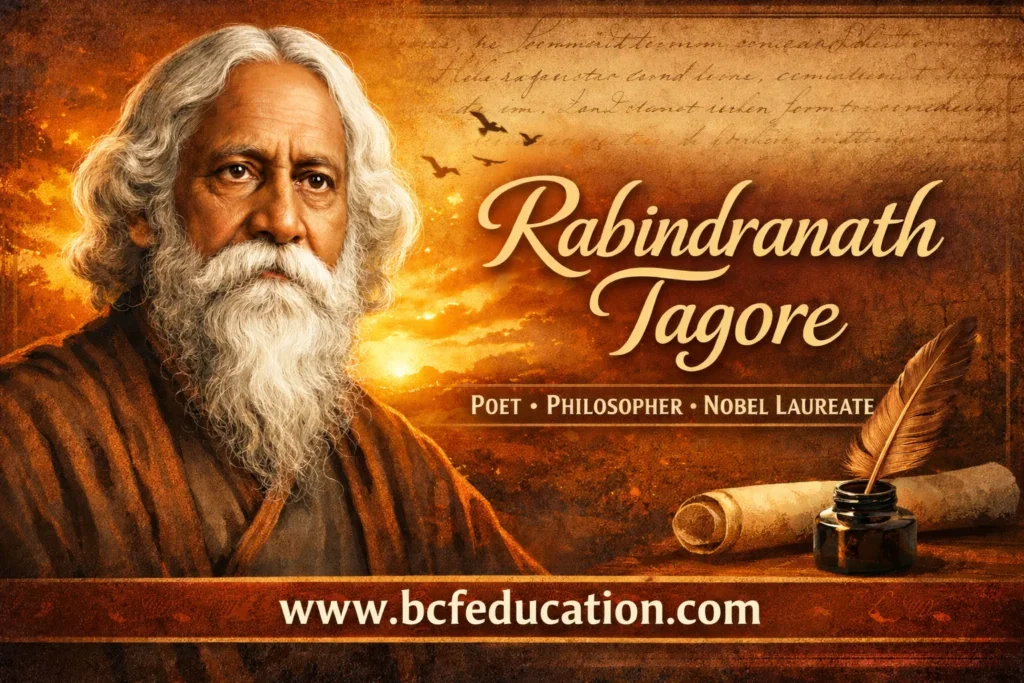
Rabindranath Tagore: A Detailed Biography
Rabindranath Tagore (7 May 1861 – 7 August 1941) was one of the greatest literary figures of modern India and a towering intellectual of world literature. A poet, philosopher, novelist, dramatist, composer, painter, and educationist, Tagore reshaped Bengali literature and music while also contributing profoundly to global thought. He was the first non-European to win the Nobel Prize in Literature, awarded in 1913 for his collection Gitanjali. His life and work reflect a rare synthesis of art, spirituality, humanism, and social reform.
Early Life and Family Background
Rabindranath Tagore was born on 7 May 1861 in Calcutta (now Kolkata), in the Jorasanko Thakur Bari, the ancestral home of the Tagore family. His family belonged to the Brahmo Samaj, a reformist movement within Hinduism that emphasized monotheism, rational thought, and social reform.
His father, Debendranath Tagore, was a philosopher and religious reformer, and his mother, Sarada Devi, passed away when Rabindranath was very young. He was the youngest of thirteen children. The Tagore household was intellectually vibrant—filled with music, literature, art, and discussions on religion and philosophy—which deeply shaped Rabindranath’s creative and intellectual development.
Tagore disliked formal schooling and was largely educated at home by tutors. He began writing poetry at a very young age and published his first poems under the pseudonym “Bhanusimha” when he was still a teenager.
Education and Early Travels
In 1878, Tagore traveled to England to study law, but he soon abandoned formal studies, preferring independent learning. During his stay, he was exposed to Western literature, music, and philosophy, which broadened his worldview. However, he remained deeply rooted in Indian cultural and spiritual traditions.
This blending of Eastern and Western thought later became a defining feature of his work.
Literary Career
Rabindranath Tagore’s literary output was vast and remarkably diverse. He wrote poetry, short stories, novels, essays, plays, and songs, primarily in Bengali, though many of his works were later translated into English and other languages.
Poetry
Tagore is best known for his poetry, which explores themes of nature, love, devotion, human freedom, and the divine. His most famous poetry collection, Gitanjali (Song Offerings), brought him international acclaim. Its deeply spiritual and lyrical poems resonated with readers worldwide.
Fiction and Short Stories
Tagore was also a pioneer of the modern Bengali short story. His stories often dealt with social issues, including gender inequality, poverty, rigid traditions, and the conflict between individual desire and social norms. Notable works include Kabuliwala, The Postmaster, and The Home and the World (Ghare-Baire).
Drama and Essays
His plays, such as Dak Ghar (The Post Office) and Raktakarabi (Red Oleanders), are rich in symbolism and philosophical depth. His essays addressed education, nationalism, culture, and humanity, showing his role as a public intellectual.
Music and Artistic Contributions
Tagore composed over 2,000 songs, known collectively as Rabindra Sangeet, which remain central to Bengali culture. His compositions combined classical Indian music with folk and Western influences.
Remarkably, Tagore also took up painting in his later years and gained international recognition as a visual artist, with exhibitions held across Europe.
Nobel Prize and International Recognition
In 1913, Rabindranath Tagore was awarded the Nobel Prize in Literature for Gitanjali, making him the first Asian Nobel laureate. This brought Indian literature to the global stage and established Tagore as an international literary figure.
He traveled extensively across Europe, the Americas, East Asia, and the Middle East, delivering lectures and engaging with leading thinkers such as Albert Einstein, W.B. Yeats, and Romain Rolland.
Educational Philosophy and Santiniketan
Tagore was deeply dissatisfied with colonial education systems. In 1901, he founded an experimental school at Santiniketan, which later became Visva-Bharati University in 1921. His vision was to create an institution where the world meets in a single nest, blending global knowledge with Indian traditions.
He emphasized learning in harmony with nature, creativity, freedom of thought, and the moral development of individuals.
Views on Nationalism and Social Reform
Though deeply patriotic, Tagore was critical of narrow nationalism and blind political fanaticism. He supported India’s freedom struggle but warned against hatred and violence. In 1919, after the Jallianwala Bagh massacre, he renounced the knighthood awarded to him by the British government as a protest against colonial brutality.
Tagore consistently advocated for humanism, universalism, women’s emancipation, and social reform.
Rabindranath Tagore: Poet of the Universal Human Spirit
Rabindranath Tagore (1861–1941) stands as one of the greatest cultural figures of modern India and a towering voice in world literature. Poet, philosopher, novelist, dramatist, composer, painter, and educationist, Tagore reshaped Bengali literature and brought Indian thought to a global audience with a rare blend of lyric beauty and moral depth.
Born in Calcutta (now Kolkata) into the illustrious Tagore family, Rabindranath grew up in an environment steeped in art, music, and reformist ideas. Largely educated at home, he developed an independent mind early on, absorbing classical Indian traditions while engaging deeply with Western literature and philosophy. This synthesis would later become a hallmark of his work.
Tagore’s literary output was vast and varied. He wrote poetry, short stories, novels, essays, and plays, often exploring themes of nature, love, freedom, spirituality, and the dignity of the individual. His poetry is especially celebrated for its musicality and emotional clarity. In 1910, he published Gitanjali (“Song Offerings”), a collection of devotional poems that expressed a profound, intimate relationship between the human soul and the divine. When Tagore translated parts of Gitanjali into English, the book captivated readers in the West. In 1913, he became the first Asian to win the Nobel Prize in Literature, a recognition that brought him international fame.
Beyond literature, Tagore was a visionary thinker. He believed in universal humanism and opposed narrow nationalism, advocating instead for harmony between cultures. His ideas were shaped by a deep concern for social justice, education, and freedom of thought. While he criticized British colonial rule, he also warned against blind nationalism that could lead to hatred and division. His debates and dialogues with contemporaries like Mahatma Gandhi reveal a mind both principled and open to questioning.
Tagore’s contribution to music is equally remarkable. He composed over 2,000 songs, known collectively as Rabindra Sangeet, which remain deeply woven into Bengali cultural life. Two of his compositions became national anthems: India’s “Jana Gana Mana” and Bangladesh’s “Amar Shonar Bangla,” a rare testament to his enduring influence.
As an educationist, Tagore founded Visva-Bharati University at Santiniketan, envisioning it as a place where learning would be free, creative, and connected to nature. He rejected rigid, mechanical schooling and promoted an education that nurtured imagination, ethical values, and global understanding.
In his later years, Tagore also took up painting, producing bold and expressive works that reflected his restless creativity. Until his death in 1941, he continued to write and reflect on the challenges of the modern world.
Rabindranath Tagore’s legacy lies not only in his extraordinary body of work but in his vision of humanity—one that transcends borders, celebrates beauty, and seeks truth through compassion and creativity. His words continue to inspire readers across generations, reminding us of the enduring power of art to illuminate the human condition.