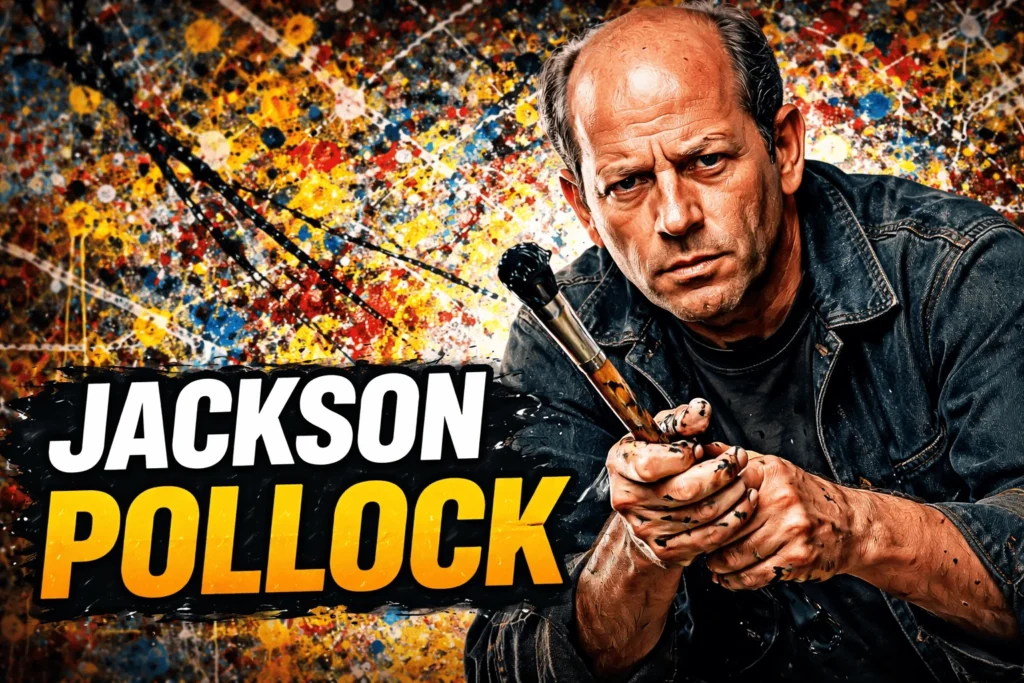
Jackson Pollock (1912–1956) was one of the most revolutionary artists of the 20th century and a central figure in the rise of Abstract Expressionism. His radical “drip painting” technique transformed modern art and shifted the global art center from Europe to the United States. Pollock redefined painting—not as an image to be composed carefully on an easel—but as an event, an act of movement and energy.
Table of Contents
Early Life (1912–1930s)
- Born January 28, 1912, in Cody, Wyoming, USA.
- Raised in California and Arizona.
- Influenced early by Native American sand painting traditions, especially their ritualistic floor-based methods.
- In 1930, moved to New York to study at the Art Students League under Thomas Hart Benton.
Benton’s emphasis on rhythm and movement deeply influenced Pollock’s later dynamic compositions, even though Pollock eventually rejected realism.
During the 1930s:
- Worked under the Federal Art Project (WPA).
- Studied Mexican muralists such as Diego Rivera and José Clemente Orozco.
- Explored Jungian psychology and symbolism.
Artistic Evolution
1️⃣ Early Figurative & Surrealist Period (1930s–Early 1940s)
Pollock’s early works contained:
- Mythological imagery
- Dark palettes
- Symbolic figures
- Influences from Surrealism and Picasso
Example:
Guardians of the Secret
Shows symbolic forms inspired by Jungian archetypes.
2️⃣ The Drip Period (1947–1950)
This is Pollock’s most famous and groundbreaking phase.
He developed what became known as “Action Painting.”
Instead of painting on an easel, Pollock:
- Placed canvas on the floor
- Walked around it
- Dripped, poured, and flung paint
This method allowed him to:
- Enter the painting physically
- Create 360-degree compositions
- Remove traditional foreground and background
Major Works from This Period:
- No. 5, 1948
- Autumn Rhythm (Number 30)
- Blue Poles
These works are characterized by:
- Dense webs of line
- All-over composition
- No central focal point
- Rhythmic movement
3️⃣ Late Black & White Series (1951–1953)
Pollock shifted to:
- Thinner paint
- Stark black enamel on raw canvas
- More open compositions
Example:
Echo: Number 25, 1951
This period showed more control and structure compared to the chaotic drip works.
Mediums and Materials: Technical Breakdown
Pollock’s material choices were radical for fine art at the time.
🎨 1️⃣ Paint Types
Industrial Enamel Paint
Pollock famously used:
- Synthetic resin-based enamel house paint
- Brands like Duco and commercial hardware paints
Why enamel?
- More fluid than oil paint
- Dripped smoothly
- Dried quickly
- Allowed continuous movement
He rarely used traditional artist oil paints during his drip period.
🖌 2️⃣ Tools Used
Pollock rejected traditional brushes.
Instead, he used:
- Sticks
- Hardened brushes
- Trowels
- Palette knives
- Turkey basters
- Syringes
- Direct pouring from cans
He sometimes embedded objects into paint.
He once said:
“I prefer sticks, trowels, knives, and dripping fluid paint.”
🧱 3️⃣ Surface & Ground
Canvas
- Unstretched canvas
- Laid directly on studio floor
- Often raw (unprimed)
This allowed paint to:
- Soak into fibers
- Create stain effects
- Become part of the material itself
In some works:
- Light priming was applied
- Sometimes Masonite board was used
🎯 4️⃣ Technique: The Drip Method
Pollock did NOT randomly splash paint.
Scientific analysis shows:
- Controlled arm motion
- Rhythmic body movement
- Layered building of composition
- Fractal-like pattern repetition
Steps in process:
- Lay canvas flat
- Walk around and over it
- Drip from varying heights
- Layer multiple colors
- Rotate canvas for balance
The floor method gave him:
- Full body engagement
- No fixed orientation
- Gravity-assisted flow
🎨 5️⃣ Color Palette
During peak drip years:
- Black
- White
- Aluminum paint
- Earth tones
- Occasionally blue and yellow
Unlike Matisse, Pollock focused less on color harmony and more on energy and structure.
🧪 6️⃣ Scientific & Material Innovation
Studies show:
- His paintings contain fractal geometry
- Complex layering with controlled chaos
- Precise paint viscosity control
He adjusted:
- Paint thickness
- Speed of movement
- Distance from canvas
Pollock was experimenting physically with matter.
Exhibition History & Recognition
- First major solo show: 1943 (Peggy Guggenheim’s Art of This Century Gallery)
- 1949: Featured in Life Magazine (“Is he the greatest living painter in the United States?”)
- Became symbol of American modernism during Cold War era
- International exhibitions elevated New York as global art capital
Personal Life & Struggles
Pollock struggled with:
- Alcoholism
- Depression
- Volatile temperament
He married painter Lee Krasner in 1945.
She played a crucial role in managing his career and preserving his legacy.
Pollock died in a car accident in 1956 at age 44.
Artistic Philosophy
Pollock believed:
- Painting is an act, not an image.
- Art should express subconscious emotion.
- Control and accident coexist.
He famously said:
“I am nature.”
Legacy
Pollock:
- Redefined painting as performance
- Influenced performance art
- Influenced contemporary installation art
- Inspired minimalism and process art
His work shifted art from representation to pure gesture.
Final Insight
Jackson Pollock turned:
- The floor into a studio tool
- Gravity into a collaborator
- Paint into motion
- The body into the brush
His art is not about what we see —
it is about the act of making.