
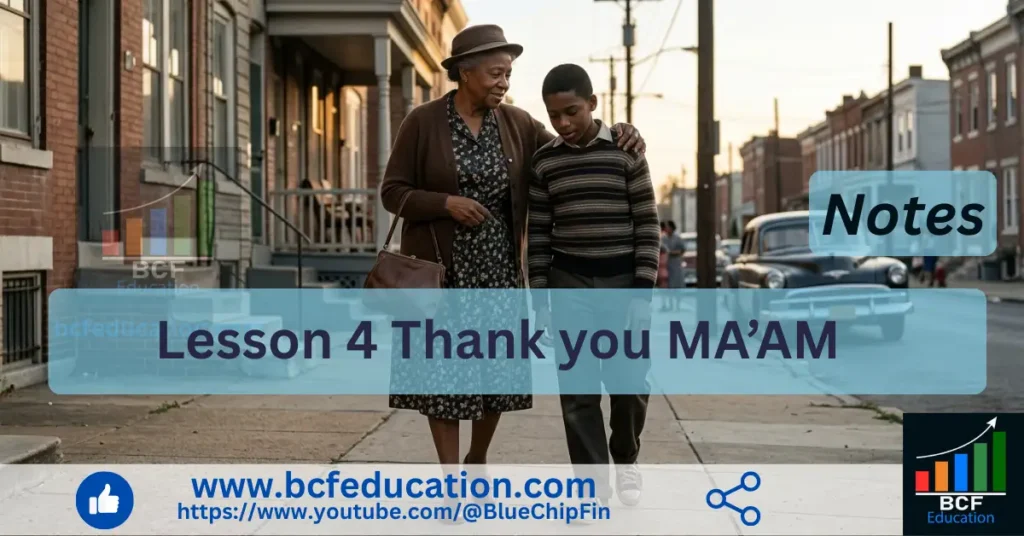
In this helpful blog post, I’ve solved all the exercises for Lesson 4: Thank You, Ma’am from the English SSC II (10th Class) textbook of the Federal Board of Intermediate and Secondary Education, Islamabad FBISE. From comprehension questions, vocabulary, and grammar to translation and writing tasks—this post covers everything you need to prepare for your board exams. Ideal for students looking for accurate, easy-to-understand solutions that follow the official FBISE syllabus. Master this heartwarming story and boost your exam confidence today!. For other lessons and their solved exercises, follow the link
Table of Contents
Understanding Lesson 4 Thank you MA’AM
Lesson 4 Thank you MA’AM
She was a large woman with a large purse that had everything in it but hammer and nails. It had a long strap,
and she carried it slung across her shoulder. Itwas about eleven o’clock at night, and she was walking alone, when a boy ran up behind her and tried to snatch her purse. The strap broke with the single tug the boy gave it from behind. But the boys weight and the weight of the purse combined caused him to lose his balance so, instead of taking off full blast as he had hoped, the boy fell on his back on the sidewalk, and his legs flew up. The large woman simply turned around and kicked him right square in his blue-jeaned sitter. Then she reached down, picked the boy up by his shirt front, and shook him until his teeth rattled.
After that the woman said, ” Pick up my pocketbook, boy, and give it here.” She still held him. But she bent down enough to permit him to stoop and pick up her purse. Then she said, “Now aren’t you ashamed of yourself?”
Firmly gripped by his shirt front, the boy said,”Yes’m.”
The woman said, “What did you want to do it for?”
The boy said, “I didn’t aim to.”
She said, “You a lie!”
By that time two or three people passed, stopped, turned to look, and some stood watching.
“If I turn you loose, will you run?” asked the woman.
“Yes’m,” said the boy.
“Then I won’t turn you loose!” said the woman. She did not release him. ” I’m very sorry, lady, I’m
sorry,” whispered the boy.
“Um-hum! And your face is dirty. I got a great mind to wash your face for you. Ain’t you got nobody home to tell you to wash your face?”
“No’ma’am,” said the boy.
“Then it will get washed this evening,” said the large woman starting up the street, dragging the frightened boy behind her.
He looked as if he werefourteen or fifteen, frail and willow-wild, in tennis shoes and blue jeans.
The woman said, “You ought to be my son. I would teach you right from wrong. Least I can do right now is to wash your face. Are you hungry?”
“No’ma’am,” said the being dragged boy. “I just want you to tum me loose.”
“Was I bothering you when I turned that corner?”‘ asked the woman.
“No’m.”
“But you put yourself in contact with me,” said the woman. ”If you think that that contact is not going to last awhile, you got another thought coming. When I get through with you, sir, you are going to remember Mrs. Luella Bates Washington Jones.”
Sweat popped out on the boy’s face and he began to struggle. Mrs. Jones stopped, jerked him around in front of her, put a half-nelson about his neck, and continued to drag him up the street. When she got to her door, she dragged the boy inside, down a hall, and into a large kitchenette furnished room at the rear of the house. She switched on the light and left the door open. The boy could hear other roomers laughing and talking in the large house. Some of their doors were open, too, so he knew he and the woman were not alone. The woman still had him by the neck in the middle of her room.
She said, “What is your name?”
“Roger,” answered the boy.
“Then, Roger, you go to that sink and wash your face,” said the woman, whereupon she turned him loose-at last. Roger looked at the door- looked at the woman- looked at the door-and went to the sink. Let the water run until.it gets warm,” she said. “Here’s a clean towel.”
“You gonna take me to jail?” asked the boy, bending over the sink.
“Not with that face, I would not take you nowhere,” said the woman. “Here I am trying to get home to cook me a bite to eat and you snatch my pocketbook! Maybe, you ain’t been to your supper either, late as it be. Have you?”
“There’s nobody home at my house,” said the boy.
“Then we’ll eat,” said the woman, “I believe you’re hungry- or been hungry-to try to snatch my pocketbook.”
“I wanted a pair of blue suede shoes,” said the boy.
“Well, you didn’t have to snatch my pocketbook to get some suede shoes,” said Mrs. Luella Bates Washington Jones. “You could’ve asked me.”
“M’am?”
The water dripping from his face, the boy looked at her. There was a long pause. A very long pause. After he had dried his face and not knowing what else to do dried it again, the boy turned around, wondering what next. The door was open. He could make a dash for it down the hall. He could run, run, run, run, run!
The woman was sitting on the day-bed. After a while she said, “I were young once and I wanted things I could not get.”
There was another long pause. The boy’s mouth opened. Then he frowned, but not knowing he frowned. The woman said, “Um-hum! You thought I was going to say but, didn’t you? You thought I was going to say, but I didn’t snatch people’s pocketbooks. Well, I wasn’t going to say that.” Pause.
Silence. “I have done things, too, which I would not tell you, son- neither tell God, if he didn’t already know. So you set down while I fix us something to eat. You might run that comb through your hair so you will look presentable.”
In another corner of the room behind a screen was a gas plate and an icebox. Mrs. Jones got up and went behind the screen. The woman did not watch the boy to see if he was going to run now, nor did she watch her purse which she left behind her on the day-bed. But the boy took care to sit on the far side of ·the room where he thought she could easily see him out of the corner of her eye, if she wanted to. He did not trust the woman not to trust him. And he did not want to be mistrusted now.
“Do you need somebody to go to the store,” asked the boy, “maybe to get some milk or something?” “Don’t believe I do,” said the woman, “unless you just want sweet milk yourself. I was going to make cocoa out of this canned milk I got here.”
“That will be fine,” said the boy.
She heated some lima beans she had in the icebox, made the cocoa, and set the table. The woman did not ask the boy anything about where he lived, or his folks, or anything else that would embarrass him. Instead, as they ate, she told him about her job in a hotel beauty-shop that stayed open late, what the work was like, and how all kinds of women came in and out, blondes, red-heads, and Spanish. Then she cut him a half of her ten-cent cake.
“Eat some more, son,” she said.
When they were finished eating she got up and said, “Now, here, take these ten dollars and buy yourself some blue suede shoes. And next time, do not make the mistake of latching onto my pocketbook nor nobody else’s- because shoes come by devilish ways will burn your feet. I got to get my rest now. But I wish you would behave yourself, son, from here on in.”
She led him down the hall to the front door and opened it. “Good-night! Behave yourself, boy!” she said, looking out into the street.
The boy wanted to say something else other than “Thank you, m’am” to Mrs. Luella Bates Washington Jones, but he couldn’t do so as he turned at the barren stoop and looked back at the large woman in the door. He barely managed to say “Thank you” before she shut the door. And he never saw her again.
Langston Hughes (1901-19 67), a key figure of the Harlem Renaissance in the 1920s, was a versatile writer known for his poetry, novels, short stones, essays, and plays. He aimed to authentically depict the experiences of working-class Black Americans, away from idealized portrayals or harmful stereotypes. The main message in Langston Hughes· short story “Thank You, Ma’am” is the power of kindness, compassion, and second chances in influencing a person’s life. Through the interaction between Mrs. Luella Bates Washington Jones and the young boy, Roger, Hughes emphasis that understanding and empathy can be more transformative than punishment. Mrs. Jones chooses to care for Roger and teach him a lesson about trust and respect, demonstrating that positive reinforcement and human connection can lead to personal growth and moral reflection.
African American English, also known as AAVE or Black English, reflects the rich linguistic heritage and cultural identity of African American communities in the United States. It includes unique grammar, such as habitual “be” (e.g., “She be singing”), double negatives for emphasis (“I don’t know nothing”), and simplification of verb endings (“He walkin”‘). Vocabulary may differ, with terms like “yo” for “your” or
“ain’t” for “isn’t.” Pronunciation can vary, like dropping final consonants (“gain'”) or vowel shifts (“ax”
instead of “ask”). Additionally, AAVE often embraces creative language use, like slang.
Questions
1) What would you do if someone tries to snatch something away from you?
I would try to protect my belongings and call for help if necessary. I would also try to stay calm and avoid harming the other person.
2) Why do you think people try to take things that do not belong to them?
People often do this because of poverty, lack of guidance, or wrong choices. Sometimes they are influenced by bad circumstances or desperation.
3) What does the large woman do immediately after the boy tries to snatch her purse, and how does she handle the situation?
The large woman catches the boy, shakes him, and holds him firmly. Instead of punishing him, she takes control of the situation calmly and wisely.
4) Do you think the woman’s approach toward the boy will lead to a positive change in his behaviour? Why or why not?
Yes, her kindness and understanding will likely change his behavior. She treats him with respect and teaches him a moral lesson without harsh punishment.
5) If you were in the boy’s place, how would you react to Mrs. Jones’ actions? How might this incident influence your future choices?
I would feel ashamed and grateful for her kindness. This incident would make me think carefully before making wrong choices in the future.
6) What did the large woman have in her purse, and what was missing from it?
She had money and other personal items in her purse. However, it did not have much money, which the boy expected to find.
7) How did the boy try to snatch the woman’s purse, and what happened as a result?
The boy ran up behind the woman and tried to snatch her purse. He lost his balance, fell down, and was caught by the woman.
8) Describe the woman’s reaction when the boy tried to snatch her purse.
The woman reacted bravely and confidently. She caught the boy, scolded him, and decided to teach him a lesson through kindness.
9) Why did the boy want the woman to turn him loose?
The boy was frightened and ashamed. He wanted to escape because he feared punishment or being handed over to the police.
10) What reason did the boy give for trying to snatch the woman’s purse, and how did the woman respond?
The boy said he wanted money to buy blue suede shoes. The woman understood his desire but told him that stealing was not the right way.
11) What did the woman offer the boy after bringing him into her home?
She offered him food, allowed him to wash his face, and gave him money to buy the shoes he wanted.
12) How did the woman’s attitude change towards the boy by the end of the story?
By the end, her attitude became caring and motherly. She trusted him and treated him with kindness and respect.
13) Have you ever received kindness or understanding from someone when you least expected it? How did it affect your behavior or perspective afterward?
Yes, such kindness makes a person feel valued and responsible. It encourages positive behavior and motivates one to do better in life.
Vocabulary & Grammar
A. Connotations vs Den notations:
Connotations and denotations are two aspects of word meanings that play a crucial role in understanding language. They represent different layers of meaning associated with words.
Denotations:
Denotation refers to the literal or dictionary definition of a word, its primary and explicit meaning.
Example: The denotation of the word “snake” is, a long, legless reptile.
Connotations:
Connotation refers to the emotional, cultural, or social associations and secondary meanings that a word carries beyond its literal or dictionary definition. Example: The word “snake” may have connotations of deceit or danger, as snakes are often used metaphorically to represent these qualities in various cultures.
More Examples:
Home vs house
Denotation: A place where one lives; a residence.
Connotation: Warmth, comfort, security, and emotional attachment. Saying Tm going home” may
evoke positive feelings beyond the literal meaning. “House” might lack the emotional warmth associated with the connotation of “home.”
Slim vs. Skinny:
Denotation: Both words may refer to a person who is thin.
Connotation: “Slim” may have a more positive connotation, suggesting a healthy and attractive thinness. On the other hand, “skinny” may carry a more negative connotation, implying a lack of health or an unattractive thinness.
Youthful vs Immature
Denotation: Having the characteristics of youth; young in appearance, lacking experience
Connotation: Energetic, fresh, vibrant. Describing someone as “youthful” often carries a positive and lively connotation. “Immature” carries a negative connotation, suggesting a lack of maturity and experience.
B: Give the denotative and connotative meanings of the following pair of words and use them in your own sentences:
Thrifty vs. Cheap
Determined vs. Stubborn
Wise vs. Cunning
Frugal vs. Stingy
Confident vs. Arrogant
Answer:
1) Thrifty vs. Cheap
Thrifty
Denotative meaning: Careful in spending money
Connotative meaning: Positive; sensible and responsible
Sentence: A thrifty person saves money for future needs.
Cheap
Denotative meaning: Low in price or unwilling to spend
Connotative meaning: Negative; miserly and low-minded
Sentence: He is so cheap that he never helps anyone.
2) Determined vs. Stubborn
Determined
Denotative meaning: Firmly decided to achieve a goal
Connotative meaning: Positive; strong-willed and focused
Sentence: She is determined to succeed through hard work.
Stubborn
Denotative meaning: Unwilling to change one’s opinion
Connotative meaning: Negative; rigid and unreasonable
Sentence: He is too stubborn to accept good advice.
3) Wise vs. Cunning
Wise
Denotative meaning: Having good judgment and knowledge
Connotative meaning: Positive; thoughtful and intelligent
Sentence: A wise teacher guides students with patience.
Cunning
Denotative meaning: Clever in achieving one’s aims
Connotative meaning: Negative; deceitful and tricky
Sentence: The cunning man fooled others for his benefit.
4) Frugal vs. Stingy
Frugal
Denotative meaning: Careful in using money and resources
Connotative meaning: Positive; economical and practical
Sentence: She lives a frugal life to manage her expenses.
Stingy
Denotative meaning: Unwilling to spend or share
Connotative meaning: Negative; mean and selfish
Sentence: A stingy person avoids helping even close friends.
5) Confident vs. Arrogant
Confident
Denotative meaning: Sure of one’s abilities
Connotative meaning: Positive; self-assured and calm
Sentence: He spoke confidently during the presentation.
Arrogant
Denotative meaning: Having an exaggerated sense of self-importance
Connotative meaning: Negative; proud and disrespectful
Sentence: His arrogant behavior offended everyone.
C. Adverbs:
let’s revise adverbs that we have learnt in earlier grades.
Adverbs are words that modify or describe verbs, adjectives, or other adverbs in a sentence. They provide additional information about how, ·when, where, or to what degree an action is performed.
Examples:
• Sadia walked gracefully to receive her award.
• We will meet you soon at the park for our morning walk.
• The children played outside in the garden.
• Tehmina goes to the gym regularly to stay fit.
• The weather turned very cold, catching everyone off guard.
Types of adverbs:
All adverbs do not end with -Ly. That is only one type of adverbs (adverb of manner). let’s look at different types of adverbs:
Adverb of Place
They help you talk about where things are. Behind, Here, Above
Adverb of Time
They help you know what time is it. Now, Soon, Often
Adverb of Manner
They show how something is done. Well, Badly, loudly
Adverb of Frequency
They help you say how many times something happens. Always, Often, Something
Adverb of Degree
They help you say how much something happens. Very, Too, Quite
Adverb of Reason
These adverbs help us understand the reasons. So, Thus, Hence
Examples:
Adverb of Manner:
They help you know what time is it.
Now, Soon, Often
They help you say how much something happens.
Very, Too, Quite
He spoke confidently during the business presentation.
Adverb of Time:
They will arrive early for the movie at the cinema.
Adverb of Place:
The cat slept underneath the cozy blanket.
Place: (Where the action took place)
Example: They found the treasure in the ancient cave.
Adverbial Phrase: in the ancient cave
Frequency: (How often the action takes place)
Example: They meet twice a month.
Adverbial Phrase: twice a month
Degree: (To what extent)
Example: She was somewhat disappointed.
Adverbial Phrase: somewhat disappointed
E: Read the following sentences and identify the adverbial phrases. Consider the questions they answer (how, when, where, etc.) and the role they play in modifying the verbs, adjectives, or adverbs.
- She completed the puzzle with great concentration.
- We will meet at the park after sunset.
- The students gathered in the library to study for their exams.
- He exercises at the gym three times a week.
- The temperature dropped quite suddenly in, the evening.
- They danced with incredible grace at the party.
- The train departed at midnight.
- She visits her grandparents every summer.
- He spoke with a surprisingly loud voice during the presentation.
- The mountain climbers reached the summit with considerable difficulty.
Answer:
i. She completed the puzzle with great concentration.
Adverbial phrase: with great concentration
Question answered: How?
Role: Modifies the verb completed
ii. We will meet at the park after sunset.
Adverbial phrases: at the park / after sunset
Questions answered: Where? / When?
Role: Modify the verb will meet
iii. The students gathered in the library to study for their exams.
Adverbial phrases: in the library / to study for their exams
Questions answered: Where? / Why?
Role: Modify the verb gathered
iv. He exercises at the gym three times a week.
Adverbial phrases: at the gym / three times a week
Questions answered: Where? / How often?
Role: Modify the verb exercises
v. The temperature dropped quite suddenly in the evening.
Adverbial phrases: quite suddenly / in the evening
Questions answered: How? / When?
Role: Modify the verb dropped
vi. They danced with incredible grace at the party.
Adverbial phrases: with incredible grace / at the party
Questions answered: How? / Where?
Role: Modify the verb danced
vii. The train departed at midnight.
Adverbial phrase: at midnight
Question answered: When?
Role: Modifies the verb departed
viii. She visits her grandparents every summer.
Adverbial phrase: every summer
Question answered: When?
Role: Modifies the verb visits
ix. He spoke with a surprisingly loud voice during the presentation.
Adverbial phrases: with a surprisingly loud voice / during the presentation
Questions answered: How? / When?
Role: Modify the verb spoke
x. The mountain climbers reached the summit with considerable difficulty.
Adverbial phrase: with considerable difficulty
Question answered: How?
Role: Modifies the verb reached
F. Verbals:
Verbals are verbs that appear as nouns, adjectives, and adverbs. Three types of verbals: gerunds, participles,
and infinitives function as other parts of speech. The function of gerunds are as nouns and they end in ·ing.
Gerunds
Gerunds are verb forms that function as nouns, ending in “‘ing” They represent actions or activities and can serve various roles in a sentence.
Examples:
Swimming is my favorite summer activity.
In this sentence, “swimming” is a gerund functioning as the subject.
I enjoy reading novels in my free time.
Here, “‘reading”‘ acts as the direct object of the verb “enjoy.”
Adverb of Frequency:
She checks her email every morning for important updates.
Adverb of Degree:
The temperature dropped too low after the sun set.
Order of Adverbs in a sentence:
When there is more than one adverb in a sentence describing a verb, they usually go in this order:
manner, place (location), frequency, time, reason/purpose.
It is uncommon to use all five types of adverbs to modify the same word.
Examples:
| Subject | Verbs | Adverb of Manner | Adv. Place | Adv. frequency | Adv. Time |
| Khalid | swims | enthusiastically | In his pool | daily | Before dusk |
| Dad | walked | impatiently | To the garage | Before work | |
| Jahangir | sleeps | happily | After lunch |
Q: Read the following sentences and identify the adverbs. Also mention the type of adverb.
i. Javeria confidently answered all the questions during the interview. She speaks English fluently and practices attentively every day at the language institute.
ii. Laila quickly completed her homework before heading to the library. She studies diligently and always finishes her assignments on time to relax.
iii. Murtasim patiently waited for his friends at the cafe. He usually meets them on Fridays after work for a relaxing evening.
Answer:
- Sentence:
Javeria confidently answered all the questions during the interview. She speaks English fluently and practices attentively every day at the language institute.
| Adverb | Type of Adverb |
| confidently | Adverb of Manner |
| fluently | Adverb of Manner |
| attentively | Adverb of Manner |
| every day | Adverb of Time |
- Sentence:
Laila quickly completed her homework before heading to the library. She studies diligently and always finishes her assignments on time to relax.
| Adverb | Type of Adverb |
| quickly | Adverb of Manner |
| diligently | Adverb of Manner |
| always | Adverb of Frequency |
| on time | Adverb of Time |
- Sentence:
Murtasim patiently waited for his friends at the cafe. He usually meets them on Fridays after work for a relaxing evening.
| Adverb | Type of Adverb |
| patiently | Adverb of Manner |
| usually | Adverb of Frequency |
| on Fridays | Adverb of Time |
| after work | Adverb of Time |
D. Adverb phrase
An adverbial phrase is a group of words that functions as an adverb, providing additional information about the manner, time, place, frequency, or degree of an action or the circumstances surrounding it. Adverbial phrases often answer questions such as how, when, where, why, or to what extent.
Adverbial phrases are typically formed by groups of words that act together to modify a verb, an adjective, or another adverb. They can be single words or longer phrases.
Usage with Examples:
Manner: (How the act ion was done)
Example: He completed the task with great precision.
Adverbial Phrase: with great precision
Time: (When the action took place)
Example: She will arrive after the meeting.
Adverbial Phrase: after the meeting
G: Read the passage and identify the gerunds.
Life on a Farm
The life on a farm is full of interesting activities. Reading by the barn, swimming in the pond, hiking through small hills, horse riding at sunset, farming from dawn till dusk, and cattle rearing with care are some of them. Each task woven into the rhythm of farm life, making every day an adventure under the wide sky.
Answer:
Gerunds in the Passage
A gerund is a verb ending in –ing that functions as a noun.
The gerunds in the passage are:
- Reading (by the barn)
- Swimming (in the pond)
- Hiking (through small hills)
- Riding (horse riding at sunset)
- Farming (from dawn till dusk)
- Rearing (cattle rearing with care)
- Making (making every day an adventure)
Infinitives
Infinitives are the base form of a verb, usually preceded by “to.” They function as nouns, adjectives, or adverbs it1 a sentence.
Examples:
• I like to read before bedtime. (Noun: Direct object)
• She has the determination to succeed. (Noun: Predicate)
• The decision to leave was difficult. (Noun: Subject)
• He is eager to learn new skills. (Adjective modifying “eager”)
• We have a plan to explore the city. (Adjective modifying “plan”)
Why do we use infinitives?
Infinitives are used to express purpose, intention, or desire. They often follow certain verbs (e.g., want, need, like) or function as the subject, object, or complement of a sentence.
H. Identify and underline the infinitive in each sentence.
- We decided to visit the museum next weekend.
- Aqsa’s goal is to complete the marathon in a record time.
- I would like to learn a new language before I turn 30.
- The best time to plant a tree is now.
- Our plan is to travel to Makkah next summer.
- I need to finish my homework before dinner.
- Hasan hopes to become a successful entrepreneur.
- It is essential to exercise regularly for good health.
- The purpose of the meeting is to discuss upcoming projects.
- Atiqa promised to help the community center with fund raising.
Answer:
- We decided to visit the museum next weekend.
- Aqsa’s goal is to complete the marathon in a record time.
- I would like to learn a new language before I turn 30.
- The best time to plant a tree is now.
- Our plan is to travel to Makkah next summer.
- I need to finish my homework before dinner.
- Hasan hopes to become a successful entrepreneur.
- It is essential to exercise regularly for good health.
- The purpose of the meeting is to discuss upcoming projects.
- Atiqa promised to help the community center with fund raising.
Review 1
Q No 1: Choose the correct option:
i. The courage of the firefighter saved many lives. The underlined word is a/an noun:
A) Concrete B) Abstract C) Collective D) Material
ii. Select the correct pair of concrete and abstract nouns from the options below.
A) Cat – Freedom B) Apple – Tasty C) Desk – Happy D) Chair – Sit
iii. Identify the noun phrase in the following sentence. “The quick brown fox jumps over the lazy dog.”
A) The quick brown fox B) Jumps over C) The lazy dog D) Over the lazy dog
iv. Choose the correct synonym for the word “happy”.
A) Sad B) Joyful C) Angry D) Tired
v. Choose the correct antonym for the word “ancient”.
A) Modern B) Old C) Historical D) Traditional
vi. Choose the correct sentence using past indefinite tense.
A) She was cooking dinner when I arrived.
B) She cooked dinner when I arrived.
C) She cooks dinner when I arrived.
D) She is cooking dinner when I arrived.
vii. I listened to the music you recommended. The underlined. word is a/an noun:
A) Abstract B) Collective C) Concrete D) Countable
Q. No 2: Read the given passage and answer the questions given at the end:
The James Webb Space Telescope (JWST) is an amazing observatory launched by NASA to explore the universe in great detail. With its advanced technology, JWST will change how we understand space, from how stars and planets form to the possibility of life on other planets. The telescope has a large mirror and very sensitive tools that can see faint infrared light from faraway galaxies.
Unlike the older Hubble Space Telescope, JWST can look through cosmic dust clouds, giving us a clearer view of hidden parts of space. This powerful telescope is a team effort by NASA, the European Space Agency (ESA), and the Canadian Space Agency (CSA). By discovering new secrets about the universe, JWST aims to inspire future scientists and expand our knowledge of space.
- What is the main goal of the James Webb Space Telescope (JWST)?
- What makes JWST different from the Hubble Space Telescope?
- What kind of light can JWST detect to explore faraway galaxies?
- Which organizations worked together to build JWST
- How might JWST affect future scientists?
- Identify the topic sentence of the paragraph.
- List the supporting details provided in the passage.
- Write a short summary of the passage.
Answer:
Main goal of JWST:
To explore the universe in great detail and improve our understanding of space.
Difference from Hubble Telescope:
JWST can see through cosmic dust clouds and observe infrared light.
Type of light detected:
Infrared light.
Organizations involved:
NASA, European Space Agency (ESA), and Canadian Space Agency (CSA).
Effect on future scientists:
It will inspire future scientists and expand scientific knowledge.
Topic sentence:
“The James Webb Space Telescope (JWST) is an amazing observatory launched by NASA to explore the universe in great detail.”
Supporting details:
Advanced technology
Large mirror
Ability to see infrared light
Can look through cosmic dust
International collaboration
Short summary:
The passage describes the James Webb Space Telescope, its advanced features, and how it differs from Hubble. It explains its ability to observe distant galaxies using infrared light. The telescope is a joint effort of multiple space agencies and aims to inspire future discoveries.
Q. No 3: Read the following sentences and underline the adverb phrases. Circle the adjective phrases.
1. The car with the broken headlight needs to be repaired.
2. She arrived earlier than expected.
3. The book on the top shelf is very old.
4. He runs with remarkable speed.
5. The painting by the famous artist was sold for a million dollars.
6. They traveled to the mountains last summer.
7. The girl in the blue dress is my sister.
8. He finished the test in a hurry.
Answer:
- The car (with the broken headlight) needs to be repaired. (Adjective Phrase)
- She arrived earlier than expected. (Adverb Phrase)
- The book (on the top shelf) is very old. (Adjective Phrase)
- He runs with remarkable speed. (Adverb Phrase)
- The painting (by the famous artist) was sold for a million dollars. (Adjective Phrase)
- They traveled to the mountains last summer. (Adverb Phrase)
- The girl (in the blue dress) is my sister. (Adjective Phrase)
- He finished the test in a hurry. (Adverb Phrase)
Q. No 4: Choose the correct modal (should, must, can, may) to fill in the blanks.
1. You _________ finish your homework before going out to play. Must
2. _________I borrow your book for a day? May
3. He _________ swim very well. Can
4. We _________ visit the museum this weekend if we have time. May
5. You _________ see a doctor if you’re feeling unwell. Should
6. Students _________ submit their assignments by Friday. Must
7. You _________ use your phone during the exam. Must not
8._________ you help me with my project? Can
Q. No 5: Identify and correct the mistakes in the use of infinitives and gerunds in the following sentences.
1. She enjoys to read books.
2. He wants becoming a pilot.
3. They practiced to play the guitar.
4. I decided going to the gym.
5. We need finishing the project by tomorrow.
Answer:
- She enjoys reading books.
- He wants to become a pilot.
- They practiced playing the guitar.
- I decided to go to the gym.
- We need to finish the project by tomorrow.
Q. No 6: Write an essay of 150-200 words on the following topic: “The Importance of Discipline in Student Life”
Answer:
The Importance of Discipline in Student Life
Discipline plays a vital role in the life of a student. It helps students develop good habits and maintain focus on their goals. A disciplined student manages time wisely and completes assignments regularly. Discipline teaches students respect for rules, teachers, and fellow students, which creates a positive learning environment.
In student life, discipline improves academic performance. When students follow a proper routine, they can balance studies, sports, and other activities effectively. Discipline also builds self-control and responsibility, which are essential for success in later life. It enables students to face challenges with patience and determination.
Moreover, discipline shapes character and moral values. It encourages honesty, punctuality, and dedication. Students who practice discipline grow into confident and successful individuals. Therefore, discipline is not only important for academic success but also for personal growth. In short, discipline is the key to a bright and successful future for students.