In this detailed blog post, I’ve provided complete, step-by-step solutions to all exercises from Lesson 3 Media Literacy in the Modern Age for English SSC II (10th Class) under the Federal Board of Intermediate and Secondary Education, Islamabad (FBISE). Perfect for exam preparation, this post covers short questions, translation, vocabulary, grammar, and writing tasks—all aligned with the official FBISE syllabus. Boost your understanding of critical media evaluation and ace your board exams with ease. For other lessons and their solved exercises, follow the link
Table of Contents
Lesson 3 Media Literacy in the Modern Age
Theme: Digital Globalization
Sub Theme: Impact on Culture and Economy
In the digital age, where the internet and diverse media platforms shape our daily lives, the significance of media literacy cannot be overstated. Media literacy, the ability to critically understand and evaluate content across various platforms, is a vital skill that transforms individuals from passive
Understanding Lesson 3 Media Literacy in the Modern Age
consumers into informed navigators of the complex web of modern information. We need to explore the evolving nature of media literacy, its key components, and its crucial role in fostering informed decision-making, active citizenship, and a resilient society.
• Media literacy is not merely about understanding content; it involves a comprehensive approach to assessing the purpose, message, and impact of information being viewed. It. Requires individuals to recognize and evaluate the techniques employed by media producers to convey their messages effectively.
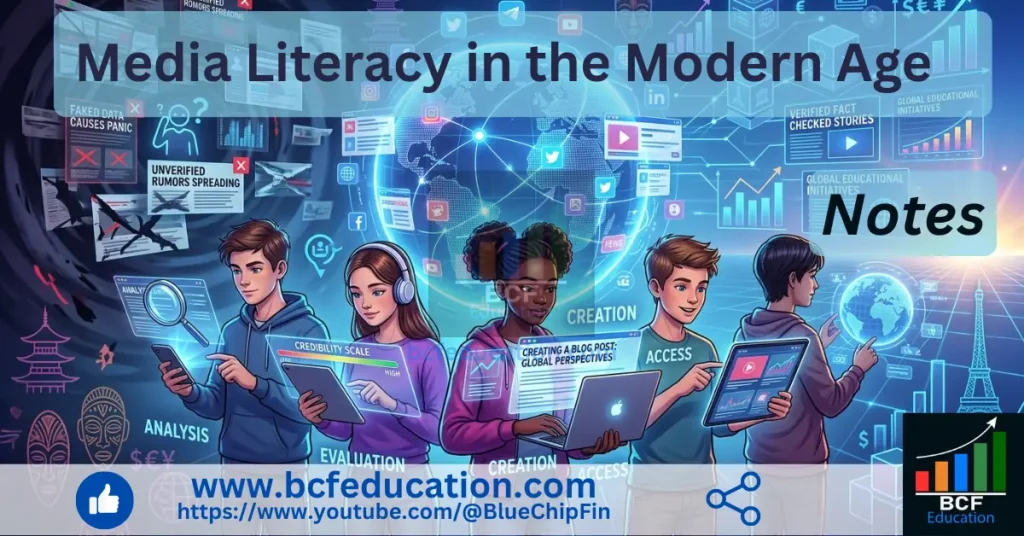
• Media literacy comprises several key components, each contributing to an individual’s ability to engage with media critically:
• Access: The ability to obtain and use media in various formats.
• Analysis: Decoding and understanding the meanings behind media messages.
• Evaluation: Critically assessing media content for quality and credibility.
• Creation: The capability to produce media content responsibly.
• Action: Engaging with media in a productive and socially responsible manner.
These components enable individuals to navigate the complex landscape of modern communication with knowledge and confidence. Media literacy plays a pivotal role in promoting critical thinking and informed engagement with content that shapes public opinion. It enables individuals to discern truth from misinformation, participate actively in democratic processes, and navigate the complexities of the modern Information environment. Media literacy provides individuals with tools to dissect and understand media content. Essential practices include evaluating sources and identifying bias, critical to ascertaining the truth in news consumption and ensuring news literacy.
a) Creating Responsible Content:
Nowadays, for views and likes, influencers and media content developers create content which is morally and ethically very questionable. Responsible content creation on mass media and social media platforms requires a clear understanding of the ethical implications of one’s writing and imagery. Content creators must take accountability for the accuracy of their information and the impact of their point of view on the audience.
b) Engaging with Diverse Perspectives:
Media literacy empowers individuals to seek out and engage with a wide range of perspectives, enhancing critical thinking and allowing a -more comprehensive understanding of global issues and cultural contexts. Instead of just following and believing one point of view, it teaches us to read, understand and evaluate differing perspectives which makes us better and flexible media users.
c) Combating Fake News:
Fake news, defined as deliberate misinformat10n spread via media, poses risks that requires a strategic approach to media usage. Critical thinking skills serve as a primary tool, requiring individuals to evaluate sources critically, cross-check facts, and reflect on biases influencing their perception. Users learn to check and recheck the source through multiple mediums before actually believing in it.
d) Guarding against Extremism:
Media literacy equips individuals to discern and question extremist content. It serves as a protective barrier by promoting understanding of how media messages shape societal views, encouraging engagement in civil discourse, and instilling resilience against extremist narratives. Media platforms have strict checks in place to filter out fake news, hate speech, online harassment, etc.
e) Encouraging Healthy Media Habits:
Too much time spent on social media platforms give rise to many social, emotional and psychological issues. Healthy media habits are essential for mental and physical health. Media literacy contributes to this by enabling individuals to analyze various genres of media, control consumption, and maintain a healthy balance in life.
Inconclusion, media literacy is a transformative skill in the digital age,shaping individuals into active, informed, and resilient participants in the modern information landscape. By integrating media literacy into education arid everyday practices, we equip younger generations to adapt to the challenges posed by emerging technologies. As the media landscape continues to broaden, the importance of fostering media literacy becomes evenmore pronounced, ensuring individuals are prepared to confront the complexities of the media they interact with daily.
Q. Read the unit carefully and answer the following questions.
i. What is media literacy, and why is it considered a vital skill in the modern era?
Media literacy is the ability to access, understand, analyze, evaluate, and create media content responsibly. It is vital in the modern era because people are constantly exposed to information through digital media, and media literacy helps them distinguish between true and false information and make informed decisions.
ii. Explain the significance of each key component of media literacy in navigating the modern media landscape.
Access: Helps individuals find and use media in different formats.
Analysis: Enables understanding of hidden meanings and messages in media.
Evaluation: Helps judge the credibility, quality, and reliability of content.
Creation: Encourages responsible and ethical production of media content.
Action: Promotes responsible engagement with media for social good.
iii. Provide examples of how media literacy can be applied to combat fake news and promote responsible content creation.
Media literacy helps users verify news by checking sources, cross-referencing facts, and identifying bias to combat fake news. It also encourages content creators to share accurate information and consider the ethical impact of their content on society.
iv. How does media literacy contribute to creating a well-informed and critically thinking individual capable of engaging with diverse perspectives?
Media literacy teaches individuals to question information and understand different viewpoints. This helps them think critically, avoid blind acceptance of one opinion, and develop a broader understanding of global and cultural issues.
v. Discuss the role of media literacy in guarding against extremism.
Media literacy helps individuals recognize and question extremist messages by understanding how media influences opinions. It promotes critical thinking, civil discussion, and resistance to harmful and extremist narratives.
vi. How can media literacy promote healthy media habits?
Media literacy helps individuals manage their media use by analyzing content and limiting overconsumption. This supports mental and physical health by encouraging balanced and responsible media usage.
vii. Describe a time when you encountered questionable information online and how you verified it.
I once saw a news post on social media that seemed exaggerated. I checked other reliable news websites, verified the source, and compared facts before believing it. After confirming it was false, I chose not to share it.
Q. Complete the sentences by choosing the appropriate transitional device.
- The movie was entertaining; ________, the book was more detailed. (however)
- Ayan is tall; ____, his sister is quite short. (however)
- Our school focuses more on science; __________, the neighboring school focuses on the arts. (on the other hand)
- Tom likes to study in the morning; __________, his roommate prefers late-night studying. (whereas)
- She enjoyed playing basketball; __________, her brother preferred soccer. (in contrast or conversely)
Q. Identify the transitional devices used in the passage. Also differentiate if the device is of comparison or contrast.
Excessive screen time has become common inour lives, similarly, to an ever-present companion. In contrast, the physical toll is evident; inactive habits lead to health issues. Likewise, mental health suffers, with increased screen exposure comes heightened stress. On the other hand, moderation promotes well-being. Conversely, neglecting this balance jeopardizes our physical and mental equilibrium. Striking a harmonious blend, however, ensures a healthier and more balanced lifestyle for the long term.
Answer:
| Transitional Device | Type | Explanation |
| similarly | Comparison | Shows likeness between excessive screen time and an ever-present companion |
| In contrast | Contrast | Highlights the difference between screen use and its physical effects |
| Likewise | Comparison | Adds a similar idea about mental health effects |
| On the other hand | Contrast | Presents an alternative or opposing point |
| Conversely | Contrast | Shows an opposite result of neglecting balance |
| however | Contrast | Indicates a shift toward a differing or opposing idea |
Q. Read the following sentences and fill in the blanks with suitable personal pronouns.
- Do you know __________ is my brother. (he)
- Areeba is a great cricketer. __________has won many competitions. (She)
- Would __________like to go to the movies with Rubab? (you)
- Van Gogh drew beautiful pictures. One of __________famous works is “The Starry Night”. (his)
- When the incident happened, Zaraq was present there. __________ was the only witness of the event. (He)
- The dog gave birth to many puppies. Would __________ like to have one ______ of? (you, of them)
- Rizwan and Muneeba are siblings. __________ came to visit the museum. (They)
- This is Nauman. __________ is the class monitor. (He)
- The team won the match. __________ played surprisingly well. (They)
- My brother brought a new phone, but __________ doesn’t like __________ much. (he, it)
Q. Read these sentences and rewrite these with correct order of adjectives:
- Ali saw a cat black small.
Ali saw a small black cat.
- I bought a leather new bag.
I bought a new leather bag.
- We had a delicious Italian homemade dinner.
We had a delicious homemade Italian dinner.
- Shafaq wore a red Sindhi beautiful dress.
Shafaq wore a beautiful red Sindhi dress.
- It was an interesting old book.
It was an interesting old book.
- He lives in a modern Spanish big Villa.
He lives in a big modern Spanish villa.
- The students solved a difficult math complex problem.
The students solved a complex difficult math problem.
- We visited an ancient historic castle.
We visited an ancient historic castle.
- She received a gold lovely necklace.
She received a lovely gold necklace.
- They found an abandoned German old car.
They found an old abandoned German car.
Q. Identify the adjective phrases in the following sentences:
- The house on top of the hill has a stunning view of the city.
- In the bustling city center, we found a charming little cafe.
- She wore a dress with sparkles and sequins for the special occasion.
- The detective examined the mysterious case with a magnifying glass.
- A group of energetic kids played in the spacious, sunlit park.
- The old, creaky door in the haunted mansion gave everyone a fright.
- The scientist presented an experiment with groundbreaking results.
- The chef prepared a delicious meal with fresh, locally sourced ingredients.
- The dog with the wagging tail eagerly greeted its owner at the door.
- The student with the brilliant idea received praise from the teacher.
Answer:
- on top of the hill (describes house)
- in the bustling city center (describes the location related to cafe); charming little (describes cafe)
- with sparkles and sequins (describes dress)
- with a magnifying glass (describes case)
- of energetic kids (describes group); spacious, sunlit (describes park)
- old, creaky (describes door); in the haunted mansion (describes door)
- with groundbreaking results (describes experiment)
- delicious (describes meal); with fresh, locally sourced ingredients (describes meal)
- with the wagging tail (describes dog)
- with the brilliant idea (describes student)
Q. Read the paragraph given below and identify the sentences that use the future indefinite tense. Consider how the tense is employed to convey actions happening in the future.
“As the sun sets, Sarah looks forward to her upcoming trip. She has packed her bags and will travel to the serene mountains. The journey won’t take long, and she will explore the picturesque landscapes. She shall stay in a cozy cabin and will hike to the mountaintop at sunrise. Sarah knows that this adventure will create lasting memories, and she won’t forget the breathtaking views.”
Answer:
She has packed her bags and will travel to the serene mountains.
The journey won’t take long, and she will explore the picturesque landscapes.
She shall stay in a cozy cabin and will hike to the mountaintop at sunrise.
Sarah knows that this adventure will create lasting memories, and she won’t forget the breathtaking views.