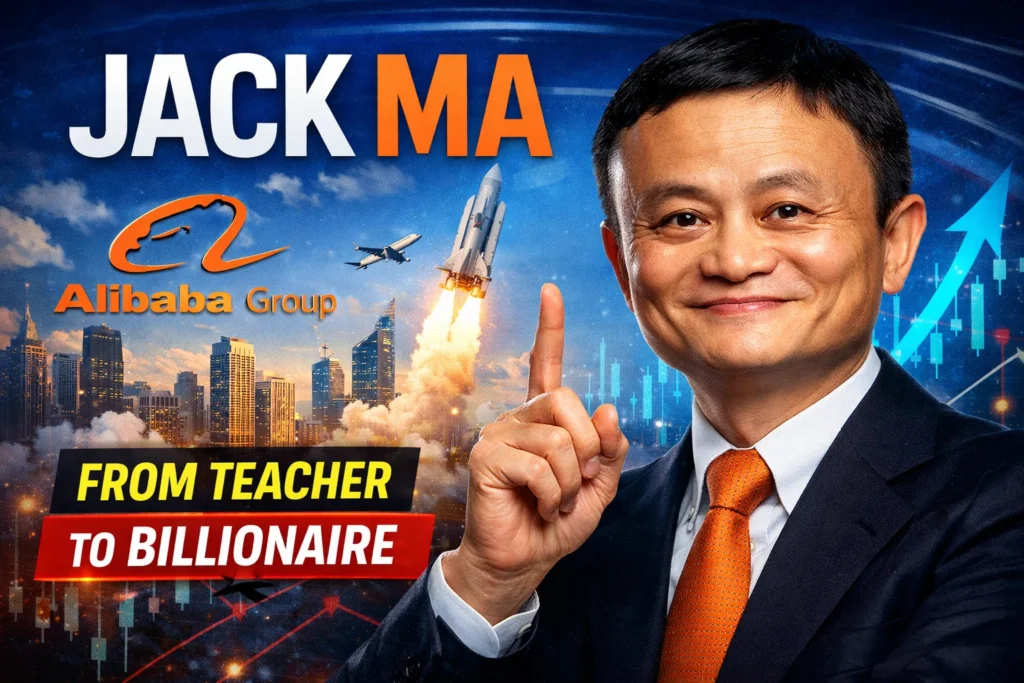
Jack Ma is a Chinese entrepreneur, philanthropist, and former English teacher best known as the co-founder of Alibaba Group, one of the world’s largest e-commerce and technology companies. His life story is often cited as a powerful example of perseverance, resilience, and unconventional success.
Early Life and Education
Jack Ma was born as Ma Yun in 1964 in Hangzhou, China. Growing up, he struggled academically, especially in mathematics, and failed China’s university entrance exam multiple times. Despite these setbacks, he developed a strong interest in English. As a teenager, he practiced English by giving free tours to foreign visitors, which helped him build language skills and confidence.
He eventually graduated from Hangzhou Normal University with a degree in English and worked as a teacher, earning a modest salary. His early career was marked by repeated rejections, including failed job applications and business attempts.
Founding Alibaba
In 1995, Jack Ma was introduced to the internet during a trip to the United States. Seeing its potential, he returned to China and, in 1999, co-founded Alibaba with a group of friends in his apartment. The company aimed to help small and medium-sized Chinese businesses sell products online.
Alibaba started with limited resources and faced strong competition, but Ma’s vision and leadership helped it grow rapidly. Over time, the Alibaba Group expanded into e-commerce (Taobao, Tmall), digital payments (Alipay through Ant Group), cloud computing, and logistics.
In 2014, Alibaba’s initial public offering (IPO) in New York became one of the largest in history, making Jack Ma one of the wealthiest individuals in the world at the time.
Leadership Style and Philosophy
Jack Ma is known for his charismatic speaking style and motivational messages. He often emphasizes:
- Learning from failure
- Long-term thinking over short-term profits
- The importance of small businesses
- Creativity and adaptability over rigid planning
He has frequently encouraged young people not to fear mistakes and to embrace change.
Later Years and Philanthropy
Jack Ma stepped down as Alibaba’s executive chairman in 2019, focusing more on education and philanthropy. Through the Jack Ma Foundation, he supports teachers, rural education, environmental initiatives, and entrepreneurship.
Jack Ma, born Ma Yun in 1964, is one of China’s most influential entrepreneurs, best known as the co-founder of Alibaba Group. His journey from an English teacher in Hangzhou to a global business icon illustrates resilience, vision, and innovation.
Early Life and Education
- Birth and Background: Jack Ma was born on September 10, 1964, in Hangzhou, Zhejiang Province, China.
- Education: He graduated with a Bachelor’s degree in English from Hangzhou Normal University in 1988.
- Early Career: Before venturing into business, Ma worked as an English teacher and tour guide, which helped him develop strong communication skills and global exposure.
Founding Alibaba
- Initial Struggles: Jack Ma faced numerous rejections, including job applications at KFC and government positions.
- Creation of Alibaba: In 1999, he co-founded Alibaba Group with 17 friends in his apartment. The company aimed to connect Chinese manufacturers with international buyers.
- Growth: Alibaba grew rapidly, becoming a leader in e-commerce, cloud computing, digital payments, and logistics. Its platforms include Taobao, Tmall, and Alipay.
Achievements and Impact
- IPO Milestone: In 2014, Alibaba launched its IPO on the New York Stock Exchange, raising $25 billion, the largest IPO at the time.
- Global Recognition: Jack Ma became the face of Chinese entrepreneurship, often compared to figures like Jeff Bezos and Elon Musk.
- Philanthropy: Through the Jack Ma Foundation, he has supported education, environmental causes, and public health initiatives.
Leadership Style
- Visionary Thinking: Ma emphasized long-term growth, customer focus, and employee empowerment.
- Inspirational Speaker: Known for his motivational speeches, he often highlighted perseverance, innovation, and embracing failure.
- Global Influence: He advocated for small businesses and women entrepreneurs, promoting inclusivity in digital commerce.
Challenges and Retirement
- Regulatory Scrutiny: In recent years, Alibaba and its affiliate Ant Group faced tighter regulations from Chinese authorities.
- Retirement: Jack Ma stepped down as Alibaba’s chairman in 2019, focusing on philanthropy and education.
- Public Absence: His reduced public presence after 2020 sparked global speculation, though he continues to support innovation and social causes.
Legacy
Jack Ma’s legacy lies in transforming China’s digital economy and inspiring millions of entrepreneurs worldwide. His story demonstrates how vision, persistence, and adaptability can turn humble beginnings into global success.
Would you like me to expand this into a timeline of Jack Ma’s career milestones or a comparative analysis of Alibaba vs. other global tech giants like Amazon?
Alibaba Group is at a crucial pivot point, aggressively transforming from a dominant e-commerce player into an integrated ecosystem powered by AI and cloud computing. This strategic overhaul is delivering resilient revenue growth but is placing significant strain on its financial performance and cash flow.
Here is a snapshot of Alibaba’s current strategic pillars and financial performance.
1. Core Strategic Pillars
· China E-Commerce: Focus: Core revenue driver (54% of revenue). Strategy: Expand wallet share via platforms like Taobao and quick commerce services.
· International Commerce: Focus: Key growth area. Strategy: Global expansion through cross-border and local retail platforms.
· Cloud Intelligence: Focus: Primary growth driver. Strategy: Lead in AI and enterprise digitalization with heavy infrastructure investment.
· Artificial Intelligence (AI): Focus: Foundational technology. Strategy: Develop open-source models (Qwen family) and integrate AI across all business units.
2. Q2 FY2026 Financial & Operational Highlights
· Revenue: RMB247.8B | Trend: +5% YoY, beat estimates.
· Profit (non-GAAP): RMB4.36/ADS | Trend: -71% YoY, below expectations.
· Cloud Revenue: RMB39.8B | Trend: +34% YoY, AI products show triple-digit growth.
· Local E-commerce Revenue: N/A | Trend: +16% YoY, fastest since 2021.
· Key Metric: Net cash flow outflow of RMB21.8B due to an 80% YoY increase in capital expenditure.
🔥 Navigating Growth and Financial Pressure
The financial data reveals a central tension in Alibaba’s strategy.
· Aggressive Investment for Future Leadership: The company is executing a massive, front-loaded investment plan. This includes a RMB380 billion commitment over three years for cloud and AI infrastructure and a RMB50 billion investment to boost its quick commerce business. The goal is to cement leadership in China’s AI applications market and capture new consumer spending habits.
· Significant Short-Term Costs: These investments are the primary cause of the 71% year-on-year profit decline and a negative shift in cash flow. Marketing expenses have also more than doubled as Alibaba competes fiercely for market share against rivals like JD.com and PDD.
🧭 Strategic Evolution: From E-commerce to Ecosystem
Alibaba’s transformation is structured around three key areas guided by its ESG principles: consumption, cloud, and globalization.
· Reinventing Consumption: In China, Alibaba is moving beyond traditional e-commerce to become a “comprehensive consumption platform.” It is integrating services like food delivery (Ele.me) and travel (Fliggy) into its core Taobao app and heavily funding instant, on-demand “quick commerce” to drive user engagement. This creates a multi-dimensional service matrix for different consumer needs.
· Betting on Cloud and AI as the New Engine: The Cloud Intelligence Group is now the main growth driver. Alibaba is focusing on enterprise digitalization and aims to be a leader in the “new AI era”. Its strategy involves developing a full-stack of AI innovations—from its proprietary Qwen large language models (LLMs) and visual-generation models to platforms for building AI agents—and integrating them across its cloud services and consumer apps like Quark.
· Pursuing Global Expansion: While the China market remains its economic anchor, globalization is a strategic priority. The goal is to leverage its supply chain advantages to serve global users and expand its position as a leading cloud service provider in the Asia-Pacific region.
⚔️ Competitive Landscape and Risks
Alibaba operates in an intensely competitive and dynamic environment.
· Diverse Domestic Rivals: In China, it faces pressure from:
· JD.com: Competes on reliability with a self-owned logistics model and strong supply chain focus.
· PDD Holdings (Pinduoduo/Temu: Uses an asset-light, social-commerce model focused on extreme value, which has allowed it to manage cash flow pressure more effectively.
· ByteDance (Douyin): Blurs content and commerce through live-streaming shopping, directly competing for user attention and transaction volume.
· Key Risks to Monitor:
· Sustained Profitability Pressure: High investment levels may continue to suppress margins in the near to medium term.
· Execution and Monetization: The success of its strategy hinges on effectively monetizing its AI and cloud investments and turning quick commerce into a profitable segment.
· Regulatory Environment: As a dominant platform, it remains subject to regulatory scrutiny in China and geopolitical tensions affecting international operations.
In summary, Alibaba is making a high-stakes bet that massive, sustained investment in AI, cloud, and integrated consumer services will secure its long-term dominance. While this is driving revenue growth and technological advancement, it has sharply reduced profitability and strained cash flow. The company’s future trajectory depends on its ability to successfully navigate this investment phase and translate it into sustained, high-quality earnings.
For more readings;