The History of Finance: From Barter to Digital Coins
Finance is the story of how human beings learned to store value, measure wealth, and exchange goods efficiently. From simple barter systems to modern digital cryptocurrencies, the evolution of money reflects the growth of civilizations, trade, technology, and trust.
Table of Contents
1. The Barter System – The Beginning of Exchange
Before money existed, early human societies used the barter system (around 10,000 BCE).
- People exchanged goods directly.
- Example: A farmer traded wheat for a pot made by a potter.
- Value depended on mutual agreement.
Problems of Barter:
- Double coincidence of wants (both parties must want what the other has).
- No standard measure of value.
- Difficult to store wealth.
- Hard to divide goods (e.g., splitting livestock).
These limitations led to the invention of commodity money.
2. Commodity Money – First Forms of Currency
As trade expanded, societies began using items with intrinsic value as money.
Common early commodities:
- Salt
- Cattle
- Grains
- Shells (especially cowrie shells)
- Precious stones
Cowrie Shells – Early “Seals” as Currency
Cowrie shells were widely used in:
- China
- India
- Africa (various regions)
They were:
- Durable
- Portable
- Difficult to counterfeit
- Limited in supply
In ancient China, shells were sometimes carved or cast into bronze imitations. These evolved into early metal money shaped like shells — an important step toward coinage.
3. The First Metal Coins (Around 7th Century BCE)
The first true metal coins are widely believed to have originated in:
🥇 Lydia (Modern-day Turkey)
Around 650–700 BCE:
- Made from electrum (a natural gold-silver alloy)
- Stamped with official seals
- Standardized weight and value
This was revolutionary because:
- Coins carried government authority.
- They had fixed denominations.
- Trade became faster and more reliable.
Soon, coinage spread to:
- Ancient Greece
- Roman Empire
- Persia
Metal coins remained dominant for over 2,000 years.
4. Paper Money – The Chinese Innovation
Paper money first appeared in:
📜 China during the Tang and Song Dynasties
Around the 7th–11th centuries CE:
- Merchants used promissory notes.
- Government later issued official paper currency.
- Known as “Jiaozi.”
Why paper money?
- Coins were heavy for large transactions.
- Trade across long distances increased.
- It was easier to transport.
Marco Polo later introduced the concept of paper currency to Europe after visiting China.
5. Banking and Financial Institutions
As commerce expanded, banking systems developed.
Important financial milestones:
- The Medici banking system in Renaissance Italy
- Creation of central banks such as:
- Bank of England (1694)
Banks introduced:
- Deposits
- Loans
- Interest
- Credit systems
This marked the beginning of modern finance.
6. Gold Standard and Modern Currency
By the 19th century:
Many countries adopted the Gold Standard:
- Currency backed by a fixed quantity of gold.
- Governments guaranteed conversion into gold.
After World War II:
- Bretton Woods Agreement established the US Dollar as the global reserve currency.
- In 1971, the US ended gold convertibility.
This created fiat money:
- Currency backed by government authority
- Not tied to physical gold
Examples:
- US Dollar
- Euro
- Pakistani Rupee
7. Digital Banking and Electronic Money
Late 20th century:
- Credit cards
- Debit cards
- Online banking
- Mobile payments
Money became electronic entries in bank databases.
No physical exchange required.
8. Cryptocurrency – Digital Coins
In 2009, a major revolution occurred:
₿ Bitcoin
Created by:
- Satoshi Nakamoto
Key features:
- Decentralized
- Blockchain-based
- Limited supply (21 million coins)
- No central bank control
This led to:
- Ethereum
- Thousands of other digital coins
Cryptocurrencies represent:
- Programmable money
- Smart contracts
- Decentralized finance (DeFi)
Timeline Summary
| Era | Form of Money | Key Feature |
|---|---|---|
| 10,000 BCE | Barter | Direct exchange |
| 3000 BCE | Commodity money | Intrinsic value |
| 700 BCE | Metal coins (Lydia) | Government stamp |
| 7th century CE | Paper money (China) | Lightweight |
| 17th century | Banking system | Credit & loans |
| 19th century | Gold Standard | Gold-backed |
| 1971 | Fiat currency | Government-backed |
| 2009 | Bitcoin | Decentralized digital |
How Currency Evolved Conceptually
- Barter → Trust between individuals
- Commodity money → Trust in physical value
- Coins → Trust in government stamp
- Paper → Trust in issuer
- Fiat → Trust in national economy
- Cryptocurrency → Trust in mathematics and code
Conclusion
The history of finance is a story of increasing abstraction and trust:
- From trading cows and shells,
- To stamped metal coins,
- To government-issued paper,
- To invisible digital money,
- To blockchain-based decentralized currency.
Money evolved because societies needed:
- Efficiency
- Portability
- Standardization
- Security
- Scalability
Today, we are entering a new era where digital assets, central bank digital currencies (CBDCs), and blockchain technology may redefine finance again.
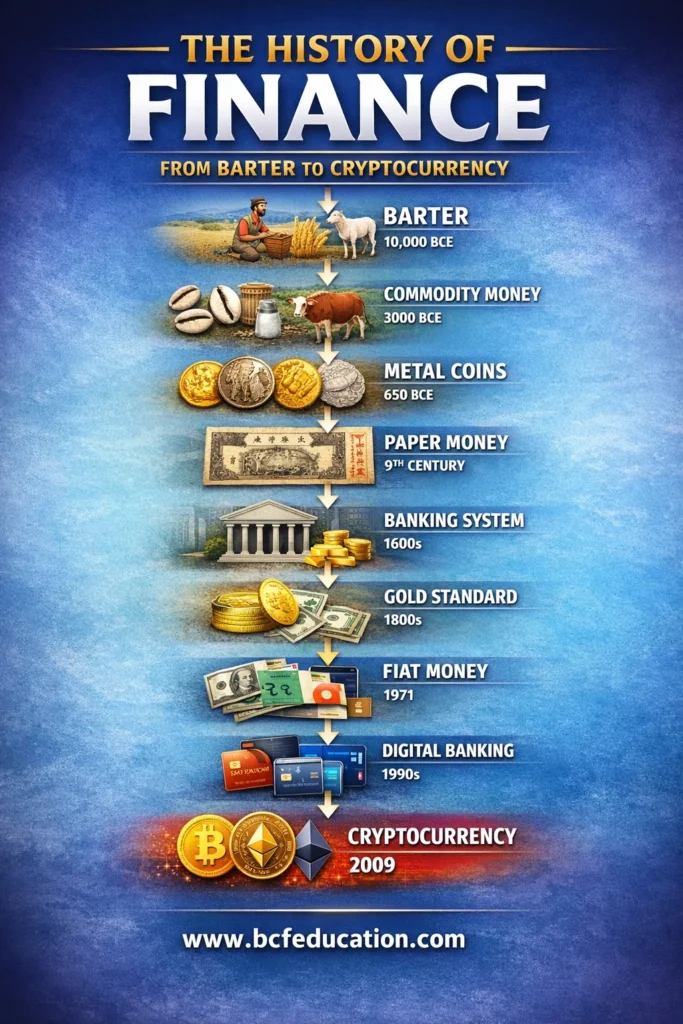
📜 HISTORY OF FINANCE – VISUAL TIMELINE
🪨 10,000 BCE — BARTER SYSTEM
Direct exchange of goods
👨🌾 Wheat ⇄ 🐐 Goat
- No money
- Based on mutual need
- Problem: Double coincidence of wants
⬇️
🐚 3000–1000 BCE — COMMODITY MONEY
Objects with intrinsic value used as currency
Used items:
- 🐄 Cattle
- 🧂 Salt
- 🌾 Grain
- 🐚 Cowrie Shells
Widely used in:
- China
- India
- Africa
✔ Portable
✔ Durable
✔ Limited supply
⬇️
🥇 650 BCE — FIRST METAL COINS
Stamped and standardized currency
Origin:
- Lydia
Material:
- Electrum (Gold + Silver)
Innovation:
✔ Government seal
✔ Fixed weight
✔ Recognized value
Spread to:
- Ancient Greece
- Roman Empire
⬇️
📜 7th–11th Century — PAPER MONEY
First official paper currency
Origin:
- China
Dynasties:
- Tang
- Song
Name:
- “Jiaozi”
Why?
✔ Coins were heavy
✔ Trade increased
✔ Easier transportation
⬇️
🏦 1600s–1700s — BANKING SYSTEM
Institutional finance begins
Major milestone:
- Bank of England (1694)
Introduced:
✔ Deposits
✔ Loans
✔ Interest
✔ Credit
⬇️
🪙 1800s — GOLD STANDARD
Money backed by gold reserves
- Fixed gold value
- International trade stability
- Government guarantee
⬇️
💵 1971 — FIAT MONEY ERA
Currency backed by government authority
Key Event:
- Bretton Woods Agreement
After 1971:
✔ No gold backing
✔ Trust in national economy
Examples:
- Dollar
- Euro
- Rupee
⬇️
💳 1990s — DIGITAL BANKING
Electronic money revolution
- Credit cards
- Debit cards
- Online banking
- Mobile payments
Money becomes digital database entries.
⬇️
₿ 2009 — CRYPTOCURRENCY ERA
Decentralized digital coins
First cryptocurrency:
- Bitcoin
Creator:
- Satoshi Nakamoto
Features:
✔ Blockchain technology
✔ Limited supply
✔ No central authority
Followed by:
- Ethereum
🔁 EVOLUTION OF TRUST
Barter → Trust in People
Commodity → Trust in Object
Coins → Trust in Government
Paper → Trust in Issuer
Fiat → Trust in Economy
Crypto → Trust in Code