
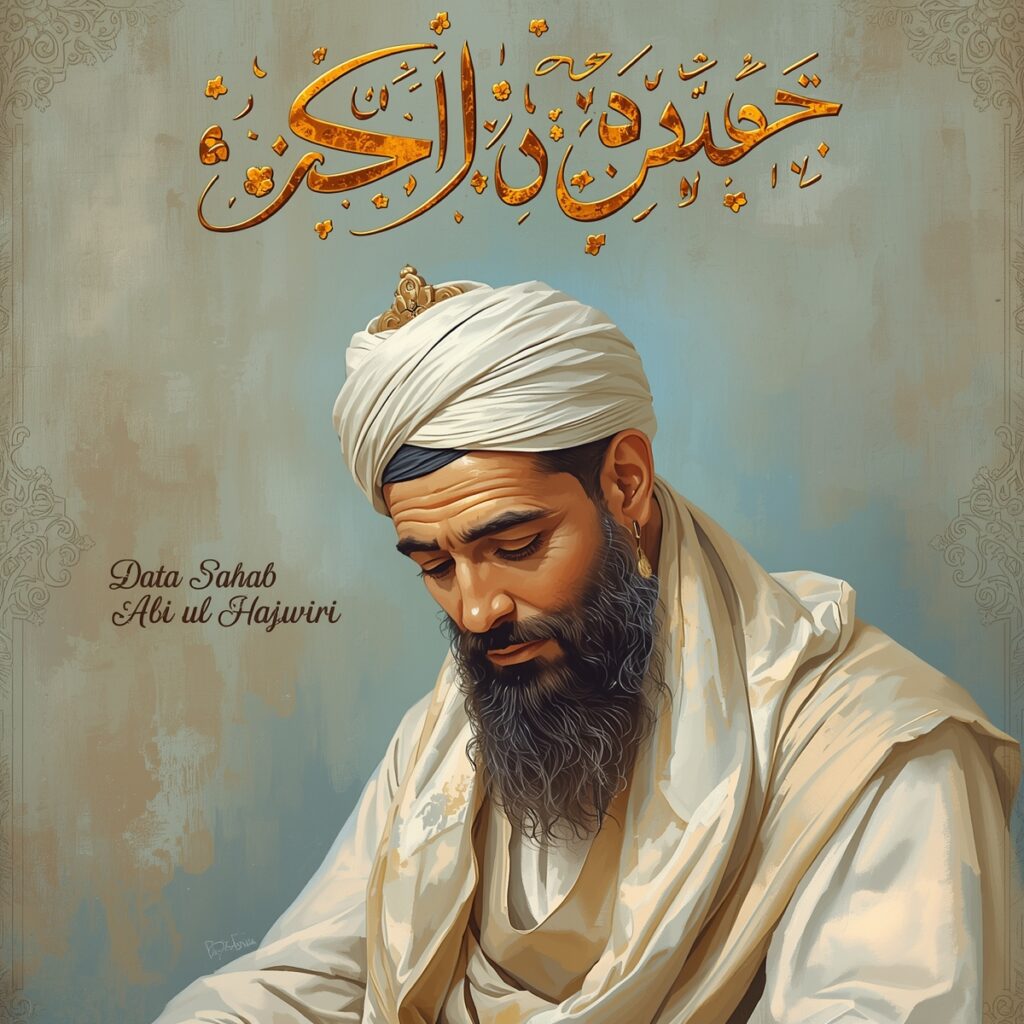
Data Sahab, also known as Hazrat Ali al-Hujwiri (c. 1009–1072 CE), is the patron saint of Lahore, Pakistan, and one of the most venerated Sufi saints in South Asia. He is commonly revered by the honorific titles Data Ganj Bakhsh (Bestower of Treasures) and Data Sahab.
Based on available historical records, here is a detailed biography of Hazrat Ali al-Hujwiri (Data Ganj Bakhsh).
⛪ Identity and Significance
· Full Name: Abu al-Hasan Ali ibn Uthman al-Jullabi al-Hujwiri
· Titles: Data Ganj Bakhsh (Bestower of Treasures), Data Sahib
· Era: Islamic Golden Age (c. 1009 – c. 1072)
· Major Contribution: Authored Kashf al-Mahjub, the earliest major treatise on Sufism in Persian
· Legacy: Revered as the primary saint of Lahore; his shrine is one of South Asia’s most frequented🕋 Core Beliefs and Teachings
Ali al-Hujwiri was a Sunni Hanafi scholar who emphasized strict adherence to Islamic law (Sharia) as the foundation for all authentic mystical practice. He was a traditionalist who vigorously defended the orthodoxy of Sufism by anchoring it in the example of the early Muslim community.
His views on key figures and concepts include:
· Rightly Guided Caliphs: He held the first four Caliphs in the highest esteem, considering them foundational models for Sufi conduct.
· Family of the Prophet (Ahl al-Bayt): He expressed deep reverence for the Prophet’s descendants, praising their knowledge and spiritual status.
· Sufi Practice: He rejected mere ritual dancing, distinguishing it from involuntary spiritual states. He permitted listening to virtuous poetry but forbade that which incited base desires.🧭 Early Life and Travels
· Birth: Born around 1009 CE in Ghazni (present-day Afghanistan) into a family of noble lineage, claiming descent from the Prophet Muhammad.
· Education: Received formal education in Hanafi jurisprudence and other Islamic sciences.
· Spiritual Quest: Embarked on extensive travels lasting for years across the Islamic world, including Persia, Syria, Iraq, and Central Asia, seeking knowledge and meeting renowned scholars and mystics.
· Spiritual Master: He was initiated into the Junaydiyya Sufi order and became a disciple of Shaykh Abu al-Fadl Muhammad al-Khuttali in Syria.📜 Major Work: Kashf al-Mahjub
His magnum opus, Kashf al-Mahjub (The Revelation of the Veiled), is a systematic and comprehensive manual of Sufism.
· Purpose: Written to explain and defend the orthodox principles of Sufism, distinguishing true mysticism from heresy and innovation.
· Content: Covers doctrines, states, stations, etiquette, and biographies of early Sufis.
· Legacy: It remains a foundational text for the study of classical Sufism.🇵🇰 Mission in Lahore and Death
· Arrival in Lahore: Following his teacher’s instructions, he settled in Lahore (then part of the Ghaznavid Empire) around 1041 CE.
· Role: He is credited with contributing significantly to the spread of Islam in the region through his preaching and personal example. Many stories attribute miraculous events (karamat) to him, symbolizing his spiritual authority.
· Death and Shrine: He died in Lahore around 1072 CE. His tomb, the Data Darbar, has been a site of pilgrimage for centuries and is now Pakistan’s largest shrine complex. The Pakistani government marks his death anniversary (urs) with a public holiday.💎 Enduring Legacy
Ali al-Hujwiri’s legacy is profound and multifaceted.
· Spiritual Figure: He is venerated as a patron saint of Lahore, known as Data Sahib (the Bestowing Master). His shrine is a major center of devotion.
· Theoretical Influence: Through Kashf al-Mahjub, he systematized early Sufi thought, influencing all subsequent generations of Sufis across the Persianate and South Asian world.
· Cultural Symbol: He represents a tradition of mystical Islam that emphasizes love, tolerance, and inner purification, continuing to attract followers worldwide.🤔 What You May Want to Explore Further
· Translation of Kashf al-Mahjub: Reading an English translation (like the one by R. A. Nicholson) is the best way to understand his teachings directly.
· Comparative Sufism: How his structured, law-oriented approach in the Junaydiyya order compares with the love-centric philosophy of later South Asian orders like the Chishtiyya.
· Modern Veneration: The role of his shrine in contemporary Pakistani culture and spirituality.Would you like a more detailed look into any specific aspect of his life or teachings, such as the core arguments in his book or his influence on later South Asian culture?
To help you understand his key aspects quickly, here are the most important facts about his life and legacy:
Ali al-Hujwiri (Data Sahab): Life & Legacy
· Full Name: Abu al-Hasan Ali ibn Uthman al-Jullabi al-Hujwiri
· Titles: Data Sahib, Data Ganj Bakhsh
· Born: ~1009 CE, Ghazni (present-day Afghanistan)
· Died: ~1072 CE, Lahore (present-day Pakistan)
· Resting Place: Data Darbar shrine, Lahore
· Major Work: Kashf al-Mahjub (The Revelation of the Veiled)
· Significance: Early Persian treatise on Sufism; key figure in spreading Islam in South Asia
· Annual Visitors to Shrine: Up to 1 million during urs festival
📜 Historical Life and Spiritual Journey
Data Sahab was born in Ghazni, Afghanistan, into a family claiming descent from the Prophet Muhammad. His early education was grounded in the Hanafi school of Sunni Islamic law.
His quest for knowledge led him on extensive travels across the Islamic world, including Iraq, Syria, Iran, and Central Asia, where he studied under renowned Sufi masters of his time. He eventually settled in Lahore, then a city with a predominantly non-Muslim population, where he preached, taught, and contributed significantly to the spread of Islam until his death.
✍️ Literary Masterpiece: Kashf al-Mahjub
Data Sahab’s enduring influence stems largely from his authorship of Kashf al-Mahjub (The Revelation of the Veiled), written in Persian. This work is critically important because:
· It is the earliest surviving major treatise on Sufi doctrine and practice in the Persian language.
· It systematically explains Sufi concepts, terms, and the stages of the spiritual path.
· It provides biographies of earlier Sufi saints, preserving their history and teachings.
· He stressed strict adherence to Islamic law (Sharia) as the essential foundation for any mystical pursuit, rejecting antinomian ideas.
🕌 The Data Darbar: A Living Shrine
Data Sahab is buried in Lahore at the Data Darbar shrine, which has grown from a simple grave to the largest Sufi shrine in South Asia. The shrine is a cornerstone of Lahore’s spiritual and social life.
Key Facts about Data Darbar:
· Status: Largest Sufi shrine in South Asia.
· Daily Visitors: 30,000 to 60,000; numbers double on Thursdays.
· Annual Urs Festival: Commemorates his death anniversary; attracts up to 1 million pilgrims.
· Social Service: Runs a massive free kitchen (langar) serving up to 50,000 meals daily, a tradition about 1,000 years old.
· Cultural Hub: A center for qawwali (Sufi devotional music) and a rare social space where people from all economic classes gather.
The shrine was nationalized by the Pakistani government in 1960 and is managed by the Punjab Auqaf Department, generating significant revenue used for its upkeep and other religious affairs.
⚖️ Core Teachings and Spiritual Views
Data Sahab’s teachings, as recorded in Kashf al-Mahjub, present a balanced and orthodox view of Sufism. His key positions include:
· Primacy of Islamic Law: He insisted that genuine mysticism must operate within the boundaries of the Sharia. He considered those who believed mystical revelation could replace religious law to be heretics.
· Veneration of Early Muslims: He held the early Caliphs, the Prophet’s family, and foundational scholars in the highest esteem, considering them spiritual models.
· Cautious View on Ecstatic Practices: While recognizing genuine spiritual ecstasy, he criticized sensual dancing and the use of intoxicants as distractions from the true path. He also cautioned against secular love poetry that incited carnal desire.
📈 Enduring Legacy
Data Sahab’s legacy is immense and multi-layered:
· Spiritual Authority: He is revered as the patron saint of Lahore and is popularly believed to be the spiritual gatekeeper for all Sufi saints in the Indian subcontinent.
· Cross-Sectarian Respect: His shrine is visited by Muslims of all schools of thought and remains a potent symbol of South Asian Islamic piety.
· Literary Pillar: Kashf al-Mahjub remains a foundational text for students of Sufism worldwide.
· Cultural Icon: His shrine is a living institution that embodies the social, charitable, and cultural dimensions of Sufism in Pakistan.
Final Note: Two of the search results were about modern digital data services and were unrelated to the Sufi saint Data Sahab. The information provided here is based solely on the relevant historical and religious sources.
I hope this detailed overview provides a clear understanding of Data Sahab. If you are interested in a specific aspect of his life, teachings, or the practices at his shrine, feel free to ask for more details.