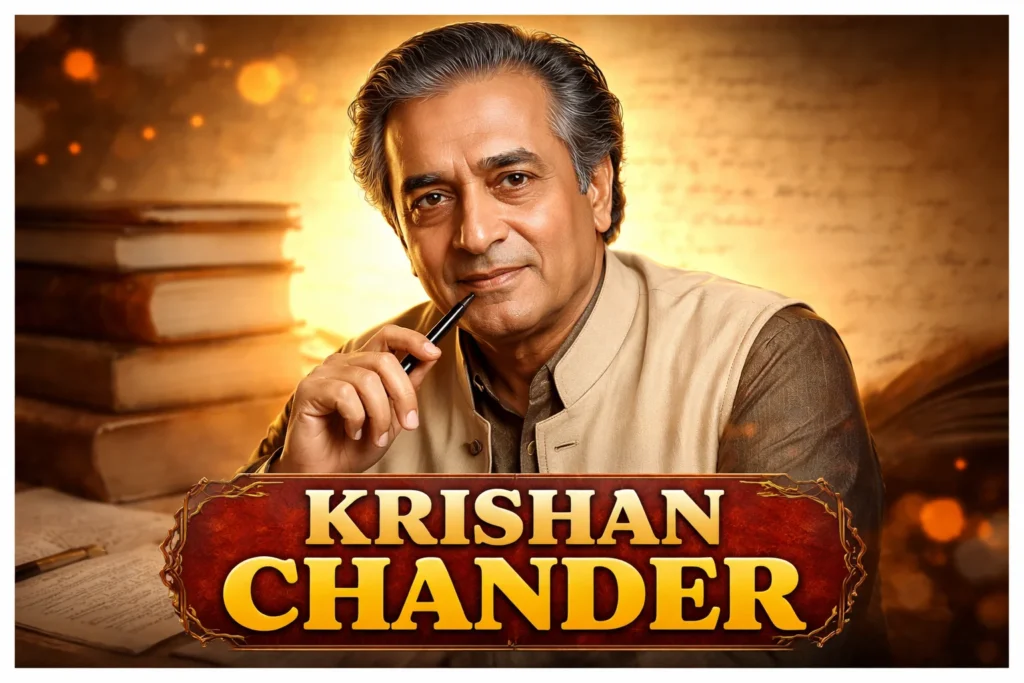
Krishan Chander: The Voice of India’s Marginalized
Krishan Chander (23 November 1914 – 8 March 1977) stands as one of the most prolific and influential voices in modern Indian literature. A master of the short story and novel in both Urdu and Hindi, he dedicated his prolific career to giving voice to the poor, the oppressed, and the marginalized. His extraordinary body of work, which includes over 20 novels and 30 short story collections, along with screenplays, essays, and radio plays, cemented his role as a leading pillar of the Progressive Writers’ Association and a humanist “storyteller of the oppressed”.
📜 Life and Literary Formation
Krishan Chander’s worldview was shaped by the diverse landscapes and political ferment of early 20th-century India.
· Early Years and Education: Born in Bharatpur, Rajasthan, he spent his formative years in the princely state of Poonch, Jammu and Kashmir, where his father was a royal physician. This deep connection to Kashmir’s beauty and people profoundly influenced his sensibilities. He pursued higher education at Forman Christian College in Lahore, earning an M.A. in English and an M.A. in Political Science. Lahore’s vibrant, cosmopolitan culture of the 1930s was a critical incubator for his intellectual and literary development. His first Urdu short story, “Sadhu”, was published in 1932 through the help of a fellow editor.
· The Progressive Writer’s Path: Chander’s literary philosophy was forged in the fires of the All India Progressive Writers’ Association (AIPWA), a movement committed to using literature as a tool for social reform, anti-imperialism, and the critique of feudal and capitalist oppression. He became one of its most dedicated practitioners, eventually serving as its General Secretary from 1975 until his death. Unlike some peers, his commitment extended beyond writing into active politics, including presiding over a sweepers’ union (bhangis Union) and joining the Socialist Party.
✍️ Literary Evolution and Major Works
Chander’s creative journey can be understood in three distinct phases, each marked by a deepening engagement with the world.
1. The Romantic Phase (from 1939): His early work was imbued with youthful idealism and emotional depth.
2. The Social Realist Phase (from 1940): He turned his focus to capturing the bitter hardships and aspirations of ordinary people with unflinching realism.
3. The Anti-Colonial & Internationalist Phase (from 1945): His work broadened to engage with global movements for freedom, equality, and socialist revolution.
Major Novels:
· Ek Gadhe Ki Sarguzasht (Autobiography of a Donkey): A celebrated satirical novel that critiques bureaucratic and societal oppression through the eyes of a donkey.
· Ghaddaar (The Traitor): A powerful novel about the human suffering and moral complexities during the Partition of India in 1947.
· Shikast (Defeat): His debut novel from 1943, dealing with themes of personal and collective failure.
· Mitti Ke Sanam: A popular novel drawing on his cherished childhood memories of Kashmir.
Notable Short Stories:
Chander’s short stories are where his empathy and social critique shine most brightly. Key themes include:
· Class & Labor: “Mahalaxmi ka Pull” starkly contrasts the lives of the rich and poor through laundry drying on a bridge. “Kalu Bhangi” and “Kachra Baba” expose the dehumanizing scorn faced by sanitation workers.
· Partition Trauma: Collections like “Hum Wahshi Hain” (We Are Savages) contained masterpieces like “Peshawar Express.” The poignant “Aik Tawaif ka Khat” (A Courtesan’s Letter) is a searing indictment of the violence inflicted on women.
· Formal Innovation: “Do Farlaang Lambi Sarak” is noted as an early example of stream-of-consciousness writing in Urdu literature.
🎬 Cinematic Contributions and Legacy
To supplement his income, Chander was also a successful screenwriter in Hindi cinema (Bollywood), writing scripts in Urdu. His first major film was Dharti Ke Lal (1946), based on his story “Annadata” about the Bengal famine. He went on to write dialogues and screenplays for popular films like Mamta (1966) and Sharafat (1970).
His contributions were recognized with India’s third-highest civilian award, the Padma Bhushan, in 1969, and the Soviet Land Nehru Award in 1966. India Post honored him with a commemorative stamp in 2017.
Krishan Chander: A Literary Biography
Early Life and Formative Years
Krishan Chander (1914-1977) was born on November 23, 1914, in Bharatpur, Rajasthan, into a Hindu family. His father, Dr. Gopal Chand, served as a royal physician in the princely state of Poonch, Jammu and Kashmir, where Chander spent much of his childhood. This early exposure to the majestic landscapes and cultural diversity of Kashmir profoundly influenced his literary imagination. He pursued higher education at Forman Christian College in Lahore, earning both an M.A. in English Literature and an M.A. in Political Science. It was during his time in Lahore—a cultural and intellectual hub in pre-Partition India—that he published his first Urdu short story, “Sadhu” (The Saint), in 1932, marking the beginning of his literary journey.
Literary Career and Evolution
Chander emerged as a prolific and versatile writer, producing over 20 novels, 30 collections of short stories, and numerous essays, screenplays, and radio plays. His work evolved through distinct phases:
1. Romantic Phase (1930s): Early stories like “Nazneen” reflected lyrical, emotional themes.
2. Social Realist Phase (1940s onward): Influenced by the Progressive Writers’ Movement, he shifted to stark realism, addressing poverty, inequality, and oppression. Stories like “Mahalaxmi ka Pul” and “Kalu Bhangi” highlighted class divides and the plight of marginalized communities.
3. Post-Partition and Internationalist Phase: The trauma of Partition deeply affected him, resulting in powerful works like “Ghaddaar” (The Traitor) and the short story “Peshawar Express.” He also engaged with global socialist ideals, reflecting anti-colonial and humanist concerns.
Chander’s writing was characterized by empathy, vivid imagery, and a commitment to social justice. His satirical novel “Ek Gadhe Ki Sarguzasht” (Autobiography of a Donkey) critiqued bureaucracy and societal hypocrisy through allegory. He experimented with narrative forms, employing stream-of-consciousness in stories like “Do Farlaang Lambi Sarak.”
Role in the Progressive Writers’ Movement
Krishan Chander was a central figure in the All India Progressive Writers’ Association (AIPWA), serving as its General Secretary from 1975 until his death. The movement, rooted in anti-imperialism and social reform, shaped his literary philosophy. He believed literature should serve as a “weapon” for change, advocating for the rights of laborers, peasants, and the oppressed. His activism extended beyond writing—he presided over a sweepers’ union and joined the Socialist Party, embodying his ideals.
Contributions to Cinema and Other Media
To sustain himself financially, Chander ventured into screenwriting for Hindi films, often writing dialogues and scripts in Urdu. His notable cinematic works include:
· Dharti Ke Lal (1946): Based on his story “Annadata,” addressing the Bengal famine.
· Mamta (1966) and Sharafat (1970): Successful mainstream films showcasing his versatility.
His screenplays retained his signature social consciousness, bridging popular cinema and literary depth.
Personal Life and Legacy
Krishan Chander married Saraswati Devi, a novelist and poet, and the couple lived in Mumbai. He passed away on March 8, 1977, from a heart attack while working at his desk—a testament to his lifelong dedication to writing. His legacy endures through:
· Literary Influence: He inspired generations of writers with his humanist vision.
· Awards and Honors: Recipient of the Padma Bhushan (1969), the Soviet Land Nehru Award (1966), and a commemorative postage stamp (2017).
· Cultural Impact: Parks, institutions, and continued academic studies keep his memory alive.
Chander’s works remain relevant for their poignant exploration of inequality, resilience, and the human spirit. As he once stated, “I write for those who cannot write their own stories”—a mission he fulfilled through a lifetime of storytelling.