Economics

🌍 Economics – Decoding the Forces That Shape Our World 🌍

Welcome to your essential guide to Economics—where scarcity meets strategy and policy transforms lives. This page is designed for students, professionals, and curious minds who want to understand how markets, governments, and societies make critical choices about resources, growth, and human behavior.

Key Topics Explored:

✅ Microeconomics – Supply & demand, market structures, elasticity, consumer choice
✅ Macroeconomics – GDP, inflation, unemployment, fiscal & monetary policy
✅ International Trade – Comparative advantage, tariffs, exchange rates, globalization
✅ Behavioral Economics – Irrational decision-making, biases, and nudge theory
✅ Economic Systems – Capitalism, socialism, and mixed economies in practice

Why Economics Matters:

📈 Real-World Applications – How economic theories drive business, policy, and everyday life
💡 Critical Perspectives – Debates on inequality, climate economics, and tech disruption
📊 Data & Trends – Interactive charts, case studies, and current global economic analysis

Economics isn’t just about money—it’s about understanding the hidden rules that govern our choices, opportunities, and future.

🧠 Start Thinking Like an Economist Today!
“The economy is a means, not an end. The end is human well-being.” – Amartya Sen

2.4 The Law of Equal Marginal Utility EMU

The Law of Equal Marginal Utility EMU

The Law of Equal Marginal Utility EMU is a core concept in the cardinal approach to consumer behavior analysis. The Law of Equal Marginal Utility EMU, also known as The Law of Equal Marginal Utility EMU, is a principle in consumer behavior that states a consumer maximizes total utility by allocating their limited resources such that the marginal utility (additional satisfaction) gained from the last unit of currency spent on each good or service is equal. In other words, consumers distribute their expenditures across goods so that each purchase provides equal utility per unit of cost, achieving the most efficient satisfaction of their needs within a budget constraint. This topic is equally important for the students of economics across all the major Boards and Universities such as FBISE, BISERWP, BISELHR, MU, DU, PU, NCERT, CBSE & others & across all the business & finance disciplines.

2.4 The Law of Equal Marginal Utility EMU Read More »

2.3 The Law of Diminishing Marginal Utility DMU

The Law of Diminishing Marginal Utility DMU

The Law of Diminishing Marginal Utility DMU is a core concept in the cardinal approach to consumer behavior analysis. This blog delves into how this law explains the decreasing satisfaction consumers experience with each additional unit of a good, shedding light on consumer choices and the limits of consumption. Discover how understanding marginal utility can provide valuable insights into purchasing decisions and economic behavior. This topic is equally important for the students of economics across all the major Boards and Universities such as FBISE, BISERWP, BISELHR, MU, DU, PU, NCERT, CBSE & others & across all the business & finance disciplines.

2.3 The Law of Diminishing Marginal Utility DMU Read More »

2.2 Total Utility, Marginal Utility, Point of Satiety & Types of Utilities

Total Utility, Marginal Utility, Point of Satiety & Types of Utilities

Total Utility, Marginal Utility, Point of Satiety & Types of Utilities is the effort to explore the essentials of total utility and marginal utility in this blog, uncovering their relationship and impact on consumer choices. Discover the different types of utility, from form to time and place, and how each influences satisfaction and decision-making in our daily lives.

2.2 Total Utility, Marginal Utility, Point of Satiety & Types of Utilities Read More »

2.1 Theory of Consumer Behaviour

Total Utility, Marginal Utility, Point of Satiety & Types of Utilities

Theory of Consumer Behaviour explores how individuals make decisions to allocate their resources, particularly their income, to various goods and services. Central to this theory is the utility function, which represents the satisfaction a consumer derives from consuming different products. By analysing the relationship between consumption patterns and preferences, the utility function helps explain how consumers aim to maximize their overall satisfaction. Additionally, several factors—ranging from personal tastes and income levels to market conditions and cultural influences—determine consumer choices. Understanding these determinants provides valuable insights into the decision-making process in different economic environments.

2.1 Theory of Consumer Behaviour Read More »

Evolving different thoughts of Economics

Evolving different thoughts of Economics

Evolving different thoughts of Economics. “Economic thought has evolved through centuries, shaping the way we understand wealth, markets, and human behavior. The journey begins with Adam Smith’s classical economics, where the ‘invisible hand’ and the pursuit of self-interest lay the foundation for market dynamics. Later, Alfred Marshall’s neo-classical economics refined these ideas, introducing concepts like marginal utility and supply-demand equilibrium. Finally, Lionel Robbins’ modern approach redefined economics as the science of scarcity and choice, focusing on the allocation of limited resources to meet endless wants. Together, these perspectives offer a comprehensive view of economic theory’s evolution.”

Evolving different thoughts of Economics Read More »

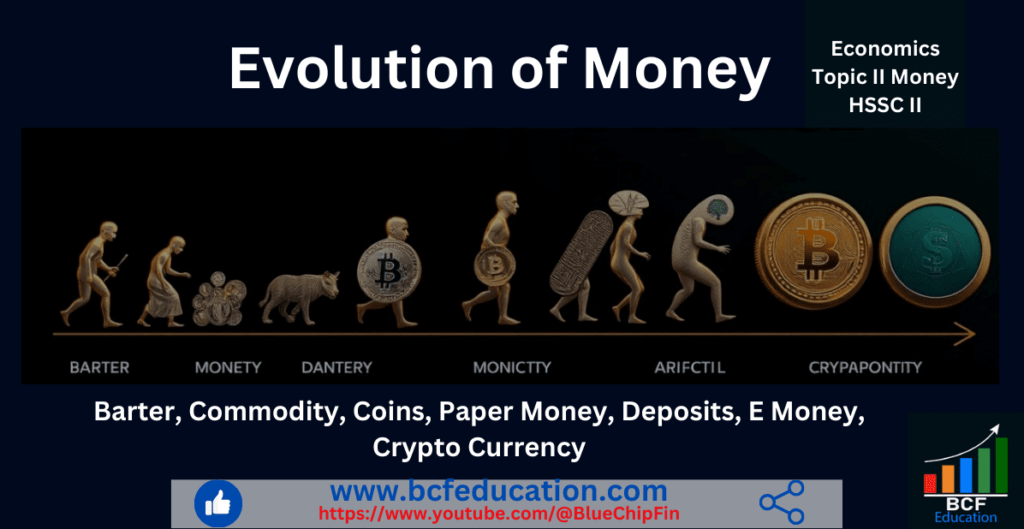
Evolution of Money

Evolution of Money

Evolution of Money, “From bartering goods and services to the rise of digital currencies, the evolution of money reflects humanity’s ongoing quest for efficiency in trade and value exchange. This journey, spanning from ancient coinage to modern financial systems, has transformed how we conduct business, save, and invest. In this post, we explore the key milestones that shaped the monetary systems we rely on today, and consider how emerging technologies may continue to redefine our concept of money in the future.”

Evolution of Money Read More »