 Who Is Jeff Bezos?
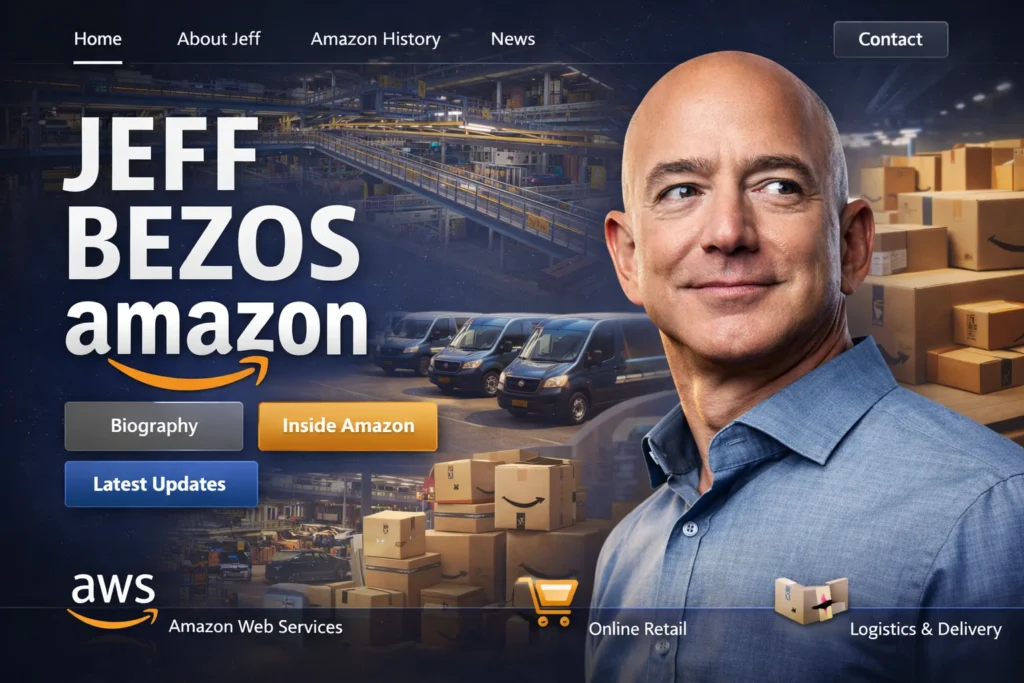
 Who Is Jeff Bezos?
Jeffrey Preston Bezos (born January 12, 1964 in Albuquerque, New Mexico, USA) is an American entrepreneur, investor, and business leader best known for founding Amazon.com, the world’s largest e-commerce and cloud computing company.
Early Life & Education
 Early Life & Education
- Born as Jeffrey Preston Jorgensen, his parents were young when he was born and shortly divorced; his mother later married Miguel “Mike” Bezos who adopted him.
- Bezos showed curiosity about how things work from a young age — building electrical projects in his parents’ garage.
- He graduated summa cum laude from Princeton University in 1986 with degrees in electrical engineering and computer science.
Early Career
 Early Career
After college, Bezos worked in finance and technology:
- Telecommunications startup Fitel
- Bankers Trust
- Hedge fund D.E. Shaw & Co., where he became one of the company’s youngest senior vice presidents.
Founding Amazon
 Founding Amazon
In 1994, Bezos left his high-paying job, moved to Seattle, and started Amazon.com as an online bookstore — operating initially out of a garage.
Amazon sold its first book in 1995 and rapidly expanded into selling a vast range of products, including electronics, apparel, and digital services like Amazon Web Services (AWS).
Amazon’s Growth
 Amazon’s Growth
Under Bezos’s leadership:
- Amazon became a retail giant and one of the most valuable public companies globally.
- AWS became the world’s leading cloud computing service.
- The company introduced innovations such as Kindle, Prime membership, and original media content.
- Bezos stepped down as CEO in 2021 and became Executive Chairman.
Other Ventures
 Other Ventures
 Blue Origin
Bezos founded Blue Origin in 2000 to develop space technologies and commercial space travel.
The Washington Post
 The Washington Post
He bought The Washington Post in 2013, aiming to modernize the newsroom and expand its digital reach.
Biographies About Bezos (Recommended Reads)
 Biographies About Bezos (Recommended Reads)
Since Jeff Bezos has not written a traditional autobiography, the best way to learn his life story in depth is through well-researched biographies like:
- The Everything Store: Jeff Bezos and the Age of Amazon by Brad Stone — comprehensive look at Bezos’s life, Amazon’s founding, and its rise to dominance.
- One Click: Jeff Bezos and the Rise of Amazon.com by Richard L. Brandt — focuses on Bezos’s leadership and Amazon’s strategy.
- The Space Barons by Christian Davenport — includes Bezos’s role in private space exploration alongside other billionaires.
Jeff Bezos’s journey from his modest beginnings to reshaping global retail, computing, and space exploration is a story of visionary risk-taking and relentless execution. Below is a synthesis of the key phases of his life and career.
Early Life & Formative Years (1964-1986)
· Birth and Family: Born Jeffrey Preston Jorgensen on January 12, 1964, in Albuquerque, New Mexico to teenage parents. His mother, Jacklyn, later married Cuban immigrant Mike Bezos, who adopted Jeff.
· Key Influences: Summers on his grandfather’s Texas ranch taught him self-reliance and problem-solving. Showed early mechanical aptitude, converting his garage into a lab.
· Education: Graduated summa cum laude from Princeton University in 1986 with degrees in electrical engineering and computer science.
Wall Street & The Idea (1986-1994)
· Early Career: Worked at several financial firms, becoming the youngest senior vice president at the hedge fund D.E. Shaw by age 30.
· The Discovery: In 1994, learned web usage was growing 2,300% a year. Developed the “regret minimization framework” to justify leaving his job.
· The Plan: Identified books as the ideal first online product. Drove to Seattle, writing the business plan on the way.
Building Amazon (1994-2021)
· Humble Start: Founded Amazon in July 1994 from his Bellevue, Washington garage. The site sold its first book in July 1995.
· Survival & Scale: Warned early investors of a 70% chance of failure. Survived the dot-com bubble burst, laying off 14% of staff in 2001. Went public in 1997.
· Core Philosophy: Built the company on principles like “customer obsession” and “frugality”. Prioritized long-term market share over short-term profits.
· Major Expansions: Launched Amazon Web Services (AWS) in 2002, introduced the Kindle e-reader in 2007, and started Amazon Prime.
· Stepping Down: Transitioned from CEO to Executive Chairman in July 2021.
Ventures Beyond Amazon
· Blue Origin: Founded the aerospace company in 2000 with the goal of enabling a future where millions live and work in space. Flew to space on its New Shepard vehicle in 2021.
· The Washington Post: Purchased the newspaper in 2013 for $250 million.
· Philanthropy: Pledged $10 billion to the Bezos Earth Fund to fight climate change. Has said he plans to give away the majority of his wealth in his lifetime.
Personal Life & Wealth
· Family: Married MacKenzie Scott in 1993; they had four children and divorced in 2019. Married journalist Lauren Sánchez in 2025.
· Net Worth: His wealth, primarily from his Amazon stake, has made him one of the world’s richest people for years. As of late 2025, his net worth is estimated at over $239 billion.
 Leadership and Legacy
Bezos’s impact stems from a few powerful, consistent ideas:
· Long-Term Thinking: His “regret minimization framework” is a personal example of prioritizing long-term fulfillment over short-term security. At Amazon, this meant sacrificing profits for years to build market share and infrastructure.
· Customer Obsession: He often stated that focus should be on the customer, not the competitor. Innovations like one-click shopping, customer reviews, and Prime were all driven by this principle.
· Embrace of Failure: Bezos normalized big bets that might fail, viewing them as necessary for outsized success. He was transparent with early investors about the high risk.
 Key Controversies and Criticisms
Bezos’s career and Amazon’s dominance have not been without significant scrutiny:
· Market Power: Amazon has faced antitrust investigations in the U.S. and Europe over its dual role as a marketplace operator and a competitor on that marketplace.
· Labor Practices: The company has faced widespread criticism and unionization efforts over working conditions, warehouse pace, and its response to employee organizing.
· Societal Impact: Critics argue Amazon’s growth has hurt small businesses and traditional retail. Its massive fulfillment network has also raised concerns about environmental impact and community subsidies.
Jeff Bezos’s success with Amazon is a masterclass in building a future-oriented company through paradoxical leadership—combining deep contradictions like patience and urgency, control and freedom, idealism and pragmatism. Below is a synthesis of the core philosophies and principles that fueled this transformation.
 Foundational Leadership Philosophy
The core of Bezos’s approach lies in several key, often contradictory, mental frameworks.
“Regret Minimization Framework”
The founding of Amazon was driven by this personal decision-making model. In 1994, Bezos decided to leave a lucrative Wall Street career to start an online bookstore. His reasoning was to look ahead to age 80 and minimize regret, choosing to participate in the internet boom despite the risk of failure.
“Day One” Mentality
Bezos famously insisted it must always be “Day One” at Amazon. He declared that “Day 2 is stasis, followed by irrelevance, followed by excruciating, painful decline, followed by death”. This mindset was a guard against bureaucracy and complacency, forcing a relentless focus on the customer, a skeptical view of internal processes, and a commitment to high-velocity decision-making.
Strategic Patience, Tactical Impatience
This is perhaps the defining paradox of his leadership. He was “strategically patient”—willing to invest in bold ideas like Amazon Web Services (AWS) or the Kindle, which took years (even a decade) to become profitable. Simultaneously, he was “tactically impatient,” demanding rapid execution and action in daily operations.
 Amazon’s Core Operating Principles
These philosophies were institutionalized into Amazon’s Leadership Principles, which codify expected behaviors. Four are particularly foundational to its success.
1. Customer Obsession
This is the undisputed “North Star.” Unlike companies that focus primarily on competitors, Amazon leaders are taught to start with the customer and work backwards. This principle was lived by Bezos, who in Amazon’s early days would have customer complaint emails forwarded to him. The logic is that if you truly champion the customer, shareholder value will follow in the long term.
2. Ownership
Leaders are expected to act like owners—thinking long-term and never saying “that’s not my job.” This principle is designed to eliminate silos and encourage employees to act on behalf of the entire company. It fosters distributed accountability and enables the “Bias for Action”.
3. Invent and Simplify
Amazon expects innovation and invention at all levels, with a constant drive to simplify complex systems. The company accepts that true innovation may be misunderstood for long periods, which provided cover for developing ventures like AWS that initially baffled outsiders.
4. Are Right, A Lot
This principle highlights judgment. Crucially, Bezos believed that being right often comes from a willingness to change your mind. He observed that the smartest people constantly revise their understanding and are open to new information. This connects to the principle’s advice to “seek diverse perspectives and work to disconfirm their beliefs”.
 Mechanisms for Execution and Scale
Philosophy and principles were enforced through unique, disciplined mechanisms.
· The Narrative Memo: Bezos banned PowerPoint presentations in favor of six-page, narratively structured memos. Meetings would begin with a period of silent reading to ensure deep understanding and clarity of thought.
· “Two-Pizza Teams”: Teams were kept small enough to be fed by two pizzas, aiming to enhance autonomy, agility, and ownership.
· Separate, “Single-Threaded” Teams: For major new initiatives (like AWS or the Kindle), Bezos would create teams that operated autonomously, away from the core business’s dependencies. This allowed them to focus and move fast.
· Data-Driven but Anecdote-Aware: While Amazon is intensely metric-driven, Bezos emphasized the importance of anecdotes and direct customer feedback, which can reveal what aggregated data obscures. The “five whys” technique is used to drill down to root causes.
 The Tensions and Criticisms
Bezos’s model created extraordinary value but also significant tensions and controversies, which are part of any complete synthesis.
The Control vs. Autonomy Paradox
Bezos was a big-picture visionary and a notorious micromanager. He could overrule engineers on minute product details while also building a system of distributed leadership. The “Have Backbone; Disagree and Commit” principle encourages fierce debate but demands full alignment once a decision is made.
The Human Cost of High Standards
The principle to “Insist on the Highest Standards” is explicit that these standards may be seen as “unreasonably high”. This drive created a high-performance culture but also contributed to a reputation for a grueling, high-attrition work environment, particularly in corporate roles. Reports of demanding conditions in fulfillment centers created a stark contrast with the innovative, customer-obsessed image.
Market Dominance and Societal Impact
Amazon’s success has made it a fundamental piece of global infrastructure, from e-commerce and cloud computing (AWS) to media and logistics. This scale has invited scrutiny over its market power, impact on competitors and publishers, and broader societal influence. The company now explicitly includes principles like “Success and Scale Bring Broad Responsibility” and “Strive to be Earth’s Best Employer” to address these critiques.
 Synthesis: The Bezos Legacy
Jeff Bezos’s success is not the story of a single brilliant idea, but of building a unique and scalable system for innovation. He combined:
1. A Compelling Vision: Framed by long-term thinking and customer obsession.
2. A Codified Culture: Translated into actionable Leadership Principles that guide daily decisions.
3. Innovative Mechanisms: Like narrative memos and two-pizza teams, that turned principles into practice.
4. A Tolerance for Paradox: Embracing contradictions (patient/impatient, controlling/freeing) to navigate complexity.
The ultimate test of this system is its endurance beyond its founder. The transition to CEO Andy Jassy—who spent over two decades at Amazon, deeply internalizing its principles—suggests the system was built to last. While the culture faces new challenges at scale, the foundational philosophy of relentless customer-centric innovation, executed with paradoxical discipline, remains the core of the Amazon empire.
For more readings;