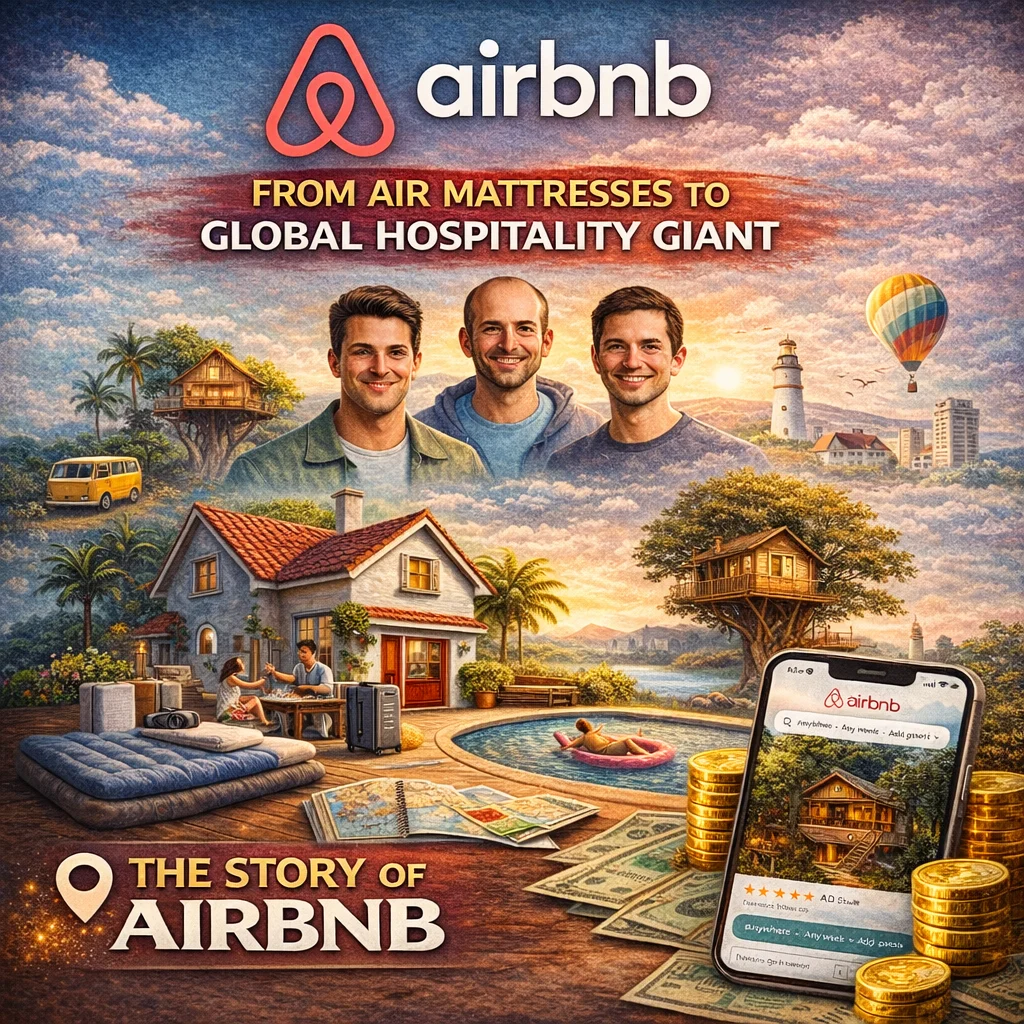
Airbnb – From Air Mattresses to Global Hospitality Giant
Airbnb is one of the most disruptive companies of the 21st century. What started as a small idea to rent out air mattresses in an apartment became a multi-billion-dollar global platform that transformed the travel and hospitality industry.
Table of Contents
1️⃣ The Beginning (2007–2008)
The Problem
In 2007, two designers in San Francisco were struggling to pay rent.
Founders:
- Brian Chesky
- Joe Gebbia
A major design conference was happening in the city, and hotels were fully booked. They saw an opportunity.
The First Idea
They:
- Bought three air mattresses
- Created a simple website
- Offered:
- A place to sleep
- Breakfast
- Local experience
They called it: Air Bed & Breakfast
Soon after, a third co-founder joined:
- Nathan Blecharczyk (technical architect)
In 2008, the company officially became Airbnb.
2️⃣ Early Struggles & Breakthrough
Funding Rejections
Investors initially rejected them. Many believed:
- Strangers would never stay in each other’s homes.
- Safety concerns would kill the idea.
To survive, the founders even sold novelty cereal boxes during the 2008 U.S. election called:
- “Obama O’s”
- “Cap’n McCain’s”
This helped them raise early money.
Y Combinator Accelerator
Airbnb joined:
- Y Combinator
This was a turning point. The founders:
- Improved listing photos
- Personally visited hosts
- Focused on trust and design
Bookings began increasing rapidly.
3️⃣ Growth & Expansion (2010–2015)
Airbnb expanded globally.
By 2011:
- Over 1 million nights booked
By 2015:
- Present in 190+ countries
- Millions of listings worldwide
It competed directly with major hotel chains like:
- Marriott International
- Hilton Hotels & Resorts
But Airbnb’s model was different:
- Asset-light (no owned hotels)
- Peer-to-peer marketplace
- Experience-driven travel
4️⃣ Business Model Explained
Airbnb is a two-sided marketplace platform.
Hosts
People who:
- Rent homes
- Rent rooms
- Offer unique stays
Guests
Travelers who:
- Book short-term stays
- Book long-term stays
- Seek local experiences
Revenue Model
Airbnb earns by charging:
- Service fee from guests (5–15%)
- Service fee from hosts (~3%)
This scalable digital model allowed massive growth without owning property.
5️⃣ Airbnb’s Main Products & Services
🏠 1. Home Stays
Core product:
- Entire homes
- Private rooms
- Shared rooms
Includes:
- Apartments
- Villas
- Cabins
- Treehouses
- Boats
- Castles
🌍 2. Airbnb Experiences (Launched 2016)
Hosts offer:
- City tours
- Cooking classes
- Cultural workshops
- Adventure activities
This expanded Airbnb beyond accommodation into travel experiences.
🏆 3. Airbnb Plus
Premium verified homes:
- High-quality design
- Inspected properties
- Reliable amenities
🏕 4. Unique Stays
Special category including:
- Tiny homes
- Treehouses
- Domes
- Farms
- Historical buildings
Focused on “Instagram-worthy” travel.
💼 5. Airbnb for Work
Business travel solution:
- Company travel management
- Group bookings
- Long-term corporate stays
📱 6. Mobile App & Digital Platform
The Airbnb app includes:
- Smart search filters
- Secure messaging
- Reviews & ratings system
- AI-powered recommendations
- Secure payments
- Identity verification
Technology is the backbone of Airbnb’s success.
6️⃣ Trust & Safety Innovations
Since strangers are involved, trust is critical.
Airbnb introduced:
- Verified IDs
- Host & guest reviews
- Secure payments
- Host protection insurance
- 24/7 customer support
The review system became one of the most powerful trust engines in the sharing economy.
7️⃣ Challenges & Crisis
⚠️ Regulatory Issues
Many cities imposed restrictions due to:
- Housing shortages
- Hotel industry pressure
- Safety regulations
Cities like:
- New York City
- Barcelona
Implemented short-term rental laws.
🦠 COVID-19 Pandemic (2020)
Travel stopped globally.
Airbnb:
- Lost billions in bookings
- Laid off 25% of staff
But instead of collapsing, it adapted by:
- Promoting local travel
- Supporting long-term stays
- Encouraging remote work rentals
8️⃣ IPO & Public Company
In December 2020, Airbnb went public on:
- NASDAQ
IPO was one of the biggest tech offerings of the year.
The valuation soared beyond $100 billion on its first trading day.
9️⃣ Why Airbnb Became So Successful
1. Strong Design Focus
The founders were designers.
User experience was always simple and attractive.
2. Asset-Light Model
No hotel buildings to maintain.
3. Global Scalability
Internet-based platform.
4. Trust-Based Reviews
Community-driven ratings system.
5. Emotional Branding
Airbnb markets:
“Belong Anywhere”
It sells experience, not just rooms.
🔟 Airbnb Today
As of today:
- Millions of hosts
- Hundreds of millions of guest arrivals
- Listings in almost every country
- Continues expanding into long-term stays & lifestyle travel
Airbnb is now not just a booking platform, but a global hospitality ecosystem.
📊 Impact on the World
Airbnb:
- Created income for millions of homeowners
- Disrupted traditional hotel industry
- Popularized the “sharing economy”
- Encouraged cultural exchange
It influenced other sharing economy companies like:
- Uber
🔮 The Future of Airbnb
Future directions include:
- AI-driven travel planning
- Remote work accommodations
- Subscription travel models
- Sustainable tourism initiatives
Airbnb continues evolving from a room rental startup into a lifestyle travel platform.
Conclusion
Airbnb’s journey shows:
💡 A simple idea
➡ Solved a real problem
➡ Leveraged technology
➡ Built trust
➡ Scaled globally
From renting air mattresses in a small apartment to becoming one of the most influential companies in modern travel, Airbnb represents the power of innovation, design, and digital platforms.