
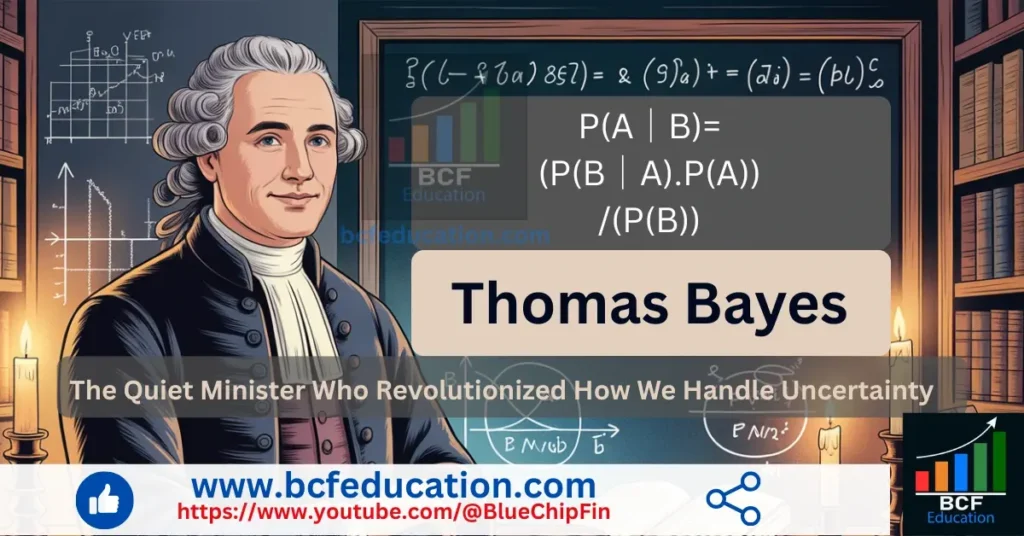
Thomas Bayes, Bayes Theorem. Discover the fascinating story of Thomas Bayes, the quiet Presbyterian minister whose groundbreaking ideas transformed the way we understand probability and uncertainty. In this insightful blog post, explore how Bayes’ revolutionary theorem laid the foundation for modern statistics, data science, economics, and artificial intelligence. Learn how a simple yet powerful mathematical concept continues to shape decision-making in finance, research, and everyday life centuries after his time.
Table of Contents
Thomas Bayes: The Quiet Minister Who Revolutionized How We Handle Uncertainty
Imagine a world where your email knows it’s spam before you even open it, doctors make smarter calls on test results, and AI predicts your next Netflix binge. At the heart of all this? A simple equation from an 18th-century preacher who shunned the spotlight. Thomas Bayes wasn’t chasing fame or fortune—he was a humble minister wrestling with big questions about evidence and belief. Yet his idea, Bayes’ Theorem, flipped probability on its head and now underpins everything from economic forecasts to self-driving cars.
This isn’t just history; it’s a toolkit for thinking in an uncertain world. We’ll dive into Bayes’ overlooked life, unpack his groundbreaking theorem, trace its rocky road to acceptance, and explore why it’s exploding in fields like economics, machine learning, and medicine. By the end, you’ll see why this “forgotten genius” matters more today than ever.
From London Streets to a Life of Quiet Inquiry
Thomas Bayes entered the world around 1701 in London, born into a family of Presbyterian dissenters—folks who bucked the Church of England’s dominance. His dad, Joshua, was a respected minister, and young Thomas seemed destined for the pulpit. But unlike the elite scholars of his day, Bayes couldn’t snag spots at Oxford or Cambridge; those demanded Anglican loyalty. Instead, he headed to the University of Edinburgh in 1719, immersing himself in logic, theology, and the era’s intellectual buzz.
Edinburgh was a hotbed for independent thinkers, and it shaped Bayes into a blend of faith and reason. By the 1730s, he was assisting his father in London before taking the helm at Mount Sion Chapel in Tunbridge Wells, a posh spa town. Life there was serene: preaching, community service, and private tinkering with math. He wasn’t a full-time academic—no university chair, no parade of papers. Bayes was a “gentleman scholar,” driven by curiosity.
His one public math splash came anonymously in 1736 with An Introduction to the Doctrine of Fluxions. It defended Isaac Newton’s calculus against philosopher Bishop George Berkeley’s attacks, showing Bayes’ chops. The Royal Society noticed, electing him a Fellow in 1742—a rare nod for a self-taught reverend. But his real masterpiece? It stayed hidden in his desk drawers, unpublished until after his death in 1761 at age 59. Buried in London’s Bunhill Fields among fellow nonconformists, Bayes took his secrets to the grave—until a friend stepped in.
The Puzzle That Changed Everything: Forward vs. Inverse Probability
Picture the 1700s: Probability was hot, thanks to pioneers like Jacob Bernoulli and Abraham de Moivre. They nailed “forward probability”—stuff like odds in card games or dice rolls. Know the setup (say, a deck’s aces), and you predict outcomes. Simple, right? What are the chances of drawing a heart?
But Bayes flipped the script. Real life hands us effects and asks us to guess causes. You’ve drawn five black balls from a mystery bag—what’s the real mix inside? Is it mostly black, or did luck strike? This “inverse probability” stumped everyone. Historians guess Bayes pondered it in the 1740s or 1750s, maybe sparked by Thomas Simpson’s work or a deeper quest: countering philosopher David Hume’s skepticism about miracles. Hume said miracle stories defy experience, so ditch them. Bayes, ever the theologian, wanted math to show how faith (a starting belief) could evolve with evidence (testimony).
Enter Richard Price, Bayes’ friend and executor. Sorting papers post-death, Price found gold: a manuscript titled “An Essay Towards Solving a Problem in the Doctrine of Chances.” In 1763, he delivered it to the Royal Society, crediting Bayes. It introduced the theorem we know today.
Bayes illustrated it vividly: Envision a square billiard table. A buddy tosses a ball, unseen, and marks a line where it stops. You roll balls and learn only if they land left or right of that line. With enough rolls, Bayes’ math narrows the line’s position—like learning from scraps of data.
Cracking the Code: What Bayes’ Theorem Really Means
At its core, Bayes’ Theorem is a recipe for updating beliefs. Forget static odds; this is dynamic learning. Mathematically, it’s:
Break it down plainly:
P(A|B): Posterior—the updated probability of your hypothesis (A) after seeing evidence (B).
P(B|A): Likelihood—how probable the evidence is if your hypothesis holds.
P(A): Prior—your starting hunch about A, from experience or logic.
P(B): Evidence—the total chance of observing B, normalizing everything.
In everyday terms: New belief = (How evidence fits your hunch × Starting hunch) ÷ Total evidence pool.
It’s like tuning a radio: Start with a fuzzy signal (prior), dial in new static (evidence), and sharpen the station (posterior). Repeat as signals improve. This “Bayesian updating” turns probability into a living process, mirroring how humans reason.
It’s like tuning a radio: Start with a fuzzy signal (prior), dial in new static (evidence), and sharpen the station (posterior). Repeat as signals improve. This “Bayesian updating” turns probability into a living process, mirroring how humans reason.
The Stats Showdown: Bayesians vs. Frequentists
Bayes’ idea didn’t conquer overnight. Pierre-Simon Laplace rediscovered and polished it independently, applying it to astronomy and law. But by the 19th century, “frequentists” like Ronald Fisher, Jerzy Neyman, and Egon Pearson dominated. They saw probability as long-run frequencies—flip a coin a million times for truth. Parameters? Fixed unknowns. No “subjective priors” allowed. Tools like p-values and confidence intervals ruled labs.
Bayesians, building on Bayes via Bruno de Finetti and others, countered: Probability measures belief, not just repeats. Parameters? Uncertain, updatable. Frequentists called it too personal; Bayesians said it was realistic. The feud raged for 200 years, with Bayes sidelined as “subjective” or computationally brutal—pre-computer era math was hell.
The Comeback Kid: Computers and Big Data Ignite the Revolution
Bayes slumbered until the late 1900s. Three game-changers woke it:
Philosophical backup: Thinkers like Frank Ramsey and Leonard Savage proved rational uncertainty demands Bayesian rules.
Data deluge: Frequentist tools choked on messy, high-dimensional data. Bayes loves complexity, weaving in priors and handling gaps.
Computing power: Markov Chain Monte Carlo (MCMC) simulations, from the 1980s on, crunched impossible integrals. Harold Jeffreys, Dennis Lindley, and others paved the way.
Suddenly, Bayes was everywhere. Today, it’s the secret sauce of the data age.
Bayes in Action: Powering Economics, AI, and Beyond
Bayes isn’t abstract—it’s your daily life.
Economics and Finance: Smarter Forecasts Amid Chaos
Economists like you know uncertainty rules markets. Bayesian methods update priors (historical trends) with fresh data (news, reports) for better predictions. Investors revise risk models; central banks tweak inflation estimates. In development economics, it helps gauge microcredit’s impact on empowerment—blending prior studies with new field data for nuanced policy.
Machine Learning and AI: The Learning Engine
AI “learns” via Bayes. Naive Bayes classifiers spot spam (priors on words like “lottery” boost posterior spam odds) or recommend movies. Google’s search, Netflix’s suggestions—all Bayesian at heart. Facial recognition? It updates face probabilities from pixel evidence.
Medicine: Beyond the Test Strip
A positive test doesn’t mean disease. Bayes factors in prevalence: Rare illness + accurate test = low true odds (tons of false positives). Doctors avoid over-screening; it saved lives in COVID diagnostics.
Everyday Wins: Spam, Courts, and Brains
Email filters Bayesian-update on shady phrases. Courts weigh DNA via likelihood ratios—updating guilt priors. The UN projects populations, blending censuses with expert priors. Even your brain? Neuroscientists say it’s a Bayesian machine, predicting ball trajectories or speech from priors plus senses.
Why Bayes Languished—and Why It Thrives Now
Posthumous pub, era’s forward-prob bias, no computers—Bayes hibernated. Critics hit subjectivity (priors!) and math hurdles. But objective priors (e.g., Jeffreys’) and MCMC fixed that. Philosophy shifted: Knowledge is probabilistic, beliefs evolve.
Flaws remain—priors need care, big models compute-heavy—but wins outweigh. In economics, it beats rigid models for volatile data.
A Lasting Echo: Humility in a Certainty-Obsessed World
Bayes published little alive, died obscure. Yet his theorem reshaped stats, AI, econometrics. As writer Tom Chivers put it, it’s possibly history’s most vital equation.
His legacy? Embrace uncertainty. Update relentlessly. In big data’s flood—fake news, economic shocks—Bayes teaches rational navigation. The minister from Tunbridge Wells showed quiet ideas echo loudest, turning belief into knowledge one update at a time.
Key Takeaways
Bayes flipped probability: From cause-to-effect to evidence-to-cause.
Theorem: Posterior = (Likelihood × Prior) / Evidence—pure updating magic.
Battles frequentists but rules modern apps: AI, econ, medicine.
Revived by computers: now essential for uncertainty.
Lesson: Knowledge evolves; evidence trumps dogma.
Bayes reminds us: Certainty’s a myth. Learn, adapt, thrive.