From Mining Magnate to Museum Pioneer: The Story of the Solomon R. Guggenheim Museum
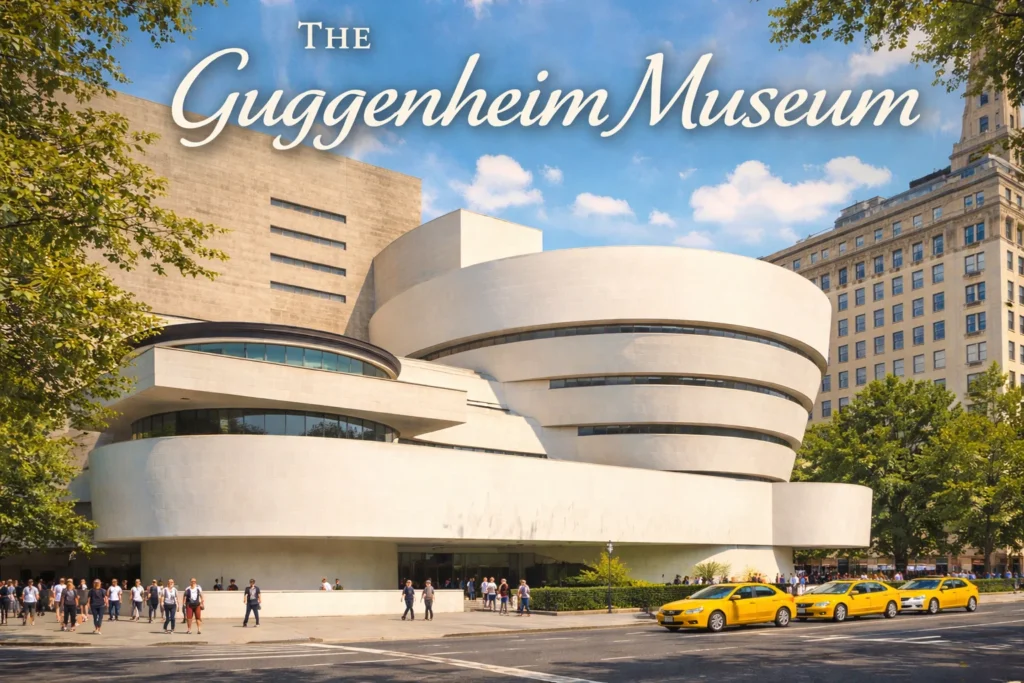
Guggenheim museum On Fifth Avenue in New York City, near Central Park, there is a museum that looks very different from other buildings. It is round, white, and shaped like a spiral. Instead of straight walls and sharp corners, it has soft curves. This famous building is the Solomon R. Guggenheim Museum.
The story of this museum is not only about art. It is about big dreams, bold ideas, and people who believed in something new.
This story mainly involves three important people:
- Solomon R. Guggenheim – the founder
- Hilla von Rebay – the art advisor
- Frank Lloyd Wright – the architect
Part 1: Solomon R. Guggenheim – The Mining Businessman
Solomon R. Guggenheim was born in 1861 in Philadelphia. His father, Meyer Guggenheim, was a Swiss immigrant who became very rich through mining. The Guggenheim family owned large mining businesses in silver, copper, and lead across America, Mexico, and Alaska.
Solomon worked in the family business for many years. He helped manage companies and made large profits. He was known as a smart and careful businessman. In 1895, he married Irene Rothschild, connecting him to another wealthy family.
For a long time, Solomon collected traditional art. He liked classical European paintings, which were popular among rich families at that time. But everything changed when he met an unusual artist in 1926.
Part 2: Hilla von Rebay – The Woman with a Vision
In 1926, Solomon met Hilla von Rebay, a German painter. She believed in a new type of art called non-objective art. This kind of art does not show people, nature, or real objects. Instead, it uses shapes, colors, and lines to express feelings and spiritual ideas.
Rebay believed this modern art could lift the human spirit. She convinced Solomon to look at art in a new way. Even though he was already 65 years old, he completely changed his taste in art.
He began collecting modern artists such as:
- Wassily Kandinsky
- Marc Chagall
- Fernand Léger
- László Moholy-Nagy
One of his most important purchases was Kandinsky’s painting Composition 8. His home soon became a private gallery filled with modern art.
Part 3: The First Museum
In 1937, Solomon created the Solomon R. Guggenheim Foundation. Its goal was to promote modern art.
In 1939, he opened a museum in Manhattan called the Museum of Non-Objective Painting. Hilla von Rebay became its first director.
The museum was designed to feel peaceful and spiritual. Soft music played in the background. The rooms were quiet and calm. Visitors were encouraged to think deeply about the art.
The collection continued to grow quickly. It became clear that the museum needed a larger, permanent building.
Part 4: A Bold Design by Frank Lloyd Wright
In 1943, Rebay wrote to the famous architect Frank Lloyd Wright. She asked him to design a “temple of the spirit” — not just a building, but something special and different.
Wright accepted the challenge. He wanted to design a museum unlike any other. Instead of small square rooms, he created a spiral ramp that goes upward around a large open space. Visitors take an elevator to the top and slowly walk down the ramp while viewing the art.
The building design looked like an upside-down pyramid or a white spiral shell. Many people were surprised by the design. Some critics thought it was too unusual. Others believed it was a masterpiece.
The project faced many delays because of World War II and building problems. There were also disagreements about the building’s color. Wright wanted it red, but it was finally built in white.
Part 5: A Legacy Completed After Death
Solomon R. Guggenheim died in 1949 before the museum was finished. The museum was renamed in his honor.
Frank Lloyd Wright also died in 1959, just months before the museum opened.
Finally, on October 21, 1959, the Solomon R. Guggenheim Museum opened to the public.
At first, opinions were divided. Some critics said the curved walls made it hard to hang paintings. Others praised the building as a work of art itself.
Over time, the museum became one of the most famous buildings in the world. In 2019, it was recognized by UNESCO as part of the World Heritage listing for important works by Frank Lloyd Wright.
A Global Legacy
The Guggenheim name did not stop in New York. The foundation later opened or supported museums in other countries.
One of the most famous is the Peggy Guggenheim Collection in Venice, created from the collection of Solomon’s niece, Peggy Guggenheim.
Another major museum is the Guggenheim Museum Bilbao in Spain, designed by Frank Gehry. When it opened in 1997, it helped transform the city of Bilbao and became a global symbol of modern architecture.
Autobiography of Solomon R. Guggenheim
The story of the Guggenheim Museum is about change and courage. Solomon Guggenheim started his life in the mining industry, digging metals from the earth. Later in life, he began searching for something different — beauty, creativity, and spiritual meaning through art.
With the help of Hilla von Rebay and Frank Lloyd Wright, he created more than a museum. He created a place where art, architecture, and imagination come together.
Today, the Guggenheim stands as a symbol of vision and transformation — proof that it is never too late to follow a new dream.
Early Life
I was born on February 2, 1861, in Philadelphia, United States. I grew up in a wealthy family. My father, Meyer Guggenheim, was a hardworking businessman who built a large fortune in the mining industry. Our family name became well known for silver, copper, and lead mining.
From a young age, I understood that business was important in our family. I was educated in Switzerland and prepared to join the family enterprise. My life at that time was focused on responsibility, discipline, and success.
Building the Mining Empire
As a young man, I joined my family’s mining business. I worked in different places, including Mexico and Alaska. Mining was not easy work. It required strong leadership, smart decisions, and courage.
I helped manage companies and improve their profits. Over time, our business grew larger and stronger. I became known as a serious and capable businessman. My life was centered on industry and finance for many years.
A New Interest in Art
For much of my early life, I collected traditional European paintings. I enjoyed classical art that many wealthy families admired. However, everything changed in 1926 when I met a remarkable woman named Hilla von Rebay.
She introduced me to modern art, especially a style called non-objective art. This kind of art did not show real-life objects. Instead, it used colors, shapes, and lines to express spiritual ideas.
At first, this art felt very different from what I knew. But soon, I became deeply interested. Even though I was already in my sixties, I decided to change my direction. I began collecting modern artists such as Wassily Kandinsky and other pioneers of abstract art.
My home slowly turned into a gallery of bold and colorful paintings.
Creating a Foundation
In 1937, I established the Solomon R. Guggenheim Foundation. My goal was to support and promote modern art. I believed this new art form had great meaning and deserved public recognition.
In 1939, I opened the Museum of Non-Objective Painting in New York City. It allowed people to see and understand modern art in a peaceful environment. I wanted art to inspire visitors and lift their spirits.
A Dream of a New Building
As the collection grew, I wanted a permanent home for it. With the help of Hilla von Rebay, I invited the famous architect Frank Lloyd Wright to design a new museum building.
His design was unlike any other museum. It had a spiral ramp and curved walls. It looked more like a sculpture than a building. It was bold, modern, and full of imagination — just like the art inside it.
Unfortunately, I did not live long enough to see the building completed.
My Final Years and Legacy
I passed away on November 3, 1949, at the age of 88. Although I did not see the finished museum, my vision continued. In 1959, the Solomon R. Guggenheim Museum opened to the public on Fifth Avenue in New York City.
Today, the museum stands as a symbol of creativity and courage. I began my life digging metals from the earth, but I ended my life searching for beauty and spiritual meaning in art.
I believe that true wealth is not only measured in money, but also in culture, imagination, and the inspiration we leave behind for future generations.
Timeline of Major Exhibitions – Solomon R. Guggenheim Museum
Here is a clear and simple chronological timeline of important exhibitions held at the Guggenheim Museum in New York:
1939
Opening of the Museum of Non-Objective Painting
The museum opened with early exhibitions focused on abstract and non-objective art, especially works by Wassily Kandinsky.
1945
Art of This Century Influence
Exhibitions began expanding to include more European modern artists who had moved to America during World War II.
1948
Karl Nierendorf Collection Exhibition
A major exhibition showed works from the estate of Karl Nierendorf, adding German Expressionist art to the museum’s collection.
1959
Grand Opening of the New Building
The new spiral museum building designed by Frank Lloyd Wright opened to the public. The inaugural exhibition featured selections from the permanent collection.
1963
Six Painters and the Object
One of the first museum exhibitions in the United States to highlight Pop Art.
1978
Kandinsky Retrospective
A major retrospective celebrating the life and work of Wassily Kandinsky, one of the museum’s most important artists.
1992
The Great Utopia: The Russian and Soviet Avant-Garde (1915–1932)
A landmark exhibition exploring Russian modern art and design.
1998
China: 5000 Years
A large-scale international exhibition exploring Chinese art and culture across centuries.
2001
Brazil: Body & Soul
A major exhibition highlighting Brazilian art and cultural history.
2009
The Third Mind: American Artists Contemplate Asia (1860–1989)
An exhibition showing how Asian art influenced American artists.
2010
Haunted: Contemporary Photography/Video/Performance
Focused on modern photography and performance art.
2017
Visionaries: Creating a Modern Guggenheim
Celebrated the founders and early supporters of the museum, including Solomon R. Guggenheim and Hilla von Rebay.
2021
Kandinsky Exhibition (Reinstallation)
A renewed presentation of Kandinsky’s masterpieces from the Guggenheim collection.
2023
Young Picasso in Paris
An exhibition exploring the early years of Pablo Picasso in Paris and his artistic development.