Audi is one of the world’s most prestigious automobile manufacturers, known for its advanced engineering, luxury vehicles, and innovative technology. As a core brand of the Volkswagen Group, Audi has established itself as a symbol of precision, performance, and modern design. The journey of Audi from a small workshop in Germany to a global automotive leader is a remarkable story of resilience, innovation, and strategic growth.
The Foundation of Audi (1899–1910)
The origins of Audi trace back to August Horch, a German engineer and automobile pioneer. In 1899, Horch founded Horch & Cie. Motorwagen Werke in Cologne, Germany. His company focused on producing high-quality automobiles, but internal disagreements with investors forced Horch to leave the company in 1909.
Determined to continue his vision, Horch established a new company in Zwickau, Germany, in 1910. Since he could not legally use his own surname for the new business, the name “Audi” was chosen. Interestingly, Audi is the Latin translation of the German word “Horch,” which means “listen.” This creative rebranding marked the official birth of the Audi brand.
Table of Contents
Early Success and Engineering Excellence (1910–1932)
Audi quickly gained recognition for its advanced engineering and motorsport success. One of its early achievements was the Audi Type A, followed by the Audi Type C, which won the Austrian Alpine Rally three consecutive times between 1912 and 1914. These victories helped establish Audi’s reputation for durability and performance.
Despite its technical success, Audi faced financial difficulties during the economic instability following World War I. The company struggled to compete with larger manufacturers, leading to major structural changes in the following years.
Formation of Auto Union and the Four Rings (1932)
In 1932, Audi merged with three other German automobile manufacturers—Horch, DKW, and Wanderer—to form Auto Union AG. This merger was symbolized by the four interlinked rings, each representing one of the founding companies. This iconic logo remains a central element of Audi’s identity today.
During this period, Auto Union achieved significant success in motorsports, especially in Grand Prix racing, where its technologically advanced “Silver Arrows” competed against Mercedes-Benz and dominated European racing circuits in the 1930s.
Post-War Challenges and Rebuilding (1945–1965)
World War II caused massive destruction to Auto Union’s factories, forcing the company to relocate to Ingolstadt, West Germany, after the war. Production resumed with modest vehicles, primarily under the DKW brand.
A turning point came in 1964, when Volkswagen acquired Auto Union. This acquisition provided financial stability and access to modern production techniques. In 1965, the Audi name was revived with the launch of the Audi F103, marking Audi’s return as an independent brand focused on innovation and quality.
Audi’s Rise to the Peak (1970s–1990s)
Audi’s true ascent began in the 1970s, driven by groundbreaking technological advancements. In 1980, Audi introduced the quattro all-wheel-drive system, revolutionizing vehicle traction and performance. The Audi quattro dominated World Rally Championship events and redefined the brand’s image as a leader in performance engineering.
Throughout the 1980s and 1990s, Audi expanded its lineup with models such as the Audi 80, Audi 100, and Audi A6, focusing on premium build quality, aerodynamic design, and advanced safety features. The company also adopted the famous slogan “Vorsprung durch Technik” (Progress Through Technology), reinforcing its commitment to innovation.
Global Expansion and Modern Peak (2000s–Present)
In the 21st century, Audi reached its peak by positioning itself among the top global luxury car brands, competing directly with BMW and Mercedes-Benz. The launch of models like the Audi A8, Q7, R8, and e-tron series showcased Audi’s leadership in luxury, performance, and electric mobility.
Audi’s success in endurance racing, particularly at the 24 Hours of Le Mans, further strengthened its reputation. The company also embraced digitalization, autonomous driving research, and sustainable manufacturing, aligning itself with the future of the automotive industry.
Today, Audi is recognized for its cutting-edge technology, premium craftsmanship, and global influence, making it one of the most respected automobile brands in the world.
1. Audi Passenger Cars (Sedans / Sportbacks)
A-Series (Core Luxury Models)
These are Audi’s traditional passenger cars, spanning compact to flagship executive classes:
- Audi A3 – Compact sedan and Sportback (hatch-style) offering efficiency and premium features; often available with petrol, hybrid, or plug-in hybrid options.
- Audi A4 / A5 – Mid-size executive segment—A4 covers sedan/Avant (estate), and the A5 has sportier Sportback/coupé variants.
- Audi A6 – Larger executive car; available in traditional combustion versions and as the A6 e-tron electric model built on the PPE (Premium Platform Electric) platform, offered in multiple body styles including liftback and Avant.
- Audi A8 – Flagship full-size luxury sedan with advanced comfort, safety and technology features.
Note: Some traditional models such as the A7 and S7 have been adjusted in select markets or discontinued as Audi restructures its lineup.
Performance Lines (Sportier Variants)
Audi adds enhanced performance variants across many A-series models:
- S models – Sport versions with sportier chassis and stronger engines (e.g., S3, S4, S6).
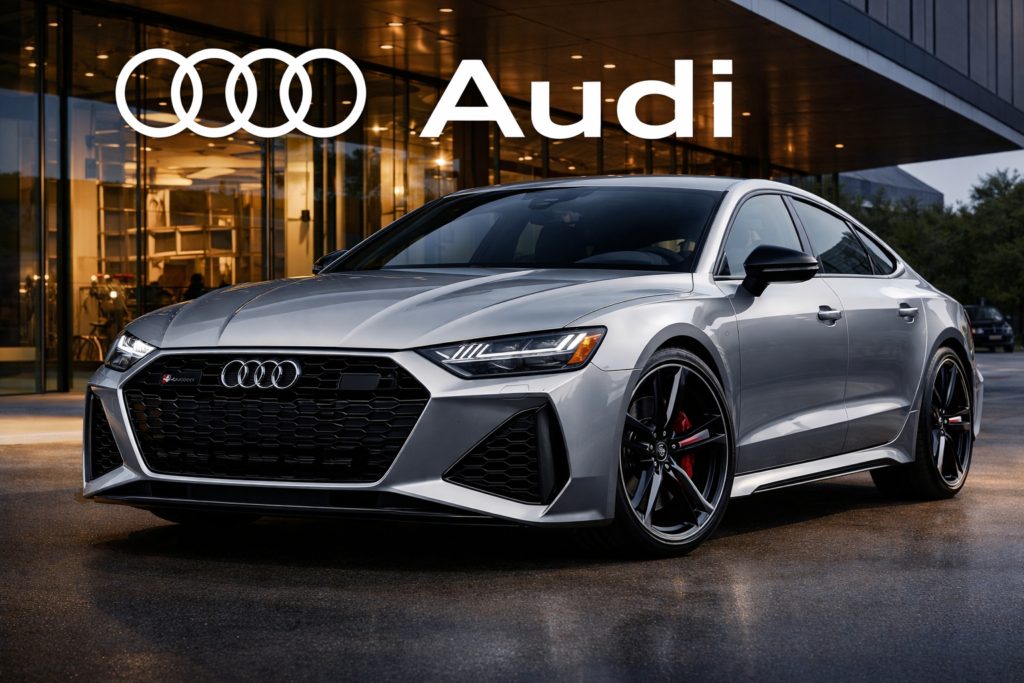
- RS models – Highest performance from Audi Sport GmbH (e.g., RS3, RS6, RS7).
2. SUVs and Crossovers (Q-Series)
Audi’s SUV and crossover range serves a broad segment from compact to full-size:
- Audi Q3 – Compact SUV with premium features; recent refreshes consolidate trim offerings for simplification.
- Audi Q5 – Mid-size SUV with balanced comfort and capability.
- Audi Q7 – Full-size SUV; next generation scheduled for future release with premium three-row seating.
- Audi Q8 – Premium flagship SUV with coupe-like styling.
Electric SUV Lineup
Audi has integrated EV variants under the Q branding:
- Audi Q8 e-tron (formerly e-tron) – Mid-size electric SUV offered in standard and Sportback body styles, with multiple battery and motor configurations including higher performance SQ8 e-tron.
- Audi Q6 e-tron – Electric SUV positioned between Q4 e-tron and Q8 e-tron in size and premium specification (market dependent).
3. Electric Sports / Performance Cars
- Audi e-tron GT / RS e-tron GT – All-electric grand tourer/sports sedan with high performance and range; the RS e-tron GT Performance delivers exceptional 0–60 mph acceleration and advanced battery tech.
4. Sports Cars and Special Models
- Audi R8 – Mid-engine sports car (production 2006–2024) built by Audi Sport GmbH; renowned for performance and quattro all-wheel drive.
- Concept & Historic Models – Audi Prologue (concept), Audi V8 (historic flagship).
5. Product Strategy Notes
- Audi is accelerating electrification, moving from traditional combustion engines to e-tronic (electric) models across segments.
- Some entry-level combustion models like the A1 and Q2 are being phased out with a planned new electric entry-level vehicle under development.
6. Key Differentiators in Audi Products
| Category | Focus | Example Models |
|---|---|---|
| Luxury Sedans | Comfort + tech | A4, A6, A8 |
| Sporty Performance | High power | S & RS models |
| Electric Mobility | Zero emissions | A6 e-tron, Q8 e-tron, e-tron GT |
| SUVs/Crossovers | Versatility | Q3, Q5, Q7, Q8 |
Audi’s journey from August Horch’s small workshop to a global automotive powerhouse is a story of innovation, determination, and strategic evolution. By overcoming financial struggles, embracing technological breakthroughs, and consistently prioritizing quality, Audi achieved its peak as a symbol of luxury and engineering excellence. Its legacy continues to shape the future of mobility, ensuring that the Audi name remains synonymous with progress and performance.