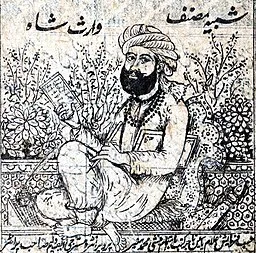
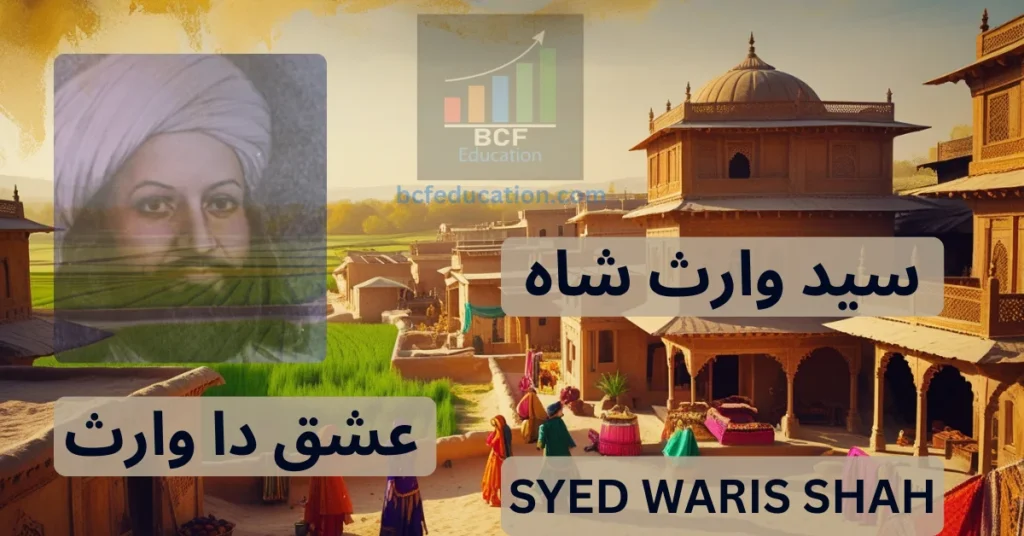
Waris Shah, Shakespeare of the Punjab, one of Punjab’s most celebrated Sufi poets, is best known for his timeless masterpiece Heer Ranjha, a soulful tale of love, devotion, and human emotion. This blog explores his life, spiritual journey, and poetic legacy that continues to inspire readers across generations. Discover his profound quotes, mystical insights, and the cultural impact of his work that shaped Punjabi literature and Sufi thought.
Table of Contents
Waris Shah, Shakespeare of the Punjab
Step into the timeless world of Waris Shah, the legendary Sufi poet whose verses have echoed through centuries of Punjabi culture. Born in the 18th century, Waris Shah transformed a simple folk tale of love and heartbreak into a spiritual masterpiece that explores the very essence of human longing and divine connection. Often hailed as the Shakespeare of Punjab, his masterpiece “Heer Ranjha” is not just a romance, it is a profound commentary on society, spirituality, and the human soul’s quest for union with the divine. Join us as we embark on a journey through the life, legacy, and unforgettable poetry of Waris Shah, whose words continue to move hearts and minds across generations and faiths.
I. Identity and Significance
Waris Shah (1722–1798) is universally acclaimed as the greatest poet in the Punjabi language and the savior of its literary soul.
Masterpiece: He is best known for authoring Heer Ranjha (ہیر رانجھا), a tragic romance considered the quintessential epic of the Punjabi culture.
Titles: He is often called the Shakespeare of Punjab and the Father of the Punjabi Qissa tradition.
Scope of Work: His work is not just a love story but a profound commentary on society, religion, spirituality, and the human condition. His poetry reflects deep human emotions, cultural richness, and Sufi wisdom.
Influence: Waris Shah standardized the Punjabi language and elevated its literature to new philosophical heights. His voice is seen as the very soul of Punjab.
II. Biographical Details
The historical details of Waris Shah’s life are a mix of verified facts and popular legends.
Birth: He was born in 1722 in the village of Jandiala Sher Khan, near Sheikhupura in present-day Pakistan.
Family Background: He was born into a reputed Syed family (claiming descent from the Prophet Muhammad). The family was known for religious scholarship.
Early Life: He became an orphan at a young age and was raised by relatives.
Education and Spiritual Path:
◦ He received formal education in Persian, Arabic, and Islamic sciences.
◦ He studied at the famous shrine and educational center of Kasur under the tutelage of Hafiz Ghulam Murtaza, where he honed his skills in languages and poetry.
◦ He became a mystic and recluse, associating with the Sufi tradition. He was a disciple of Hazrat Hafiz Ghulam Murtaza of the Qadiri Sufi Order.
Composition of Heer: After completing his education, he moved to the village of Malka Hans (near Pakpattan), or Malki Havelian. He resided in a small room adjacent to a mosque, devoting himself to prayer, meditation, and poetry. He penned his magnum opus, Heer Ranjha, around 1766.
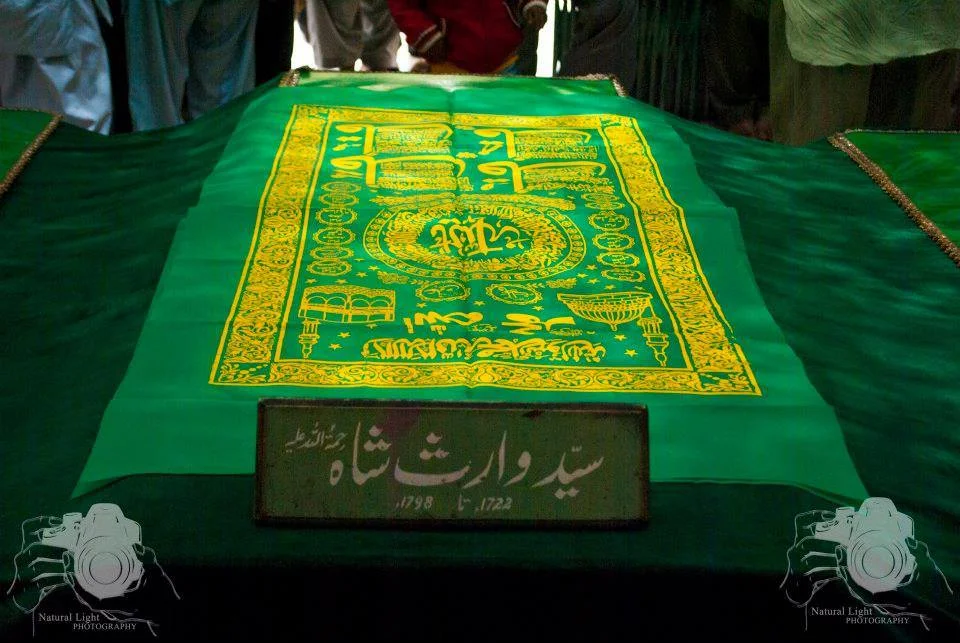
Death: Waris Shah died in 1798 and he was buried in Jandiala Sher Khan Sheikhupura. His shrine is now a place of pilgrimage for people of all faiths.
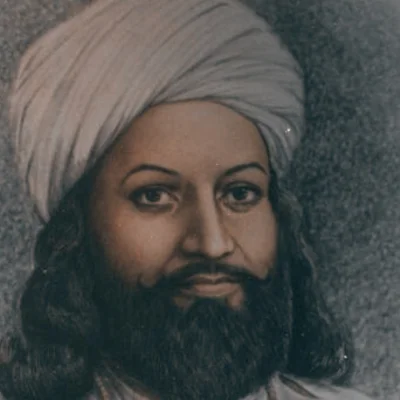
III. The Deeper Meaning of Heer Ranjha
Waris Shah took the popular folk tale of Heer and Ranjha and transformed it from a simple pastoral romance into a profound spiritual allegory. His version is considered the most refined and soulful narration.
Spiritual Allegory (Sufi Thought): In Waris Shah’s hands, the love story became a powerful vehicle for Sufi philosophy:
◦ Heer represents the human soul (Nafs).
◦ Ranjha represents the Divine Beloved (God).
◦ The relentless pursuit of Ranjha for Heer is the soul’s longing for union with the Divine.
◦ Worldly obstacles (greedy family, cunning priest Kaido) represent the material world (Dunya) and the ego that separates the soul from God.
Social and Cultural Critique: Through the allegory, Waris Shah critiqued the rigid social structures of his time, including caste, clergy, and familial tyranny. He used the love story to highlight social injustice, feudalism, greed, and hypocrisy.
Cultural Status: So definitive is his work that the phrase “Waris Shah nun kehndi” (Saying it to Waris Shah) is a common expression in Punjab, meaning to pour one’s heart out to a sympathetic listener.
IV. Legacy and Continuing Relevance
Waris Shah left an everlasting mark on Punjabi literature and Sufi poetry.
Cultural Preservation: He preserved Punjabi culture, customs, and language, and his poetry is considered an encyclopedia of Punjabi culture.
Universal Appeal: He is a cultural unifier whose work transcends religious boundaries and is equally beloved by Sikhs, Muslims, and Hindus in Punjab.
Spiritual Reverence: He is revered as a Sufi saint whose poetry serves as a guide for spiritual seekers.
Modern Impact: His critique of social hypocrisy and oppression remains strikingly relevant today. The renowned Punjabi writer Amrita Pritam famously invoked him in her poignant 1947 poem, “Ajj Aakhaan Waris Shah Nun,” asking him to look upon the violence tearing Punjab apart.
V. Famous Verses and Wisdom
Waris Shah’s poetry is a treasure trove of wisdom.
On the Uniqueness of Love’s Pain: “O Waris Shah, this is the medicine of love. Someone else, tell my lonely heart.” (Shah Warisay, Eh Ishq Di Dawa Ae, Koi Hor Das De Mere Hon Horre Nu).
Meaning: The pangs of love are so overwhelming that only another lover can understand the pain.
On Clerical Hypocrisy: “Kaido became a worshipper in the court of God, the trickster in the court of God.” (Kaido Namazi Hoya Rab De Duroon, Kholutiya Rab De Duroon).
Meaning: A scathing critique of religious leaders who perform rituals outwardly but are filled with deceit and malice inwardly.
On Separation and Sorrow: “In the eyes of Heer and Ranjha, pearls mingled with tears.” (Akhan De Vich Heere Ranjhe De, Ral Gaye Hanjuan Naal).
Meaning: Their tears of separation were as precious as pearls, highlighting the depth and value of their sorrow.
On the Nature of the World: “Waris Shah, the world is a book of pain—whoever opens it cries.” (Original Punjabi: وارث شاه، ُدنیا درد دا دفتر اے؛ ِجڑا وی کھولے رو رو تھک جائے).
Meaning: Life is full of struggle, and anyone who truly understands the reality of the world ends up in tears.
On the Transforming Power of Love: “Love is a fire that burns the body, the heart, and the soul.”. Meaning: Love transforms a person completely; it tests, tears, and changes the lover.
On Winning Hearts: “Hearts cannot be won by force; love grows only with kindness.”.
Meaning: Love cannot be created by power or pressure; it blossoms through soft words and genuine affection.
On Destiny: “When destiny writes separation, no effort can erase it.”.
Meaning: When fate decides separation, human effort becomes powerless.
On Truth: “Waris Shah, speak the truth even if the world turns against you.”.
Meaning: Truth must be spoken boldly, no matter how difficult the circumstances or how unpopular it may be.
VI. Films Inspired by Waris Shah’s “Heer Ranjha”
“Waris Shah Ishq Daa Waaris” (2006): is a deeply moving Punjabi film that brings to life the emotional and spiritual journey of the legendary poet Waris Shah during the time he wrote his timeless epic, “Heer.” Set in 18th-century India amid the reign of Mughal ruler Aurangzeb, who banned music believing it distracts from God, the story follows Waris Shah as he secretly learns and nurtures music under the tutelage of Baba Makhdum. Encouraged to feel deep pain to fully channel his creative powers, Waris moves to the village of Malkan Hans, where he finds love with Bhaagbhari but also faces rivalry from Saabo, who desires him fiercely.
As Waris immerses himself in writing “Heer,” his popularity grows, but so does opposition from the conservative village Qazi who sees his influence as a threat. Arrested but ultimately defending his singing as a form of divine worship, Waris faces heartbreak when Bhaagbhari is forced into marriage with another. Realizing that true artistic creation requires personal sacrifice, Waris lets go of his love, even as Saabo’s attempts to win him over fail. The story culminates in Waris and Bhaagbhari proving their innocence by walking unharmed on burning coals, symbolizing their pure bond, before Waris departs the village having completed his masterpiece.
The film beautifully weaves themes of love transcending boundaries, spiritual devotion, social critique, and the idea that great art arises from profound human suffering. It captures Waris Shah not only as a poet but as a deeply sensitive human being whose personal tragedies inspired the immortal poetry that continues to resonate today. Featuring soulful performances by Gurdas Maan as Waris Shah, Juhi Chawla as Bhaagbhari, and Divya Dutta as Saabo, and blessed with a powerful musical score, “Ishq Daa Waaris” stands as a poignant tribute to Punjab’s cultural and spiritual heritage.
Heer Ranjha (1970, Pakistani film): A classic Punjabi-language film directly based on Waris Shah’s legendary epic. It follows the enduring tale of Heer and Ranjha, their forbidden love, and the obstacles that fate and society place in their path.
Heer Raanjha (1970, Indian Hindi film): Directed by Chetan Anand, this unique musical film presents the entire dialogue in poetic verse, holding true to the lyrical origins of Waris Shah’s work.
Heer (1955, Pakistani Punjabi film): Another adaptation focused squarely on Waris Shah’s narrative of the star-crossed lovers.
Heer Syal (1938, Punjabi film): This is one of the early cinematic interpretations of the Heer story, keeping alive the cultural folklore in the pre-independence era.
VII. Significance and Themes in Waris Shah Cinematic Portrayals

Movies about Waris Shah and his magnum opus blend historical biography with romance and spirituality. They often portray Waris Shah not only as a literary icon but also as a mystic deeply connected to Sufi traditions. Key elements found across these films include:
Spiritual and Artistic Struggle: The film “Waris Shah: Ishq Daa Waaris,” for example, illustrates how the poet’s spiritual journey and personal suffering were essential for creating his masterpiece. Music and poetry are depicted as divine practices, sometimes suppressed by authoritarian rulers, adding historical tension to the narrative.
Sacrifice of Love: The painful personal sacrifices Waris Shah endures, especially letting go of his beloved, symbolize the price of great artistic and spiritual creation. This theme resonates strongly as it reflects the emotional depth behind “Heer Ranjha.”
Social Critique and Universal Themes: These films build on Waris Shah’s critique of social injustices and rigid traditions, showcasing love as a revolutionary and transcendent force.
Humanizing the Poet: Through fictional elements and romantic dramatization, films provide modern audiences a relatable, sensitive image of Waris Shah as a poet profoundly affected by the world around him.
Together, these cinematic works not only preserve Waris Shah’s literary heritage but also keep alive the emotional and spiritual spirit of Punjab, making the ancient tale accessible and meaningful to new generations.