
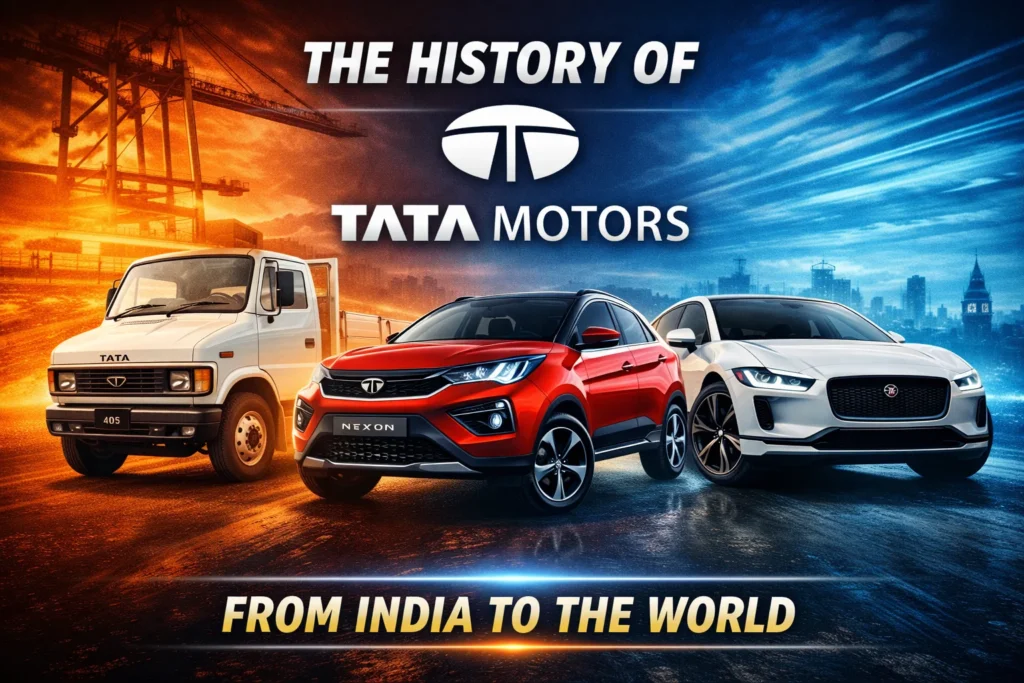
Tata Motors: Journey of India’s Automotive Giant
Introduction
Tata Motors Limited is one of India’s largest and most influential automobile manufacturers and a flagship company of the Tata Group, one of the oldest and most respected business conglomerates in India. Known for producing everything from affordable passenger cars to luxury vehicles, trucks, buses, and electric mobility solutions, Tata Motors has played a crucial role in shaping India’s automotive industry while expanding its footprint globally.
Founded in 1945, Tata Motors has evolved from a locomotive manufacturer into a global automotive powerhouse with operations across Asia, Europe, Africa, and the Americas.
Foundation and Early History (1945–1960s)
Tata Motors was originally established as Tata Engineering and Locomotive Company (TELCO) in 1945. The company’s initial focus was not passenger cars but locomotives and engineering products, aimed at supporting India’s post-independence industrial growth.
In the 1950s, Tata Motors entered the commercial vehicle segment through a collaboration with Daimler-Benz (Germany). This partnership enabled Tata to manufacture reliable trucks and buses for Indian roads, which quickly gained popularity due to their durability and affordability.
By the 1960s, Tata Motors had become a dominant force in India’s commercial vehicle market, laying a strong foundation for future expansion.
Expansion into Passenger Vehicles (1970s–1990s)
Entry into Passenger Cars
For decades, Tata Motors focused primarily on commercial vehicles. However, in the 1990s, the company took a bold step into the passenger car segment.
Tata Sierra (1991) – India’s first indigenously designed SUV
Tata Estate – A station wagon based on Tata’s commercial platform
These early models helped Tata Motors gain experience but faced stiff competition.
Game Changer: Tata Indica (1998)
The real breakthrough came in 1998 with the launch of the Tata Indica, India’s first fully indigenous passenger car.
The Indica was:
Designed, developed, and manufactured in India
Affordable and fuel-efficient
Built for Indian road conditions
Its success transformed Tata Motors into a serious player in the passenger car market and boosted national pride in Indian engineering.
Global Ambitions and Major Acquisitions (2000s)
Rebranding and Global Vision
In 2003, TELCO was officially renamed Tata Motors Limited, reflecting its broader automotive vision and global aspirations.
Acquisition of Jaguar & Land Rover (2008)
One of the most defining moments in Tata Motors’ history came in 2008, when it acquired Jaguar and Land Rover (JLR) from Ford Motor Company.
This acquisition:
Instantly positioned Tata Motors in the global luxury car market
Saved Jaguar and Land Rover during the global financial crisis
Demonstrated Tata Group’s long-term, values-driven leadership
Under Tata ownership, JLR flourished with:
New product lines
Improved quality and design
Strong global sales growth
This move is often cited as one of the most successful international acquisitions by an Indian company.
Innovation and the People’s Car: Tata Nano
In 2009, Tata Motors launched the Tata Nano, envisioned as the world’s cheapest car.
Aimed at making car ownership accessible to millions
Priced initially at around ₹1 lakh
While the Nano was an engineering marvel, it struggled commercially due to:
Marketing challenges
Perception as a “cheap” car rather than a “value” car
Despite this, the Nano remains an important chapter in Tata Motors’ innovation journey.
Modern Revival and Design-Led Transformation (2015–Present)
Turnaround Strategy
From around 2015, Tata Motors underwent a major transformation under new leadership and design philosophy.
Key pillars of revival:
Bold, modern design language
Improved safety standards
Focus on quality and technology
Successful New-Age Models
Tata Motors launched a series of successful vehicles, including:
Tata Tiago
Tata Tigor
Tata Nexon
Tata Harrier
Tata Safari (new generation)
The Tata Nexon became India’s best-selling SUV and earned high safety ratings, significantly improving the brand’s image.
Leadership in Electric Vehicles (EVs)
Tata Motors is the market leader in electric vehicles in India.
Key EV Models
Tata Nexon EV
Tata Tigor EV
Tata Tiago EV
The company benefits from the Tata Group ecosystem, including:
Tata Power (charging infrastructure)
Tata Chemicals (battery materials)
Tata Consultancy Services (software solutions)
Tata Motors’ EV strategy aligns with India’s sustainability goals and positions the company as a future-ready automaker.
Commercial Vehicles and Global Presence
Commercial Vehicle Leadership
Tata Motors is:
India’s largest commercial vehicle manufacturer
A major supplier of trucks, buses, defense vehicles, and construction equipment
Global Operations
Manufacturing plants in India, UK, South Korea, Thailand, and South Africa
Exports to over 125 countries
Subsidiaries include:
Jaguar Land Rover (UK)
Tata Daewoo (South Korea)
Corporate Philosophy and Values
Tata Motors operates under the Tata Group’s ethical framework, emphasizing:
Trust and integrity
Social responsibility
Sustainable growth
The company invests heavily in:
Road safety
Environmental sustainability
Skill development and community welfare
Challenges and Future Outlook
Challenges
Global supply-chain disruptions
EV competition
Changing consumer expectations
Future Vision
Electrification of entire product range
Hydrogen and alternative fuels
Smart, connected vehicles
Stronger global presence through JLR and EV leadership
From building locomotives in post-independence India to owning iconic global brands like Jaguar and Land Rover, Tata Motors’ journey reflects resilience, innovation, and visionary leadership.
Tata Motors Timeline Chart (1945–Present)
Key Milestones in the History of Tata Motors
| Year | Event / Milestone |
|---|---|
| 1945 | Founded as Tata Engineering and Locomotive Company (TELCO) |
| 1954 | Collaboration with Daimler-Benz to manufacture commercial vehicles |
| 1961 | Tata becomes India’s leading commercial vehicle manufacturer |
| 1977 | Roll-out of India’s first indigenous heavy commercial vehicle |
| 1991 | Launch of Tata Sierra, India’s first indigenous SUV |
| 1998 | Launch of Tata Indica, India’s first fully indigenous passenger car |
| 2000 | Indica successfully exported to Europe |
| 2003 | TELCO renamed Tata Motors Limited |
| 2004 | Acquisition of Daewoo Commercial Vehicles (South Korea) |
| 2005 | Launch of Tata Ace, revolutionizing small commercial vehicles |
| 2008 | Acquisition of Jaguar & Land Rover (JLR) from Ford |
| 2009 | Launch of Tata Nano, the world’s most affordable car |
| 2013 | Introduction of new global design and product strategy |
| 2016 | Launch of Tata Tiago, beginning brand revival |
| 2017 | Launch of Tata Nexon |
| 2018 | Launch of Tata Nexon EV; Tata becomes EV leader in India |
| 2020 | New-generation Tata Safari introduced |
| 2021 | Tata Motors announces aggressive EV roadmap |
| 2022 | Tata Motors becomes India’s top EV manufacturer |
| 2023 | Expansion of EV lineup and connected-car technology |
| 2024 | Continued dominance in EV and SUV segments |
| 2025+ | Focus on full electrification and sustainable mobility |
Tata Motors Timeline (Era-Based View)
1945–1960s: Foundation & Commercial Vehicles
Focus on locomotives and trucks
Partnership with Daimler-Benz
Backbone of India’s transport infrastructure
1970s–1980s: Domestic Leadership
Expansion of heavy and medium commercial vehicles
Strengthening manufacturing capabilities
1990s: Passenger Vehicle Entry
Tata Sierra, Estate
Landmark launch of Tata Indica
2000s: Global Expansion
Rebranding to Tata Motors
Acquisitions: Daewoo CV & Jaguar Land Rover
2010s: Innovation & Revival
Tata Nano experiment
New design philosophy
SUVs and safety-focused models
2020s: Electric & Sustainable Future
EV market leadership
Smart mobility solutions
Global growth through JLR