
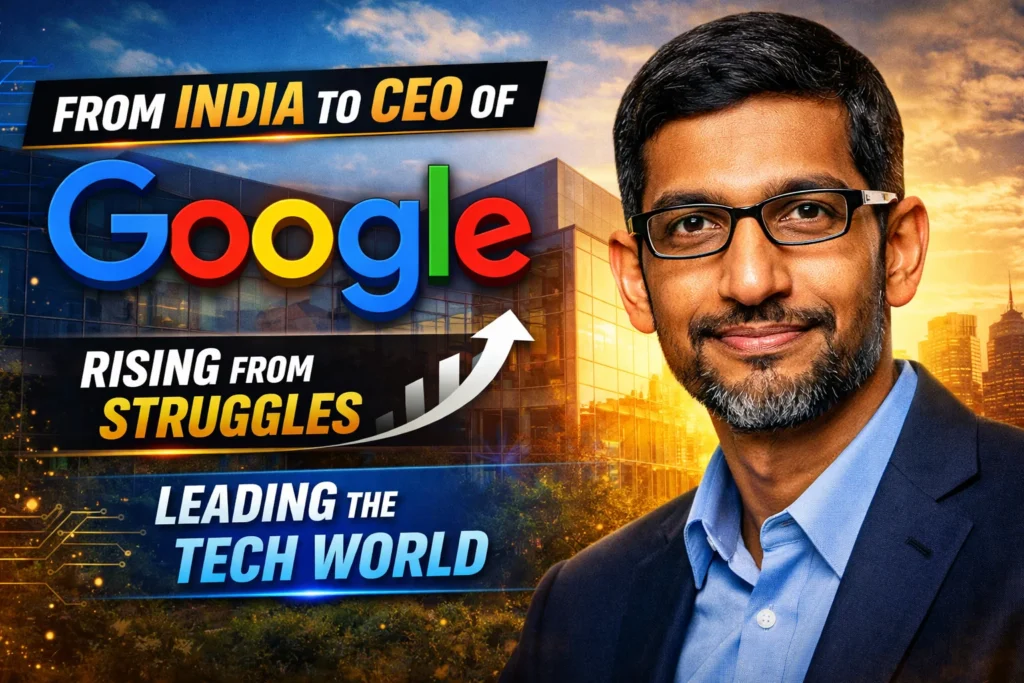
From Chennai to the Corner Office: The Remarkable Journey of Sundar Pichai
In the annals of modern corporate history, few ascents are as compelling and instructive as that of Sundar Pichai. His journey from a modest, book-filled home in Chennai, India, to the helm of Alphabet Inc., one of the world’s most influential companies, is a masterclass in quiet resilience, intellectual brilliance, and the power of empathetic leadership. This is the story not just of a CEO, but of a man whose struggles and strengths redefined what it means to lead in the digital age.
The Forging Ground: Humble Beginnings & Early Struggles
Born Pichai Sundararajan on June 10, 1972, Sundar’s childhood was marked not by privilege, but by constraint and focus. His father, an electrical engineer at GEC, and his mother, a stenographer, lived in a two-room apartment with Sundar and his younger brother. Financial limitations were a constant; the family owned no car and rarely vacationed. Yet, what their home lacked in space, it overflowed with ambition and discipline.
Struggle 1: Making Every Resource Count. Sundar’s most famous childhood anecdote is a powerful testament to this. His family didn’t have a telephone until he was 12. They didn’t get a car (a blue Ambassador) until he was in college. More poignantly, he and his brother slept in the living room, often on the floor. This environment bred resourcefulness. Sundar learned to optimize, to value what he had, and to find opportunity in limitation—a skill that would later define his approach to product development.
Struggle 2: The Relentless Academic Pressure. Education was the undisputed passport to a better life. Sundar attended Padma Seshadri Bala Bhavan and later Vana Vani school. He was a brilliant student, but the pressure to excel in India’s hyper-competitive academic system was immense. His consistency, however, was remarkable. He earned a silver medal in Class 10 and secured a state rank in Class 12. This period ingrained in him a formidable work ethic and a deep respect for the power of knowledge.
Struggle 3: The Dream Beyond Reach. For a middle-class family in 1990s India, a U.S. education was a distant dream, fraught with financial impossibility. After earning his Metallurgical Engineering degree from IIT Kharagpur (where he won a silver medal), Sundar secured a coveted scholarship to Stanford University for an M.S. in Material Sciences. But the airfare and initial costs were prohibitive. In an act of immense sacrifice, his father withdrew almost ₹1 lakh (roughly $1,200 today, but a fortune then) from the family’s savings. Sundar carried this weight of expectation with him to California, a constant reminder of the stakes of his journey.
The Crucible of Change: From Engineering to Business
At Stanford, Sundar faced a new struggle: cultural and financial shock. He saw the technological revolution firsthand and realized his passion lay not in the heart of materials, but in the promise of silicon and software. The cost of a new computer was staggering. He meticulously researched and purchased his first-ever computer—a Macintosh—only after finding a student discount. This firsthand understanding of the value of technology for the everyday user would become a hallmark of his philosophy.
A pivotal moment came during a summer internship at Applied Materials. He saw semiconductor engineers and thought, “Their work is defining the future.” But he also saw the business leaders guiding them. He recognized that to have scale and impact, he needed to understand the language of business. This led him to the Wharton School, where he earned an MBA, sharpening the technical acumen of an engineer with the strategic vision of a business leader.
The Grind Before Google: Finding His Path
Before the glitz of Silicon Valley, there was the grind. Sundar worked as an engineer and product manager at Applied Materials and later as a management consultant at McKinsey & Company. These roles were his apprenticeship in problem-solving, operational complexity, and managing large-scale projects. He learned to distill chaos into clarity—a skill that would make him indispensable at Google.
The Google Gambit: The “20% Project” That Changed Everything
Sundar Pichai joined Google on April 1, 2004—the day Gmail was launched. He was a humble product manager, tasked with overseeing the Google Toolbar. His rise was not meteoric; it was a steady, relentless burn built on a series of quiet victories.
His Secret Weapon: Empathetic Product Sense & Execution. While others chased moonshots, Pundar focused on fundamental problems. He understood that for billions of users, especially in emerging markets like his native India, the internet was slow, expensive, and accessed on low-memory devices. He championed products that solved these real-world frictions:
Google Chrome (2008): The browser wars were dominated by Internet Explorer and Firefox. Sundar’s team built Chrome on a radical idea: simplicity, speed, and security. It was derided initially but is now the world’s dominant browser. He fought for it, defended it, and shepherded it from a risky side project to a global platform.
Chrome OS & Chromebooks: He doubled down on the cloud-first, affordable computing vision.
Android: In a career-defining move, Google founder Larry Page handed the reins of Android to Sundar in 2013, merging it with the Chrome team. This wasn’t just a promotion; it was a baptism by fire, consolidating Google’s most critical ecosystems under one leader.
Through every launch, his leadership style shone: low-ego, collaborative, deeply technical, and unerringly focused on the user. He wasn’t the loudest voice in the room; he was the one who synthesized all voices into a clear, executable plan.
The Ascent to CEO: Right Time, Right Leader
The path to CEO was paved by both triumph and turmoil.
The Mobile Mandate: Sundar’s stewardship of Android and Chrome made him the architect of Google’s mobile and cloud-first strategy. As the world went mobile, he was proven unequivocally right.
A Stabilizing Force: In 2015, Google underwent a major corporate restructuring, creating Alphabet Inc. as a parent company. Co-founders Larry Page and Sergey Brin moved to run Alphabet. Google needed a new CEO. The company was facing internal fragmentation, with different product teams operating like rival fiefdoms. It needed a unifier, not a disruptor.
The Decisive Moment: On August 10, 2015, Sundar Pichai was appointed CEO of Google. In 2019, he assumed the additional role of CEO of Alphabet. The engineer who once couldn’t afford a computer was now leading one of the most powerful tech empires in history.
Why Sundar? The founders chose him because he embodied the unique blend required for the era: technical depth, product genius, calm diplomacy, and trusted stewardship. He was a consensus builder who could manage the immense complexity of Google while maintaining its innovative spirit. He had survived and thrived through Google’s internal wars, earning the respect of both brilliant engineers and hard-nosed business executives.
The Legacy: Leadership Redefined
Sundar Pichai’s struggles did not end with the CEO title. He has since navigated antitrust lawsuits, ethical AI controversies, workforce tensions, and the seismic shifts of the AI era with his characteristic calm. His story teaches us that in a world that often rewards the loudest hype, there is enduring power in quiet competence, empathetic innovation, and the resilience forged in life’s early constraints.
His journey from the two-room apartment in Chennai to the corner office in Mountain View stands as a global testament to the idea that where you start does not determine where you can finish. It is a narrative built not on flash, but on substance—a true embodiment of the very products he helped create: simple, powerful, and indispensable to the world.
Sundar Pichai: From Modest Beginnings to CEO of Google
Sundar Pichai’s journey from a small home in India to the highest executive position at one of the world’s most powerful technology companies is a remarkable story of perseverance, intellect, and quiet leadership. His rise to becoming the CEO of Google is not a tale of overnight success but the result of years of discipline, struggle, and strategic thinking.
Early Life and Background
Sundar Pichai was born on June 10, 1972, in Madurai, Tamil Nadu, India. His full name is Pichai Sundararajan. He grew up in a lower-middle-class family in Chennai. His father, Regunatha Pichai, worked as an electrical engineer at the British multinational company GEC, while his mother, Lakshmi Pichai, was a stenographer before becoming a homemaker.
The family lived in a two-room apartment, and for many years they did not have basic luxuries such as a refrigerator, television, or even a telephone. When the family finally installed a landline phone, Sundar’s extraordinary memory became evident—he could remember every phone number he dialed, a skill that later translated into his sharp analytical abilities.
Despite limited resources, education was always a priority in the Pichai household. Sundar was a bright student from an early age, showing a strong aptitude for mathematics and science.
Education and Early Struggles
Sundar completed his schooling in Chennai and went on to study Metallurgical Engineering at the Indian Institute of Technology (IIT) Kharagpur, one of India’s most prestigious institutions. He graduated with distinction, earning praise from professors who recognized his exceptional academic talent.
However, financial constraints were a constant challenge. Pursuing higher education abroad was a dream that seemed nearly impossible due to the high cost. Sundar received a scholarship to attend Stanford University for a Master’s degree in Materials Science and Engineering. The cost of his airfare to the United States reportedly exceeded his father’s annual salary, highlighting the magnitude of the sacrifice his family made.
Later, Sundar earned an MBA from the Wharton School of the University of Pennsylvania, where he was recognized as both a Siebel Scholar and Palmer Scholar, honors awarded to top-performing students.
Early Career Before Google
Before joining Google, Sundar Pichai worked at Applied Materials, a semiconductor manufacturing company, and later at the management consulting firm McKinsey & Company. These roles helped him develop a strong understanding of both technology and business strategy, preparing him for leadership roles in the tech industry.
Although these positions were stable and prestigious, Sundar was drawn toward innovation-driven environments where technology could impact millions of people. This inclination eventually led him to Google.
Joining Google
Sundar Pichai joined Google in 2004 as a Product Manager. At that time, Google was still a rapidly growing company best known for its search engine. Sundar initially worked on the Google Toolbar, which allowed users to access Google search directly from their web browsers.
During this period, Sundar noticed a critical trend: Microsoft Internet Explorer dominated the browser market, and Google was heavily dependent on it for search traffic. Recognizing the long-term risk, he strongly advocated for Google to develop its own web browser.
Despite internal skepticism and strong competition, Sundar led the initiative that resulted in the launch of Google Chrome in 2008. Chrome quickly gained popularity due to its speed, simplicity, and security, eventually becoming the most widely used web browser in the world. This success significantly elevated Sundar’s standing within the company.
Rise Through the Ranks
Following the success of Chrome, Sundar Pichai was entrusted with greater responsibilities. He became the head of Chrome OS, and later took charge of Android, Google’s mobile operating system. Under his leadership, Android expanded globally and became the world’s most widely used mobile operating system.
Sundar was known for his calm demeanor, collaborative leadership style, and data-driven decision-making. Unlike many high-profile tech executives, he avoided aggressive public personas, preferring consensus and long-term vision. These qualities earned him the trust of Google’s founders, Larry Page and Sergey Brin.
Becoming CEO of Google
In August 2015, following Google’s corporate restructuring under the newly formed parent company Alphabet Inc., Sundar Pichai was appointed CEO of Google. Larry Page became CEO of Alphabet, while Sergey Brin took on the role of President.
This appointment marked a historic moment—not only because Sundar was an internal promotion, but also because he was an immigrant from a modest background leading one of the most influential technology companies in the world.
In December 2019, Sundar Pichai was further promoted to CEO of Alphabet Inc., making him responsible for overseeing Google as well as Alphabet’s other ventures, including Waymo, DeepMind, and Google Cloud.
Leadership Philosophy and Legacy
Sundar Pichai’s leadership emphasizes innovation, inclusivity, ethical use of technology, and long-term sustainability. He has guided Google through complex challenges, including data privacy concerns, artificial intelligence ethics, and global regulatory scrutiny.
His journey demonstrates that talent, humility, and perseverance can overcome financial and social barriers. Sundar Pichai remains a powerful symbol of how education and opportunity can transform lives, inspiring millions of young professionals around the world.