
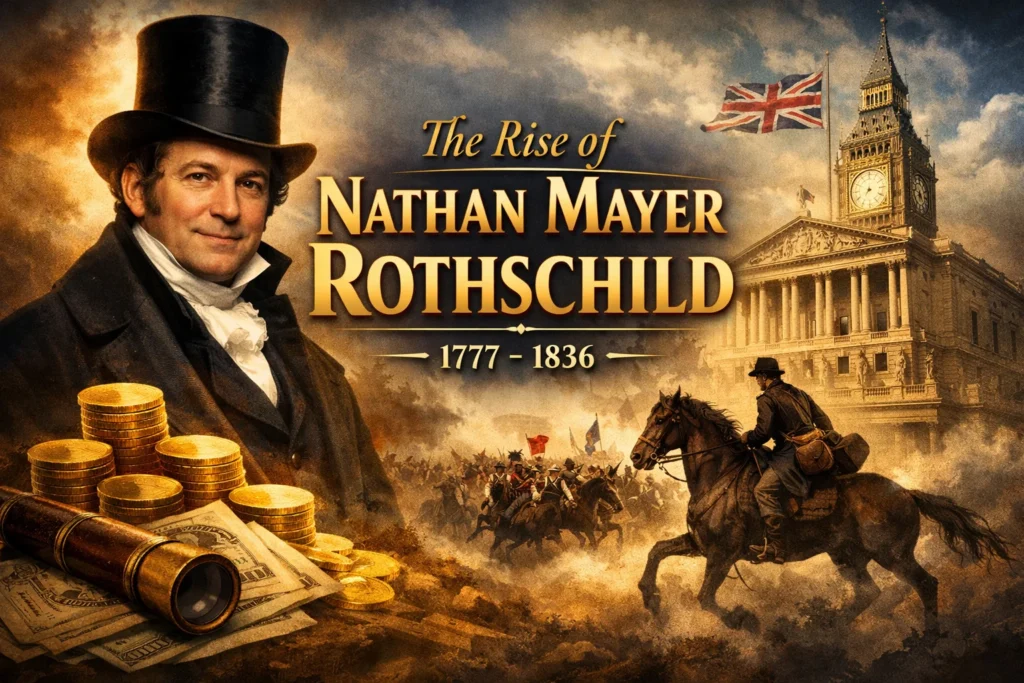
Nathan Mayer Rothschild: The Architect of Modern Finance and His Enduring Legacy
Introduction
In the annals of financial history, few names carry the weight and mystique of Rothschild. At the heart of this legendary dynasty stands Nathan Mayer Rothschild (1777-1836), the third son of Mayer Amschel Rothschild. More than just a banker, Nathan was a financial visionary, a master of information, and an institution builder whose strategies and structures laid the groundwork for modern international finance. His story is not merely one of personal wealth, but of creating the very mechanisms that power global capital markets today.
The Man and His Move: From Frankfurt to London
Sent to England in 1798 at the age of 21, Nathan initially established a textile business in Manchester, the heart of the Industrial Revolution. Here, he honed his understanding of trade, arbitrage, and the flow of goods and money. Recognizing that the real power lay in financing trade and government, he moved to London in 1809, setting up shop at New Court in the City of London.
Nathan possessed a formidable character: sharp, decisive, intimidating, and blessed with an unparalleled instinct for market dynamics. His most famous advantage was his private intelligence network. Using fast coaches, carrier pigeons, and trusted agents across Europe, he often received news of world events—most notably the outcome of the Battle of Waterloo in 1815—before the British government itself. This network wasn’t just for espionage; it was the nervous system of his financial organism.
The Core Enterprise: N M Rothschild & Sons
The cornerstone of Nathan’s empire was N M Rothschild & Sons, founded in 1811. Unlike a modern publicly-traded conglomerate, it was, and remains, a partnership and later a private limited company—the epitome of a merchant bank. Its “products” were not consumer goods but sophisticated financial services for governments, corporations, and ultra-high-net-worth individuals. Its activities included:
Sovereign Debt Issuance: This was Nathan’s masterstroke. He pioneered the issuance of large-scale government bonds on the international market. His most famous feat was financing the British war effort against Napoleon, orchestrating the shipment of gold across Europe to fund the Duke of Wellington’s armies. He later managed loans for the Prussian government and post-Napoleonic France, effectively acting as a banker to nations.
Bullion Trading and The Royal Mint Refinery: Nathan made the London bullion market. His firm became the dominant force in gold trading, and in 1852 (posthumously, under his sons), Rothschild acquired The Royal Mint Refinery. For over a century, it was the world’s premier gold refinery, setting the daily “Gold Fix” price in London until 2004. Gold was the ultimate “product” and the bedrock of the firm’s authority.
International Finance and Exchange Trading: He leveraged his family’s unparalleled European network (brothers in Frankfurt, Vienna, Naples, and Paris) to create a de facto early international clearing system. Bills of exchange and payments could be settled across borders with speed and reliability no competitor could match, financing global trade.
Early Venture Capital and Underwriting: The firm provided capital for monumental industrial projects that defined the 19th century, most notably the financing of the Cecil Rhodes’ Consolidated Gold Fields and, crucially, the Rhodes’ De Beers diamond empire. This was not passive investment; it was strategic partnership-building that controlled resources and geopolitics.
Expansion and Evolution: Key Holdings and “Products”
While N M Rothschild & Sons was the engine, the family’s influence extended through strategic investments and creations:
The French Branch: Rothschild Frères: Though established by his brother James, Nathan’s capital and coordination were vital. It financed railways (Chemin de Fer du Nord) and industries, becoming a pillar of the French economy.
Railways: The Rothschilds were instrumental in funding Europe’s railway boom, the “internet” of the 19th century, which transformed economies and linked markets.
Natural Resources: Beyond De Beers diamonds, the family had significant interests in mining, including the Rio Tinto complex in Spain (a major copper producer), and later, oil through participation in Royal Dutch Shell and Russian oil fields.
Wine: Château Lafite Rothschild & Château Mouton Rothschild: While technically under the French branch, these legendary Bordeaux estates, acquired in 1868 and 1853 respectively, became iconic “products” bearing the Rothschild name. They symbolize the dynasty’s move into prestige assets and brand-building beyond pure finance.
The Modern Legacy: Fragmentation and Focus
The 20th century saw wars, nationalism, and the decline of merchant banking. The cohesive, family-run pan-European network fractured. However, the core businesses adapted and evolved into powerful, separate entities:
Rothschild & Co: The modern successor to the Paris and London banking houses. It is a global, independent financial advisory group. Its “products” are pure high-end services:
M&A Advisory: A world leader in mergers and acquisitions advice.
Restructuring: Guiding companies through debt restructuring and turnarounds.
Wealth and Asset Management: Preserving and growing the capital of affluent families and institutions.
Investment Banking (France): Provides capital markets and advisory services.
Rothschilds Continuation Holdings AG: A Swiss-based family holding company that controls the various Rothschild financial services businesses, ensuring ongoing family influence.
Independent Asset Management Firms: Entities like RIT Capital Partners plc (London) and Edmond de Rothschild Group (Geneva) manage significant investment portfolios and private equity, founded by different branches of the family.
Vins Rothschild / Baron Philippe de Rothschild SA: This company manages the iconic wine estates (Lafite, Mouton, and others across the globe) and related luxury ventures, a direct and tangible “product” lineage from the 19th century.
Conclusion: The True “Product” Was Trust and Network
Nathan Rothschild’s greatest creation was not a single company or financial instrument. It was a system: a trusted, confidential, and extraordinarily efficient international mechanism for moving capital and information. His “products” were financial stability for governments, liquidity for markets, and strategic capital for empire-building industries.
The modern Rothschild entities no longer wield the singular, awe-inspiring power of Nathan’s era, having been supplanted by massive publicly-traded banks and investment funds. Yet, the legacy endures in their focus on discretion, advisory excellence, and independence. They are a living testament to Nathan Mayer Rothschild’s revolutionary insight: that in a world of uncertainty, the most valuable commodities are reliable information, impeccable trust, and the network that connects them. He didn’t just amass wealth; he engineered the very plumbing of the modern financial world.
📜 Timeline of Nathan Mayer Rothschild (1777–1836)
1777 – Birth
September 16, 1777: Nathan Mayer Rothschild is born in Frankfurt, Germany
He is the fifth son of Mayer Amschel Rothschild, founder of the Rothschild banking dynasty
Grows up in the Jewish ghetto of Frankfurt, known as the Judengasse
1798 – Move to England
Nathan moves to Manchester, England at the age of 21
Starts as a textile merchant, trading British cloth with European markets
Quickly learns British trade networks, shipping routes, and currency exchange
1804 – Establishment in London
Relocates to London
Founds N M Rothschild & Sons, the British branch of the Rothschild family bank
Begins focusing on banking, finance, and government bonds
1806–1815 – Napoleonic Wars
Plays a crucial role in financing Britain’s war effort against Napoleon
Builds a fast intelligence and courier network across Europe
Moves gold and funds to British allies despite war blockades
The Rothschild network becomes faster than official government communication
1815 – Battle of Waterloo
After Napoleon’s defeat at Waterloo, Nathan allegedly receives the news before the British government
Uses this early information to make major bond trades (the event later became surrounded by myths)
Emerges as Britain’s most powerful financier
1816 – Bank of England Loan
Arranges a major £5 million loan to help Britain stabilize after the war
Strengthens Rothschild influence over European government finance
1818–1825 – European Dominance
Finances governments in Austria, Prussia, France, and Britain
Becomes Europe’s leading dealer in government bonds
Rothschild banks operate in London, Paris, Frankfurt, Vienna, and Naples
1825 – British Financial Crisis
Helps prevent a total collapse during the Panic of 1825
Supplies gold to the Bank of England
Earns the reputation of being the man who could stabilize nations
1820s – Industrial Expansion
Invests heavily in:
Railways
Mining
Infrastructure projects
Supports trade growth during the early Industrial Revolution
1830 – Peak Influence
Nathan is widely regarded as the most powerful banker in the world
Governments consult him before issuing debt
His opinion can move financial markets across Europe
Legacy
Established London as the center of global finance
Perfected international banking through speed, trust, and family coordination
Set the foundation for modern central banking and global finance systems