
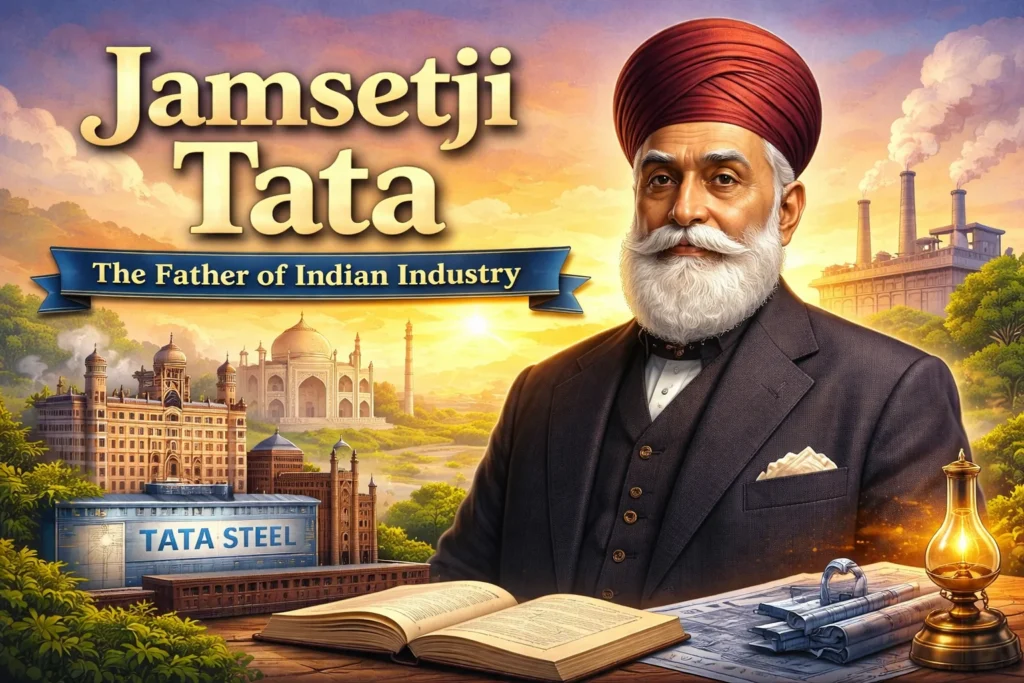
Jamsetji Tata: The Visionary Founder of India’s Industrial Revolution
Jamsetji Nusserwanji Tata (1839–1904) is widely regarded as the father of Indian industry. He was not only a successful entrepreneur but also a visionary nationalist who dreamed of building industries that would make India economically strong and self-reliant. The foundations he laid eventually grew into the Tata Group, one of the largest and most respected business conglomerates in the world.
Early Life and Education
Jamsetji Tata was born on 3 March 1839 in Navsari, Gujarat, into a Parsi family. His father, Nusserwanji Tata, was a merchant who later moved to Bombay (now Mumbai) to establish a trading business. Unlike most Indian businessmen of his time, Jamsetji received a modern education. He graduated from Elphinstone College, Bombay, in 1858, where he was exposed to Western ideas, science, and global trade practices.
This combination of Indian values and modern education shaped Jamsetji’s progressive thinking.
Early Business Career
Jamsetji joined his father’s trading firm at a young age and traveled extensively to China, Japan, England, and the United States. These travels allowed him to study global industries, technology, and management systems. He realized that India’s dependence on foreign goods was holding the nation back.
In 1868, at the age of 29, Jamsetji Tata founded a trading company with a capital of just ₹21,000. This marked the birth of what would later become the Tata Group.
Jamsetji Tata’s Vision: The Four Dreams
Jamsetji Tata is remembered not just for what he achieved, but for the four great dreams he envisioned for India—most of which were fulfilled after his death:
1. A World-Class Steel Industry
Jamsetji believed that steel was essential for national development. Despite opposition and lack of technical support under British rule, his dream led to the establishment of Tata Steel in 1907, Asia’s first integrated steel plant, in Jamshedpur.
2. A World-Class Educational Institution
He strongly believed in science and research. His vision resulted in the founding of the Indian Institute of Science (IISc), Bangalore, one of India’s top research institutions.
3. A Major Hydro-Electric Power Project
Jamsetji foresaw the importance of electricity for industrial growth. His dream led to the creation of Tata Power, one of India’s earliest power companies.
4. A Luxury Hotel of International Standards
To challenge racial discrimination under British rule, Jamsetji envisioned a world-class hotel for Indians. This dream became reality with the opening of the Taj Mahal Hotel, Bombay, in 1903.
Business Philosophy and Ethics
Jamsetji Tata believed that business should serve society. He treated employees with dignity at a time when labor rights were almost nonexistent. His principles included:
Fair wages
Employee welfare
Ethical business practices
Long-term national development over short-term profit
These values became the cornerstone of the Tata Group’s culture.
Nationalism and Social Contribution
Jamsetji Tata was a true nationalist, even though he avoided active politics. He believed that strong industries, education, and scientific research were the real tools of freedom. He invested heavily in education, healthcare, and scientific advancement, often donating large sums anonymously.
Death and Legacy
Jamsetji Tata passed away on 19 May 1904, before many of his dreams were realized. However, his successors—especially J.R.D. Tata and Ratan Tata—turned his vision into reality.
Today, the Tata Group operates in over 100 countries, employing millions of people. Jamsetji Tata’s legacy lives on as a symbol of vision, integrity, and nation-building.
Nusserwanji Tata: The Pioneer Who Laid the Foundation of the Tata Legacy
Nusserwanji Tata (1822–1871) was a pioneering Indian entrepreneur and the father of Jamsetji Tata, the founder of the Tata Group. Although he lived in a period when Indian business opportunities were extremely limited under British colonial rule, Nusserwanji Tata played a crucial role in shaping the values, vision, and commercial foundations that later evolved into one of the world’s most respected business empires.
Early Life and Background
Nusserwanji Tata was born in 1822 in Navsari, Gujarat, into a Parsi priestly family. At that time, members of his community traditionally pursued religious vocations. However, Nusserwanji chose a different path, breaking away from centuries-old tradition to enter the world of commerce and trade. This decision itself reflected his progressive mindset and courage.
Move to Bombay and Entry into Business
In the early 19th century, Bombay (now Mumbai) was emerging as a major trading port under British rule. Recognizing its commercial potential, Nusserwanji moved to Bombay in search of better opportunities. He began working as a trading agent and merchant, dealing primarily in cotton, opium, and general goods, which were major exports at the time.
Through hard work, honesty, and persistence, he built a reputation as a reliable and ethical trader, a rare quality in an era dominated by foreign business interests.
Role in Shaping Jamsetji Tata
One of Nusserwanji Tata’s greatest contributions was his influence on his son, Jamsetji Tata. Despite having a traditional background, Nusserwanji strongly supported modern education for his son. He sent Jamsetji to Elphinstone College, Bombay, exposing him to Western education, science, and global business ideas.
Nusserwanji also took Jamsetji along on business travels, helping him gain firsthand experience of international trade and industry. This mentorship played a vital role in shaping Jamsetji’s global outlook and entrepreneurial vision.
Business Values and Ethics
Nusserwanji Tata believed in:
Integrity in business
Long-term relationships
Respect for commitments
Hard work and discipline
These principles became the ethical foundation of the Tata family and were later institutionalized by Jamsetji Tata and subsequent Tata leaders.
Challenges Under British Rule
As an Indian businessman during colonial rule, Nusserwanji faced significant challenges:
Limited access to capital
Discrimination in trade and industry
Dominance of British firms
Despite these obstacles, he managed to establish a stable and respected trading business, proving that Indians could succeed in commerce even under restrictive conditions.
Death and Legacy
Nusserwanji Tata passed away in 1871, before witnessing the industrial revolution that his son would later lead. However, his courage to break tradition, commitment to ethical business, and support for education laid the groundwork for Jamsetji Tata’s extraordinary achievements.
Conclusion
Although Nusserwanji Tata did not build large factories or global companies himself, his role in Indian business history is deeply significant. He was the silent architect behind the Tata legacy—planting the seeds of ambition, integrity, and modern thinking that eventually grew into one of the world’s most admired business groups.