
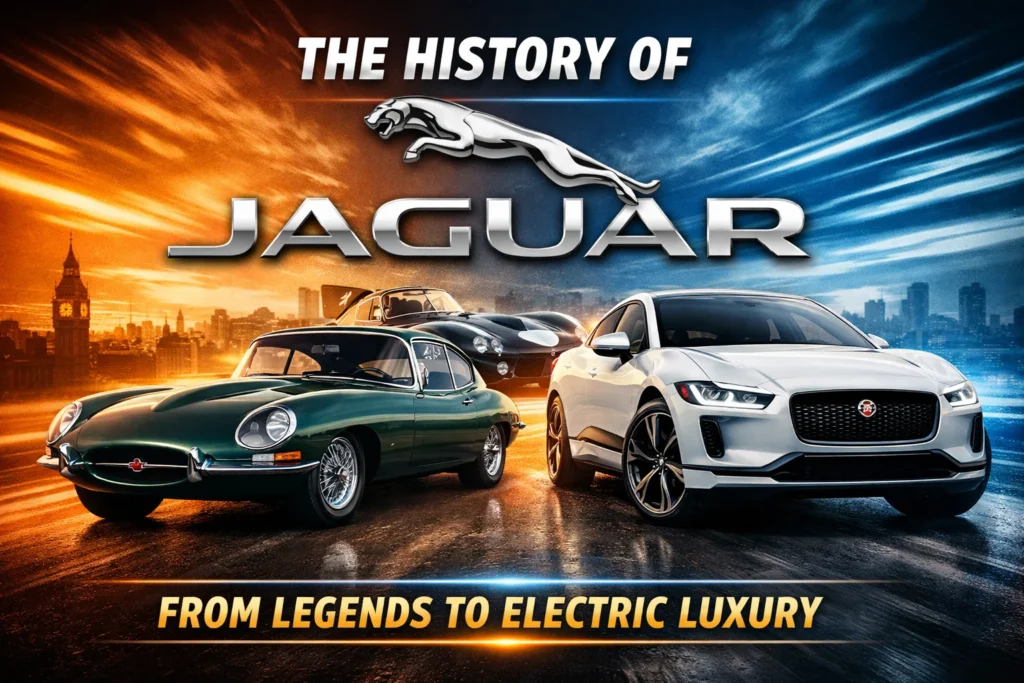
Jaguar: Automotive Icon
Jaguar is a British luxury car manufacturer renowned for elegant design, sporting performance, and technical innovation. Today it is part of Jaguar Land Rover (JLR), owned by Tata Motors of India.
Early Roots: The Swallow Sidecar Company (1922–1935)
Jaguar’s beginnings trace back to 1922, when William Lyons and William Walmsley founded the Swallow Sidecar Company, originally producing motorcycle sidecars. Soon, Lyons saw potential in automobiles and moved into car body manufacturing and coach-building.
In 1935, the company rebranded itself as SS Jaguar after producing its first saloon car, the SS Jaguar 2.5-liter sedan, which featured a sleek design and performance aspirations. This model marked the start of the “Jaguar” name in automobiles.
Post-War Growth and the Birth of an Icon (1945–1960s)
After World War II, in 1945, SS Cars officially changed its name to Jaguar Cars Limited to shed the negative connotations of the “SS” initials and emphasize the distinctive Jaguar identity.
Jaguar XK120 — A Breakthrough (1948)
The XK120, launched in 1948, was a watershed moment. With a powerful new XK engine and a top speed exceeding 120 mph, it became the world’s fastest production car at the time and propelled Jaguar into the global spotlight.
Racing Success — C-Type, D-Type, and Endurance Glory
Jaguar’s competition cars, the C-Type and D-Type, achieved major success at the 24 Hours of Le Mans, helping establish the brand as a serious performance contender. The D-Type, in particular, won Le Mans multiple times in the 1950s.
E-Type — The Beauty Icon (1961)
In 1961, Jaguar unveiled the E-Type, widely regarded as one of the most beautiful cars ever made. Its combination of performance, style, and relative affordability made it a true classic. Le Mans winner Enzo Ferrari himself famously called the E-Type “the most beautiful car ever made.”
This era solidified Jaguar’s reputation for performance with elegance.
Growth, Ownership Change, and Global Expansion (1970s–2000s)
Over the ensuing decades, Jaguar released a variety of luxury saloons, sports cars, and grand tourers, including the XJ Series (luxury flagship sedans), XJS grand tourer, and later models such as the XK8/XKR in the late 1990s, which carried forward the brand’s sporting heritage.
Ownership changed hands several times through this period, including a significant period under Ford Motor Company. These transitions brought investment but also challenges in balancing heritage with profitability.
In 2008, Jaguar (along with Land Rover) was acquired by Tata Motors, an Indian automotive giant, and integrated into Jaguar Land Rover Limited. This new ownership aimed to revitalize the brand while preserving its British identity.
Modern Era: Innovation, Electrification, and a Bold New Vision
21st Century Models and Diversification
In recent years Jaguar’s lineup diversified to include SUVs and electric models alongside traditional sedans and sports cars. For instance:
Jaguar F-Pace — a luxury SUV blending performance and practicality.
Jaguar XE & XF — compact and midsize luxury sedans.
Jaguar F-Type — a modern two-seat sports car inspired by Jaguar’s racing and styling heritage.
Jaguar I-Pace — Jaguar’s first battery-electric SUV, winning automotive awards for design and performance after its 2018 debut.
EV Pivot and Reimagine Strategy
In response to global trends toward sustainability, Jaguar announced the “Reimagine” strategy to become an all-electric luxury marque with new models launching in the mid-2020s. This includes ambitious EVs positioned against premium rivals.
However, this transition has been complex: production halts, retooling facilities, and strategic adjustments amid market pressures have characterized Jaguar’s latest chapter.
Jaguar’s Peak and Legacy
Jaguar reached its historic peak in the second half of the 20th century and into the early 2000s, thanks to:
Motorsport success that built global prestige.
Design excellence, especially with models like the XK120 and E-Type.
Technological innovation, including advanced engines, disc brakes, and aluminum construction techniques.
These achievements made Jaguar synonymous with British luxury and performance.
Detailed Overview of Notable Jaguar Products
Classic & Historic Models
XK120 (1948–1954) – Jaguar’s first post-war sports car and early performance legend.
Mark Series (Mark V, Mark 1, etc.) – Luxury saloons combining elegance and road presence.
E-Type (1961) – Iconic sports car and design benchmark.
Modern Internal Combustion Models
XJ Series – Full-size luxury sedans praised for refinement and comfort.
F-Type (2013–2024) – Contemporary sports car echoing Jaguar’s performance roots.
XE / XF – Compact and midsize executive cars, offering dynamic handling and luxury appointments.
F-Pace (SUV) – Popular entry into the premium SUV market.
Electric and Future Models
I-Pace (2018–2024/25) – Jaguar’s first pure EV, acclaimed for its design and performance.
Upcoming EV Grand Tourers and Luxury EVs – Under the Reimagine strategy, future models aim to redefine Jaguar for the electric age.
Conclusion
Jaguar’s journey — from a sidecar maker in 1922 to a globally known luxury automaker — is a testament to visionary design, racing success, and technical innovation. Its peak epochs were defined by iconic models like the E-Type, enduring performance saloons, and a loyal global fanbase.
As the automotive world pivots toward electrification, Jaguar’s heritage meets a bold new era — blending tradition with future-focused technology.
Jaguar Timeline & Complete Model History (By Year & Generation)
Jaguar Company Timeline (Key Milestones)
| Year | Milestone |
|---|---|
| 1922 | Swallow Sidecar Company founded by William Lyons & William Walmsley |
| 1935 | First SS Jaguar car launched |
| 1945 | Company renamed Jaguar Cars Ltd. |
| 1948 | XK120 unveiled – world’s fastest production car |
| 1951–1957 | Le Mans victories with C-Type & D-Type |
| 1961 | Legendary E-Type launched |
| 1968 | Jaguar XJ Series introduced |
| 1989 | Jaguar acquired by Ford |
| 2008 | Jaguar & Land Rover acquired by Tata Motors |
| 2013 | F-Type revives Jaguar sports-car legacy |
| 2018 | I-Pace electric SUV launched |
| 2021 | Jaguar announces all-electric future |
| 2025+ | Jaguar repositions as ultra-luxury EV brand |
Complete Jaguar Model List (By Era, Year & Generation)
🕰 Pre-Jaguar / Early Jaguar Era (1931–1948)
| Model | Years |
|---|---|
| SS 1 | 1931–1936 |
| SS 2½ Litre | 1935–1940 |
| SS Jaguar 100 (SS100) | 1936–1940 |
🏁 Post-War Sports & Saloon Era (1948–1960)
| Model | Years | Notes |
|---|---|---|
| XK120 | 1948–1954 | World’s fastest production car |
| XK140 | 1954–1957 | Improved comfort & power |
| XK150 | 1957–1961 | Disc brakes introduced |
| Mark V | 1948–1951 | Luxury saloon |
| Mark VII | 1950–1956 | Racing success |
| Mark VIII | 1956–1958 | Larger luxury saloon |
| Mark IX | 1958–1961 | Premium flagship |
🎨 Golden Age & Iconic Design Era (1961–1975)
| Model | Years |
|---|---|
| E-Type Series I | 1961–1968 |
| E-Type Series II | 1968–1971 |
| E-Type Series III (V12) | 1971–1975 |
| Mark 2 | 1959–1967 |
| S-Type (Classic) | 1963–1968 |
| XJ Series I (XJ6) | 1968–1973 |
| XJ Series II | 1973–1979 |
🏎 Luxury GT & XJ Dominance Era (1975–1990)
| Model | Years |
|---|---|
| XJ Series III | 1979–1992 |
| XJS (V12 Grand Tourer) | 1975–1996 |
| Daimler Double Six | 1972–1992 |
🔧 Ford Ownership Era (1990–2007)
| Model | Years | Generation |
|---|---|---|
| XJ40 | 1986–1994 | XJ (4th Gen) |
| X300 | 1994–1997 | XJ (5th Gen) |
| X308 | 1997–2003 | XJ (6th Gen – V8) |
| X350 | 2003–2009 | XJ (Aluminum body) |
| S-Type (Modern) | 1999–2008 | Retro luxury |
| X-Type | 2001–2009 | Compact executive |
| XK8 / XKR (X100) | 1996–2006 | Sports GT |
🏎 Tata Motors Era – Revival & Performance (2008–2016)
| Model | Years |
|---|---|
| XF (1st Gen) | 2007–2015 |
| XJ (X351) | 2009–2019 |
| XK (X150) | 2006–2014 |
| F-Type | 2013–2024 |
🚙 SUV & Electrification Era (2016–2024)
| Model | Years |
|---|---|
| F-Pace | 2016–present |
| E-Pace | 2017–present |
| XE | 2015–2024 |
| XF (2nd Gen) | 2015–2024 |
| I-Pace (Electric) | 2018–2025 |
⚡ Future / Electric-Only Jaguar (2025+)
| Model | Expected |
|---|---|
| Ultra-Luxury Electric GT | 2025–2026 |
| High-end Electric Sedan | 2026+ |
| Electric Luxury SUV | 2027+ |
Jaguar plans to abandon mass-market competition and move toward Bentley-level ultra-luxury electric cars.
Jaguar Generations at a Glance
XJ Series: 8 generations (1968–2019)
E-Type: 3 generations
XF: 2 generations
XK: 3 major generations
F-Type: 1 generation (iconic final ICE sports car)