
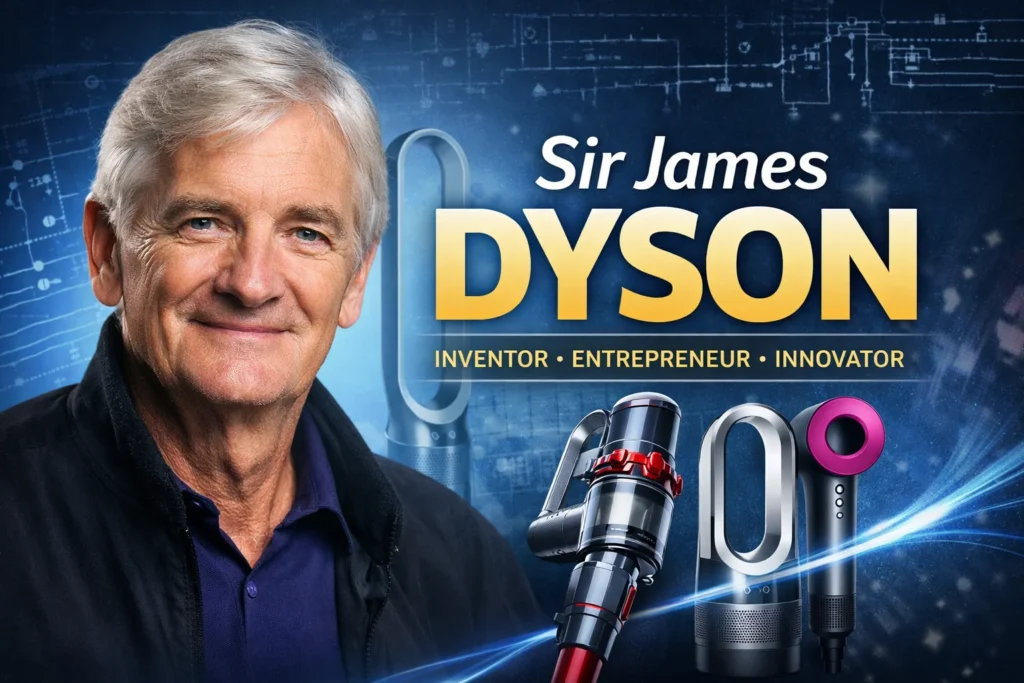
Sir James Dyson: Autobiography, Company Journey, and Revolutionary Products
Early Life and Education of Sir James Dyson
Sir James Dyson was born on 2 May 1947 in Cromer, Norfolk, England. His father was a schoolteacher who passed away when James was young, an experience that deeply influenced his independence and resilience. From an early age, Dyson showed a strong interest in engineering, design, and problem-solving.
He studied at Gresham’s School and later attended the Byam Shaw School of Art, before moving to the Royal College of Art in London, where he studied furniture and interior design. This unique combination of art and engineering would later become the foundation of Dyson’s product philosophy.
The Birth of an Idea: Frustration That Led to Innovation
James Dyson’s breakthrough idea came in the late 1970s when he became frustrated with his conventional vacuum cleaner. The vacuum kept losing suction because its bag clogged with dust. Instead of accepting this flaw, Dyson asked a simple but powerful question:
“Why should a machine lose performance just because it’s working?”
Inspired by industrial cyclone towers used in sawmills, Dyson experimented with cyclone technology to separate dust from air without using bags.
5,127 Prototypes and Years of Rejection
Dyson’s journey was far from easy. Between 1979 and 1984, he built 5,127 prototypes of his bagless vacuum cleaner. During this time, he was repeatedly rejected by major manufacturers who feared that a bagless vacuum would reduce their profits from selling replacement bags.
For nearly 15 years, Dyson struggled financially, selling products like wheelbarrows (Ballbarrow) to fund his research. His persistence became one of the most famous examples of entrepreneurial resilience in modern business history.
Founding of Dyson Ltd.
In 1991, Dyson finally found success in Japan, where his bagless vacuum cleaner won a prestigious design award. With renewed confidence, he founded Dyson Ltd. in 1993 and launched the Dyson DC01 in the UK.
The DC01 quickly became the best-selling vacuum cleaner in the UK, revolutionizing the home appliance industry.
Growth of Dyson Company
Dyson Ltd. expanded rapidly and became known for:
Heavy investment in research and development (R&D)
Engineer-led design culture
Premium, performance-focused products
Today, Dyson operates in 80+ countries and employs thousands of engineers and scientists. The company invests hundreds of millions of pounds annually in innovation.
In 2017, Dyson moved its global headquarters to Singapore, reflecting its growing focus on Asian markets and advanced manufacturing.
Major Dyson Products and Innovations
1. Dyson Vacuum Cleaners
Dyson is best known for its bagless vacuum cleaners, featuring:
Cyclone technology
Powerful digital motors
Cordless designs (Dyson V-series)
Popular models include:
Dyson V15 Detect
Dyson V11
Dyson Ball vacuums
2. Dyson Fans and Air Treatment Products
Dyson reinvented fans with Air Multiplier™ technology, producing smooth airflow without visible blades.
Products include:
Dyson Cool (fan)
Dyson Hot+Cool (fan heater)
Dyson Pure (air purifier)
3. Dyson Hair Care Products
Dyson entered the beauty industry with engineering-driven hair tools:
Dyson Supersonic™ Hair Dryer
Dyson Airwrap™ Styler
Dyson Corrale™ Hair Straightener
These products focus on heat control, reducing hair damage using intelligent sensors.
4. Dyson Lighting
Dyson developed LED lighting systems that mimic daylight and adjust based on user activity, such as:
Dyson Lightcycle desk lamps
5. Dyson Digital Motors
At the heart of most Dyson products are high-speed digital motors, designed in-house and capable of rotating at over 100,000 RPM.
Sir James Dyson’s Business Philosophy
Sir James Dyson strongly believes in:
Failure as a learning process
Long-term thinking over short-term profits
Investing heavily in engineering talent
Design driven by performance, not appearance alone
He once said:
“Enjoy failure and learn from it. You can never learn from success.”
Awards, Honors, and Recognition
Knighted in 2007 (became Sir James Dyson)
Fellow of the Royal Academy of Engineering
One of the richest self-made businessmen in the UK
Founder of the James Dyson Foundation, supporting engineering education worldwide
Legacy and Impact
Sir James Dyson transformed everyday household appliances into high-performance engineering products. His story is often taught in business schools as a lesson in innovation, persistence, and courage.
Dyson Ltd. continues to shape the future of home technology, blending science, design, and bold thinking—a true reflection of its founder’s vision.
Dyson Bagless Vacuum Cleaner: Innovation That Changed Home Cleaning
Introduction
The Dyson bagless vacuum cleaner is one of the most revolutionary home appliances ever created. Designed by Sir James Dyson, it solved a long-standing problem found in traditional vacuum cleaners—loss of suction. By eliminating dust bags and using advanced cyclone technology, Dyson transformed the way the world cleans homes.
The Problem with Traditional Vacuum Cleaners
Before Dyson, most vacuum cleaners relied on dust bags. As these bags filled up:
Airflow became blocked
Suction power decreased
Performance dropped significantly
Users were forced to replace bags frequently, increasing costs and inconvenience.
Sir James Dyson believed a vacuum cleaner should never lose suction, no matter how much dust it collects.
Birth of the Bagless Technology
Dyson’s breakthrough came from cyclone separation technology, inspired by industrial sawmills. Instead of trapping dust in a bag, Dyson’s system uses powerful centrifugal force to separate dirt from the air.
After building 5,127 prototypes, Dyson perfected the world’s first commercially successful bagless vacuum cleaner.
How Dyson Bagless Vacuum Cleaner Works
Dyson vacuums use multiple cyclones that spin air at extremely high speeds.
Key Working Principle:
Dust-filled air enters the vacuum
Cyclones spin the air rapidly
Dirt and debris are forced into a clear bin
Clean air exits the machine without clogging
✅ Result: Consistent, powerful suction
Key Features of Dyson Bagless Vacuum Cleaners
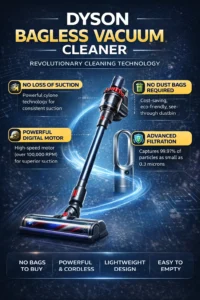
1. No Loss of Suction
Dyson’s patented cyclone technology ensures constant airflow, unlike bagged vacuums.
2. No Dust Bags Required
Saves money
Environmentally friendly
Transparent bin lets users see collected dust
3. Powerful Digital Motors
Dyson’s high-speed digital motors can spin at over 100,000 RPM, delivering exceptional suction.
4. Advanced Filtration System
Captures 99.97% of particles as small as 0.3 microns
Ideal for allergy sufferers
Expels cleaner air back into the home
5. Cordless & Lightweight Designs
Modern Dyson models are:
Easy to carry
Highly maneuverable
Perfect for stairs, cars, and tight spaces
Popular Dyson Bagless Vacuum Models
Some of the most well-known Dyson bagless vacuum cleaners include:
Dyson DC01 – The original bagless vacuum that changed the industry
Dyson V7 / V8 – Compact cordless models
Dyson V11 – Intelligent suction adjustment
Dyson V15 Detect – Laser dust detection technology
Dyson Ball Series – Powerful upright vacuums with ball steering
Benefits of Using a Dyson Bagless Vacuum Cleaner
✔ Consistent cleaning performance
✔ No recurring bag costs
✔ Hygienic dirt disposal
✔ Advanced engineering and durability
✔ Modern, stylish design
Environmental Impact
Dyson bagless vacuums reduce waste by eliminating disposable dust bags. Many models are also energy efficient and built to last longer, reducing electronic waste.
Why Dyson Bagless Vacuum Cleaners Stand Out
Dyson didn’t just improve vacuum cleaners—it reinvented them. By focusing on engineering, performance, and user experience, Dyson set new standards in the home appliance industry.
Today, Dyson bagless vacuum cleaners are trusted by millions of households worldwide and remain a symbol of innovation, quality, and reliability.