
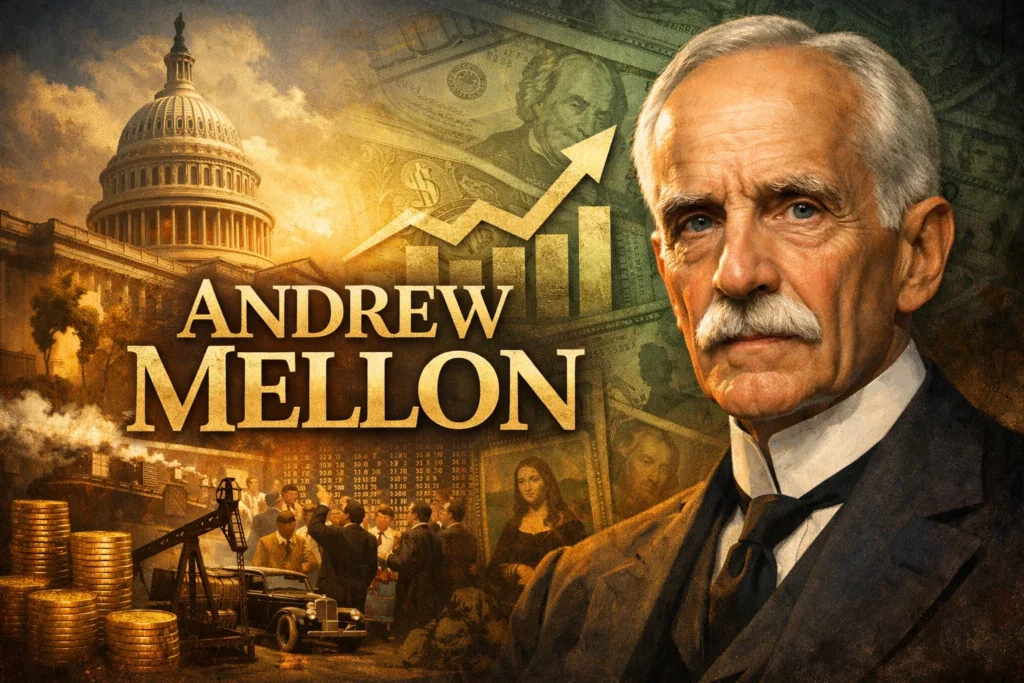
Andrew Mellon: The Banker Who Shaped American Wealth and Power
Andrew William Mellon was not a loud industrial showman like Rockefeller or Carnegie. He didn’t chase headlines or public admiration. Instead, he worked quietly behind the scenes—moving money, shaping policy, and building institutions that would define American capitalism for generations.
He was a banker, industrial investor, art patron, and U.S. Treasury Secretary, and for decades, his decisions influenced how America taxed its citizens, funded its government, and preserved its cultural heritage.
Early Life: Born Into Money, Trained for Power (1855–1873)
Andrew Mellon was born on March 24, 1855, in Pittsburgh, Pennsylvania, into a family already deeply rooted in finance and industry. His father, Judge Thomas Mellon, was a successful lawyer, banker, and real estate investor who believed strongly in discipline, self-reliance, and financial literacy.
Unlike many wealthy heirs who were handed comfort, Andrew was trained.
He learned bookkeeping as a teenager
He studied economics and finance early
He was taught to see money as a tool, not a luxury
Andrew attended Western University of Pennsylvania (now the University of Pittsburgh) and graduated at just 17 years old. His education was practical, not philosophical—perfect preparation for the hard world of banking and industry.
Building a Financial Empire: Mellon Bank & Industrial Power (1873–1900)
In 1873, Andrew joined his father’s bank, T. Mellon & Sons. What began as a family financial firm soon became one of the most influential banking houses in America.
Andrew had a rare talent:
He could identify undervalued industries
He invested early
He stayed patient
Rather than running factories himself, Mellon financed innovation. His money helped launch or expand companies that later became giants, including:
Alcoa (Aluminum Company of America)
Gulf Oil
Westinghouse Electric
Union Steel
Pullman Company
By the end of the 19th century, Mellon had become one of the richest men in the United States, though he remained intensely private.
The Mellon Philosophy: Wealth Without Noise
Unlike flamboyant tycoons, Mellon avoided publicity. He rarely gave interviews and believed wealth should operate quietly.
His core beliefs:
Government should tax less
Businesses should reinvest profits
The wealthy should steward culture and institutions
This philosophy later shaped national policy—and American museums.
U.S. Treasury Secretary: Power Without Popularity (1921–1932)
Andrew Mellon reached peak influence when he became U.S. Secretary of the Treasury under three presidents:
Warren G. Harding
Calvin Coolidge
Herbert Hoover
Serving from 1921 to 1932, Mellon held the position longer than almost anyone in history.
Mellon’s Economic Strategy
He believed:
High taxes discourage investment
Lower taxes increase business growth
Prosperity “trickles down” through the economy
He pushed for massive tax cuts, especially for corporations and wealthy individuals. This approach fueled the economic boom of the Roaring Twenties.
Criticism and the Great Depression
When the Great Depression began in 1929, Mellon’s policies came under attack. Critics argued that:
Tax cuts favored the rich
Wealth concentration worsened inequality
Government should intervene more aggressively
By 1932, political pressure forced Mellon to resign.
Art, Culture, and Redemption (1933–1937)
After leaving government, Mellon turned his focus to something deeply personal: art.
He had quietly assembled one of the world’s finest private art collections, including works by:
Rembrandt
Raphael
Titian
Vermeer
In 1937, Mellon donated his entire collection—and millions in funding—to create the National Gallery of Art in Washington, D.C.
This act reshaped his legacy:
From controversial financier → guardian of American culture
Death and Legacy
Andrew Mellon died on August 26, 1937, at the age of 82.
His legacy lives on through:
Mellon Bank (now part of BNY Mellon)
The National Gallery of Art
Foundations that still fund education, science, and the arts
Economic debates that continue to reference “Mellon-style tax policy”
Andrew Mellon Timeline (Infographic-Ready)
1855
Born in Pittsburgh, Pennsylvania
1873
Graduates from Western University of Pennsylvania
Joins T. Mellon & Sons bank
1880s–1890s
Finances early industrial giants (Alcoa, Gulf Oil, Westinghouse)
1900
Becomes one of America’s wealthiest financiers
1921
Appointed U.S. Secretary of the Treasury
1920s
Leads major tax reforms during the Roaring Twenties
1929
Stock Market Crash and start of the Great Depression
1932
Resigns as Treasury Secretary
1937
Establishes the National Gallery of Art
Dies at age 82
Andrew W. Mellon (1855–1937) was one of America’s most influential financiers, industrialists, and public servants. His vast business empire was not built around a single company but rather through a complex, interlocking network of banks, industrial corporations, and investment vehicles. His strategy was to gain controlling interests in key growth industries, provide them with capital through his banks, and guide their consolidation and expansion. His companies were the bedrock of “Mellon Capital,” which dominated sectors like aluminum, oil, coke, and banking.
Here is a detailed breakdown of the major companies and sectors he controlled or heavily influenced:
1. Banking & Finance: The Core of His Empire
Mellon’s power originated from the family bank, which he and his brother Richard B. Mellon built into the financial engine for their investments.
T. Mellon & Sons’ Bank (Founded by his father Thomas Mellon in 1869): Andrew and Richard took over in the 1880s. They were conservative but aggressive lenders, preferring to take equity stakes in promising businesses rather than just making loans. This bank was the central vault and deal-making hub.
Mellon National Bank: In 1902, they incorporated the bank as the Mellon National Bank of Pittsburgh. It became one of the nation’s most powerful financial institutions, providing capital for Mellon’s ventures and holding large blocks of their stock.
Union Trust Company (Founded 1889): Mellon helped organize and quickly gained control of this trust company. It acted as a complementary institution to the bank, handling fiduciary services, securities underwriting, and corporate reorganizations. Mellon National Bank and Union Trust Company together formed a financial powerhouse, often called the “Mellon Bank,” that was the cornerstone of his empire.
2. Aluminum: The Foundation of a Monopoly (Alcoa)
This is perhaps Mellon’s most famous industrial creation.
Pittsburgh Reduction Company (Founded 1888): Mellon provided critical startup capital to Charles Martin Hall, inventor of a cheap electrolytic process for aluminum production. In return, Mellon and his associate Henry Clay Frick gained a controlling interest. Mellon’s bank financed its massive expansion.
Aluminum Company of America (Alcoa): The company was renamed Alcoa in 1907. Through relentless vertical integration—controlling bauxite mines, alumina refining, aluminum smelting, and fabrication—and aggressive tactics, Mellon built it into a near-perfect monopoly. For decades, Alcoa was the sole producer of primary aluminum in the United States, generating colossal profits. It was the quintessential “Mellon company.”
3. Petroleum: Gulf Oil
Mellon entered the oil business after the Spindletop discovery in Texas (1901).
Gulf Oil Corporation (Founded 1907): When the wildcatters at Spindletop faced financial trouble, Mellon’s bank stepped in, consolidating various properties into the Gulf Oil Corporation. Mellon installed his own management and financed its growth into a fully integrated major (“supermajor”), involved in exploration, production, refining, transportation (including pipelines and tankers), and marketing. Gulf Oil became one of the “Seven Sisters” dominating global oil and a massive source of Mellon wealth.
4. Carborundum: An Abrasives Monopoly
Carborundum Company (Acquired 1894): Mellon bank financed Edward G. Acheson, inventor of silicon carbide (an artificial abrasive harder than natural emery). Mellon gained control and built the Carborundum Company into another dominant, near-monopoly in the abrasive market, essential for metalworking and grinding.
5. Coke & Steel: The Pittsburgh Connection
While Henry Clay Frick was the operational genius here, Mellon was the silent financial partner.
H. C. Frick Coke Company: Mellon and Frick were lifelong business allies. Mellon bank financed the expansion of Frick’s coke empire (coke is a crucial fuel for steelmaking). The company became the largest coke producer in the world.
U.S. Steel: While not a Mellon creation, through their coke interests and banking power, Mellon and Frick held enormous influence. Mellon served on the board of U.S. Steel for years, representing significant shareholder interests.
6. Other Major Investments & Ventures
Mellon’s network extended into utilities, rails, and manufacturing:
The Koppers Company (Founded 1912): Mellon financed Heinrich Koppers’ patents for recovering valuable byproducts from coke ovens. Koppers became a leader in chemicals, tar, and construction materials.
Westinghouse Electric (Bailed out 1908): During a financial panic, Mellon bank provided a critical rescue loan, taking a large stake and board seats, stabilizing this industrial giant.
Pittsburgh Coal Company: A major consolidation in the coal industry, backed by Mellon capital.
Standard Steel Car Company: A leading manufacturer of railroad cars, later merged into Pullman.
Consolidated Coal Company: Another major coal producer he invested in.
Pennsylvania Railroad: Mellon held a directorship, linking him to the nation’s most important railroad.
The “Mellon Method” of Business
Mellon’s approach was systematic:
Identify & Finance: Use the bank to identify promising, patented technologies in capital-intensive industries.
Take Equity Control: Provide capital in exchange for controlling stock, not just debt.
Vertical & Horizontal Integration: Build monopolies or oligopolies by controlling every step of production and buying out competitors.
Install Management: Place trusted associates (like Arthur V. Davis at Alcoa and William Larimer Mellon at Gulf) in charge.
Reinvest Profits: Plow enormous dividends back into the bank to fund the next venture.
Legacy & Impact
Economic Power: By the 1920s, companies controlled or heavily influenced by Mellon were estimated to have a combined market capitalization equal to a significant percentage of the entire U.S. economy.
Political Influence: As Secretary of the Treasury under Presidents Harding, Coolidge, and Hoover (1921-1932), he implemented tax-cutting and deregulation policies (often called “Mellon’s Gospel”) that directly benefited his industrial empire, leading to accusations of profound conflicts of interest.
Philanthropy: Later in life, he endowed the Mellon Institute of Industrial Research (now part of Carnegie Mellon University) and funded the National Gallery of Art in Washington, D.C., donating his unparalleled art collection to the nation.