Reliance Industries Limited (RIL)
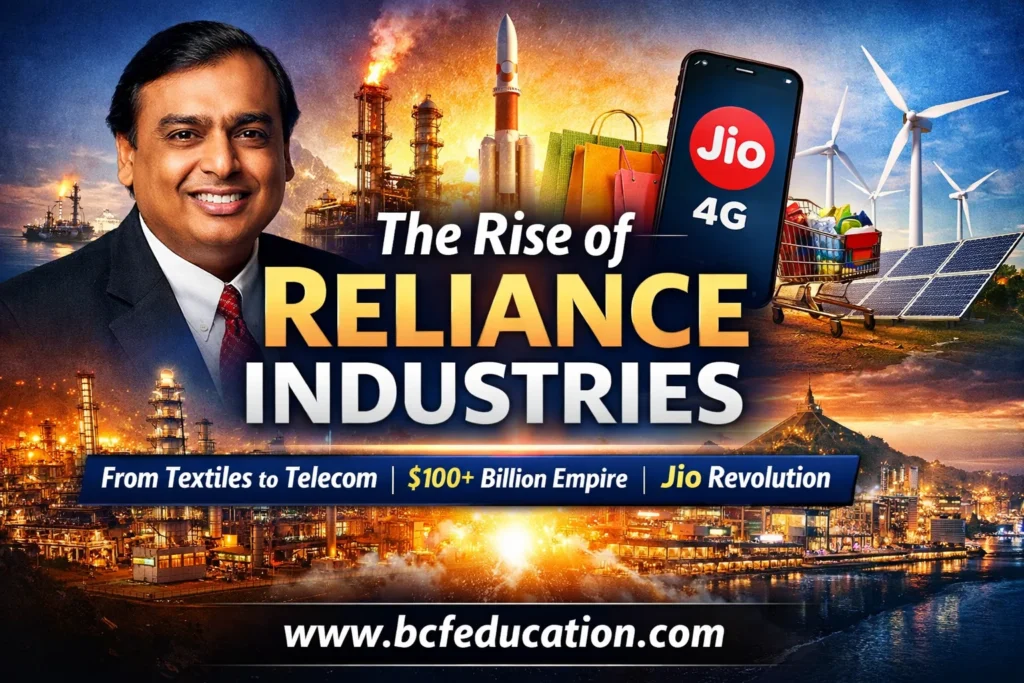
Reliance Industries Limited (RIL) is one of India’s largest and most valuable private-sector companies. It operates in energy, petrochemicals, textiles, retail, and telecommunications. From a small trading business in the 1960s, Reliance has grown into a global conglomerate with revenues exceeding $100+ billion annually.
1️⃣ How Reliance Industries Started
Founder: Dhirubhai Ambani
- Born in Gujarat, India.
- Started his career as a clerk in Yemen.
- Returned to India in 1958 with entrepreneurial ambitions.
1960 – The Beginning
Dhirubhai Ambani started a small textile trading company named Reliance Commercial Corporation in Mumbai.
Initially, the company:
- Imported polyester yarn
- Exported spices
1966 – Textile Manufacturing
Reliance established its first textile mill in Naroda, Gujarat and launched the brand “Vimal”, which became popular for quality fabrics.
2️⃣ Growth Phase – From Textiles to Petrochemicals
Dhirubhai Ambani believed in backward integration — controlling raw materials and supply chains.
1977 – IPO Launch
Reliance became a public company.
It attracted thousands of small Indian investors — a revolutionary move at that time.
1980s–1990s – Petrochemical Expansion
Reliance entered:
- Polyester manufacturing
- Petrochemicals
- Plastics production
It built massive manufacturing complexes in:
- Patalganga
- Hazira
- Jamnagar
3️⃣ The Jamnagar Refinery – A Game Changer
In 1999, Reliance built the world’s largest oil refinery complex in Jamnagar, Gujarat.
Today:
- It is one of the largest refining hubs globally.
- Major exporter of petroleum products.
This made Reliance a global energy giant.
4️⃣ Leadership Transition
After Dhirubhai Ambani’s death in 2002:
Leadership passed to his sons:
- Mukesh Ambani
- Anil Ambani
In 2005, the business split:
- Mukesh Ambani retained Reliance Industries (Oil, Gas, Petrochemicals, Retail, Telecom)
- Anil Ambani took telecom, power, and finance ventures (separate group)
5️⃣ Entry into Telecommunications – Jio Revolution
In 2016, Reliance launched:
Jio Platforms (Reliance Jio)
Impact:
- Offered free voice calls
- Extremely cheap internet data
- Disrupted Indian telecom industry
Result:
- Over 450+ million subscribers
- Became India’s largest telecom operator
Jio transformed India into one of the largest data-consuming nations in the world.
6️⃣ Retail Expansion
Reliance Retail
- Started in 2006
- Operates supermarkets, electronics, fashion stores
- Brands include:
- Reliance Fresh
- Reliance Digital
- Trends
It is now India’s largest retail chain.
7️⃣ Current Business Segments
Reliance operates in:
🔹 Oil & Gas
- Exploration and production
🔹 Refining & Petrochemicals
- Polymers
- Polyester
- Chemicals
🔹 Telecom (Jio)
- 4G & 5G network
- Fiber broadband
🔹 Retail
- Grocery
- Fashion
- Electronics
- E-commerce
🔹 New Energy (Future Focus)
- Green hydrogen
- Solar energy
- Battery storage
8️⃣ Revenue & Financial Strength
As per recent financial reports (approximate figures):
- Annual Revenue: $100–110+ billion
- Net Profit: $8–10+ billion
- Market Cap: Among top companies in India
- Listed on: NSE & BSE (India)
Reliance is often ranked in:
- Fortune Global 500 list
- Among Asia’s largest companies
9️⃣ Timeline of Reliance Industries
| Year | Milestone |
|---|---|
| 1958 | Dhirubhai Ambani starts trading business |
| 1966 | First textile mill established |
| 1977 | Reliance IPO |
| 1985 | Renamed Reliance Industries Limited |
| 1999 | Jamnagar refinery commissioned |
| 2002 | Dhirubhai Ambani passes away |
| 2005 | Business split between Mukesh & Anil |
| 2006 | Reliance Retail launched |
| 2016 | Jio launched |
| 2020 | Global tech investors invest in Jio (Facebook, Google etc.) |
| 2023–2025 | Focus on green energy & digital expansion |
🔟 Why Reliance Became So Successful
✅ 1. Visionary Leadership
Dhirubhai and Mukesh Ambani took bold, large-scale decisions.
✅ 2. Backward Integration Strategy
Controlled entire supply chain from raw material to retail.
✅ 3. Massive Infrastructure Investment
World-scale refineries and telecom networks.
✅ 4. Aggressive Pricing Strategy
Jio disrupted telecom market.
✅ 5. Diversification
Energy → Telecom → Retail → Digital → Green Energy
📌 Conclusion
Reliance Industries’ journey is one of India’s greatest business success stories. From a small textile trader to a global conglomerate, the company transformed multiple industries through scale, innovation, and strategic vision.
Under Mukesh Ambani, Reliance is now shifting toward digital services and renewable energy, aiming to shape India’s economic future.